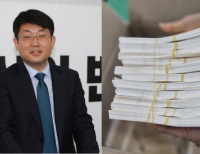
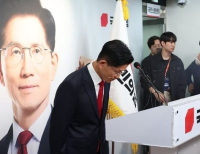
Final hearing held on the 9th [Photo = Broadcast screen capture]
The broadcast reports on January 8-9, leading up to the final hearing on charges of rebellion against former President Yoon Suk-yeol as ringleader, left an impression that could mislead viewers unfamiliar with trial procedures into mistaking the final hearing itself for a guilty verdict stage.
While a final hearing is not a verdict but merely a procedural step for the court to consolidate its judgment through sentencing recommendations and final statements, many reports blurred this distinction.
A significant number of broadcast reports described the final hearing as a "day of destiny" or posed questions like "Is it the death penalty or life imprisonment?".
Although presented as an introduction to the range of legal penalties, the narrative structure was constructed as if guilt was already presumed, and only the sentencing remained.
The points that the sentencing recommendation had not yet been made and that the first-instance trial and sentencing were much later procedures were relegated to secondary information.
As a result, the final hearing was consumed as a "moment where the conclusion is effectively reached," rather than a "stage just before judgment."
The problem lies not in the strong expressions themselves, but in the reporting structure that presented only one direction under the guise of "prospects."
At the time, the broadcast reports' prospects were not based on multiple possibilities. The weight was unilaterally placed on the possibility of guilt, with almost no mention of the possibility of innocence or partial innocence.
Key legal points such as the elements required for rebellion: the intent to overthrow the constitution, actual violent action, the criteria for recognizing a "ringleader," and the causal relationship between the act and the outcome, were omitted.
This is even more evident because it is a result of editorial choice, not a lack of information.
For prospect reporting to be valid, it must present parallel possibilities of contrasting outcomes and defer judgment until the verdict.
However, the broadcasts on the 8th and 9th repeatedly presented only information that reinforced an already established scenario of guilt. In this process, the "prospects" functioned not as a tool to explain uncertainty, but as a mechanism to hasten the conclusion.
Consequently, the reports moved beyond the realm of prospects and into a structure of confirmation bias.
This framing was directly reflected in viewer perceptions.
Analysis of comments on broadcast articles exposed on Naver News showed that a majority of reactions tended to mistake the final hearing for a verdict or a guilty conviction stage, or to discuss only the sentencing based on a presumption of guilt.
This signifies that the distinction between a final hearing and a verdict, and between a sentencing recommendation and confirmation, has become blurred in the viewers' perception.
While such reporting methods may provide an easily understandable narrative in the short term, they increase distrust in the judicial process in the long run.
If an acquittal or partial acquittal occurs, the verdict itself is more likely to be perceived as an "unusual outcome" or a "leniency."
It is a structure where the media's premature assumptions return as distrust towards the judiciary.
A final hearing is not a conclusion. It is merely a process of consolidating judgment.
Nevertheless, this reporting, which treated the final hearing as a guilty conviction, remains an example of the media accelerating the timing of judgment, beyond its role of explaining judicial procedures.
Reporting that preempts conclusions under the guise of analysis ultimately only consumes both media trust and judicial trust.
By Kim Young

 [Statement by the Seo-beo-kka Korea Military Academy Save-the-Nation Comrades Association] ㉛ Recount the Votes Publicly, as the Previous Recount Concealed Election Fraud
Tongyeong Mayoral Election Recount [Photo=Yonhap News]South Korea's liberal democracy is dying. The National Election Commission (NEC) and the judiciary, which have plummeted into criminal syndicates
[Statement by the Seo-beo-kka Korea Military Academy Save-the-Nation Comrades Association] ㉛ Recount the Votes Publicly, as the Previous Recount Concealed Election Fraud
Tongyeong Mayoral Election Recount [Photo=Yonhap News]South Korea's liberal democracy is dying. The National Election Commission (NEC) and the judiciary, which have plummeted into criminal syndicates
 What is the significance of the "Trump 2028" red hats that keep making a comeback?
It is noteworthy that President Donald Trump is "intentionally" fueling controversy over whether he can actually run in the 2028 presidential election, even though it is "highly likely he is seriously
What is the significance of the "Trump 2028" red hats that keep making a comeback?
It is noteworthy that President Donald Trump is "intentionally" fueling controversy over whether he can actually run in the 2028 presidential election, even though it is "highly likely he is seriously
 Jin Cummings: "North Korea says it will increase the number of spies, so what is the government doing?"
U.S. political columnist Gene Cummings has publicly questioned the South Korean government, asking, "North Korea is announcing plans to increase its number of spies, yet what is the South Korean
Jin Cummings: "North Korea says it will increase the number of spies, so what is the government doing?"
U.S. political columnist Gene Cummings has publicly questioned the South Korean government, asking, "North Korea is announcing plans to increase its number of spies, yet what is the South Korean
 Attorney Do Tae-woo: “Discrepancies in Voter Count and Improper Sealing Confirmed in Tongyeong Mayoral Recount… Official Request for Further Verification Filed with Gyeongnam Election Commission”
A bundle of out-of-district early voting ballots photographed by attorney Do Tae-woo at the Tongyeong mayoral election recount site. A clear, solid line visible on the side of the ballots raises suspi
Attorney Do Tae-woo: “Discrepancies in Voter Count and Improper Sealing Confirmed in Tongyeong Mayoral Recount… Official Request for Further Verification Filed with Gyeongnam Election Commission”
A bundle of out-of-district early voting ballots photographed by attorney Do Tae-woo at the Tongyeong mayoral election recount site. A clear, solid line visible on the side of the ballots raises suspi
 Stock Market Crash 'Black Tuesday'… KOSPI down 10.8%, KOSDAQ down 7.7%
The KOSPI fell by more than 5% in early trading on the 28th, triggering a sell-side sidecar.On the 28th, the KOSPI plunged by more than 10%.Due to the sharp decline, a sell-side sidecar—a temporary
Stock Market Crash 'Black Tuesday'… KOSPI down 10.8%, KOSDAQ down 7.7%
The KOSPI fell by more than 5% in early trading on the 28th, triggering a sell-side sidecar.On the 28th, the KOSPI plunged by more than 10%.Due to the sharp decline, a sell-side sidecar—a temporary
 [World Heritage Committee] 25 New World Heritage Sites Inscribed in Busan… South Korea Successfully Expands 'Getbol' Listing
The Chairperson of the World Heritage Committee speaks at the plenary session of the 48th session of the World Heritage Committee, held at BEXCO in Busan on the 20th. [Photo: Yonhap News]A total of 25
[World Heritage Committee] 25 New World Heritage Sites Inscribed in Busan… South Korea Successfully Expands 'Getbol' Listing
The Chairperson of the World Heritage Committee speaks at the plenary session of the 48th session of the World Heritage Committee, held at BEXCO in Busan on the 20th. [Photo: Yonhap News]A total of 25
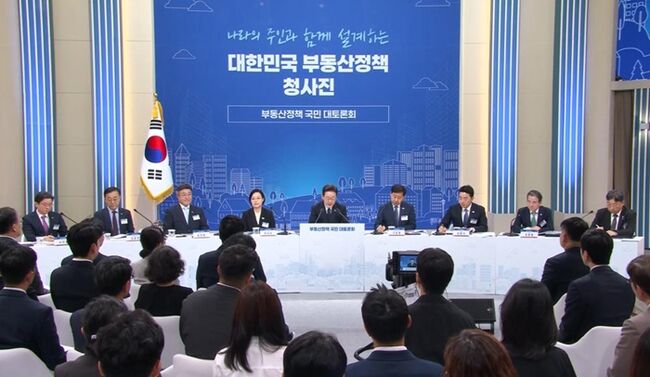 [Liberal Democratic Party Statement] Calling it a Grand Real Estate Debate… It Was Nothing More Than a Private Party Among Themselves
The 'National Grand Debate on Real Estate Policy' held on July 23rd and 27th. [Photo=Yonhap News]The 'National Grand Debate on Real Estate Policy,' hosted by the Lee Jae-myung administration under the
[Liberal Democratic Party Statement] Calling it a Grand Real Estate Debate… It Was Nothing More Than a Private Party Among Themselves
The 'National Grand Debate on Real Estate Policy' held on July 23rd and 27th. [Photo=Yonhap News]The 'National Grand Debate on Real Estate Policy,' hosted by the Lee Jae-myung administration under the
 [Photo] Evidence of Election Fraud Flooding U.S. Media… Trump Had 2.7 Million Votes Stolen
 [Video] U.S. Semiquincentennial Air Show... 'Art in the Sky' streaks across New York
 [Editorial Cartoon] A Draconian Law That Undermines Freedom of Expression

 List
List