NVIDIA CEO Jensen Huang speaking about AI. NVIDIA CEO Jensen Huang delivering a keynote address at NVIDIA's CES 2026 Live at the Fontainebleau Hotel in Las Vegas, Nevada, on the 5th (local time). [Photo=Yonhap News]
The debate surrounding Artificial Intelligence (AI) is increasingly being trapped in "doomerism."
While voices warning of AI's dangers have grown louder, consensus on the criteria for judging those dangers remains elusive. Fear has amplified, but the standards for judgment have not been shared.
NVIDIA CEO Jensen Huang has publicly raised concerns about this discourse structure.
Appearing on the podcast "No Priors" on the 9th, Huang reflected on 2025, calling it "a year of narrative warfare surrounding the future of AI."
He pointed out that apocalyptic and science-fiction narratives spread by prominent figures are causing actual harm to industries, society, and governments.
"Messages suggesting AI will bring about the end of the world are not helpful to people, industries, society, or governments," Huang stated. "Ninety percent of the overall message is focused on doomsday and pessimism."
He warned that this atmosphere is actually stifling investments that could make AI safer, more productive, and beneficial to society.
Huang specifically mentioned movements within the tech industry calling for strong regulations, expressing concern about the potential for "regulatory capture."
"Their intentions are clearly in a state of conflict of interest," he remarked. "They are CEOs and corporations, and ultimately, they are representing themselves."
The concern is that fear-mongering rhetoric, ostensibly for the public good, could actually lead to concentrated power and barriers to market entry.
Huang's remarks are not a denial of AI's risks themselves.
He prefaced his comments by stating that neither optimism nor pessimism can be simplistically excluded. However, he identified the problem with the *way* risks are discussed.
The issue is that while dangers are repeatedly warned against, no criteria are presented for what those dangers mean, at what level they are confirmed, or what responses are reasonable.
"The statement that AI is dangerous is actually preventing us from finding ways to make AI safer."
This sentence precisely captures the core of the current AI discourse.
It paradoxically highlights the absence of a standard for judging "whether AI is dangerous or not" and determining "how to solve that problem."
In other words, doomerism is problematic not because it is pessimistic, but because it is a narrative that leaves no room for judgment criteria or accountability.
The concern for AI resembles the apprehension people felt when the internet first emerged.
Back then, the crucial question was not "Is the internet dangerous?" but "How can we use it safely and beneficially?"
AI is no different. AI does not make decisions for us.
It merely provides data, and it is up to humans to decide whether to trust, use, or discard that data.
Therefore, what humans need is not an attitude of fear towards AI, but a mechanism to record the judgment process through which AI-generated results are used.
So, what changes if records are kept?
When records are absent, only the outcome remains. With only the outcome, context disappears, and the decision-making process is erased.
Conversely, when records are kept, it becomes evident what information and criteria were used as the basis for decisions.
This allows for the tracing of the root causes of problems and the avoidance of repeating the same errors.
Crucially, this is not a mechanism for punishing responsibility.
Records are not tools to amplify responsibility but safeguards that prevent unfair accusations and enable the explanation of decisions.
Judgment standards like ALO (Artificial Intelligence Linked Optimization) can serve this role.
ALO is not a system that evaluates or makes decisions on behalf of AI's conclusions.
Instead, it is a standard that structurally reveals and records what information was utilized, what criteria and context were used for judgment, and how that judgment was applied.
This is less a mechanism for expanding AI's authority and more a minimal safety net to prevent the disappearance of the decision-making process.
Microsoft (MS) CEO Satya Nadella also recently stated that we need to move beyond labeling AI content as "slop" and emphasized the need for a balance of judgment predicated on new cognitive tools.
The concerns of these tech leaders are common.
The moment fear-based language dominates technology, the criteria for judgment disappear.
AI can be dangerous. However, merely saying it is dangerous solves nothing.
Jensen Huang's warning is not about technological optimism, but about the void of judgment standards created by doomerism.
Unless this void is filled, the debate surrounding AI is likely to continue to repeat a cycle of fear, regulation, and evasion of responsibility.
What is needed in the age of AI is not fear, but standards that enable judgment.

 [Statement by the Seo-beo-kka Korea Military Academy Save-the-Nation Comrades Association] ㉛ Recount the Votes Publicly, as the Previous Recount Concealed Election Fraud
Tongyeong Mayoral Election Recount [Photo=Yonhap News]South Korea's liberal democracy is dying. The National Election Commission (NEC) and the judiciary, which have plummeted into criminal syndicates
[Statement by the Seo-beo-kka Korea Military Academy Save-the-Nation Comrades Association] ㉛ Recount the Votes Publicly, as the Previous Recount Concealed Election Fraud
Tongyeong Mayoral Election Recount [Photo=Yonhap News]South Korea's liberal democracy is dying. The National Election Commission (NEC) and the judiciary, which have plummeted into criminal syndicates
 What is the significance of the "Trump 2028" red hats that keep making a comeback?
It is noteworthy that President Donald Trump is "intentionally" fueling controversy over whether he can actually run in the 2028 presidential election, even though it is "highly likely he is seriously
What is the significance of the "Trump 2028" red hats that keep making a comeback?
It is noteworthy that President Donald Trump is "intentionally" fueling controversy over whether he can actually run in the 2028 presidential election, even though it is "highly likely he is seriously
 Jin Cummings: "North Korea says it will increase the number of spies, so what is the government doing?"
U.S. political columnist Gene Cummings has publicly questioned the South Korean government, asking, "North Korea is announcing plans to increase its number of spies, yet what is the South Korean
Jin Cummings: "North Korea says it will increase the number of spies, so what is the government doing?"
U.S. political columnist Gene Cummings has publicly questioned the South Korean government, asking, "North Korea is announcing plans to increase its number of spies, yet what is the South Korean
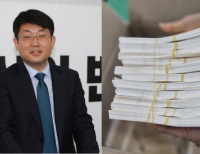
 Attorney Do Tae-woo: “Discrepancies in Voter Count and Improper Sealing Confirmed in Tongyeong Mayoral Recount… Official Request for Additional Verification Submitted to Gyeongnam Election Commission”
A bundle of mail-in early voting ballots captured by lawyer Do Tae-woo at the Tongyeong mayoral election recount site. A clear solid line, raising suspicions of election fraud, is visible on the side
Attorney Do Tae-woo: “Discrepancies in Voter Count and Improper Sealing Confirmed in Tongyeong Mayoral Recount… Official Request for Additional Verification Submitted to Gyeongnam Election Commission”
A bundle of mail-in early voting ballots captured by lawyer Do Tae-woo at the Tongyeong mayoral election recount site. A clear solid line, raising suspicions of election fraud, is visible on the side
 Stock Market Crash 'Black Tuesday'… KOSPI down 10.8%, KOSDAQ down 7.7%
The KOSPI fell by more than 5% in early trading on the 28th, triggering a sell-side sidecar.On the 28th, the KOSPI plunged by more than 10%.Due to the sharp decline, a sell-side sidecar—a temporary
Stock Market Crash 'Black Tuesday'… KOSPI down 10.8%, KOSDAQ down 7.7%
The KOSPI fell by more than 5% in early trading on the 28th, triggering a sell-side sidecar.On the 28th, the KOSPI plunged by more than 10%.Due to the sharp decline, a sell-side sidecar—a temporary
 [World Heritage Committee] 25 New World Heritage Sites Inscribed in Busan… South Korea Successfully Expands 'Getbol' Listing
The Chairperson of the World Heritage Committee speaks at the plenary session of the 48th session of the World Heritage Committee, held at BEXCO in Busan on the 20th. [Photo: Yonhap News]A total of 25
[World Heritage Committee] 25 New World Heritage Sites Inscribed in Busan… South Korea Successfully Expands 'Getbol' Listing
The Chairperson of the World Heritage Committee speaks at the plenary session of the 48th session of the World Heritage Committee, held at BEXCO in Busan on the 20th. [Photo: Yonhap News]A total of 25
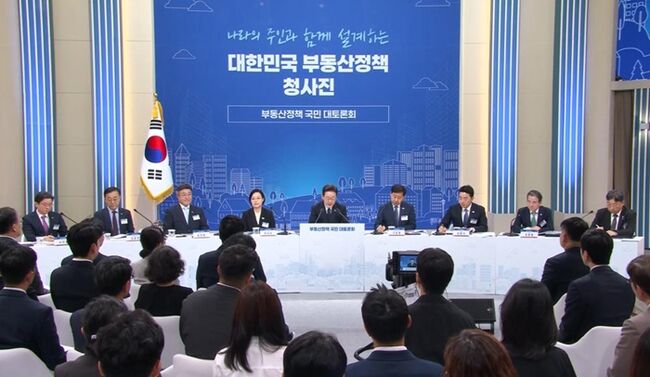 [Liberal Democratic Party Statement] Calling it a Grand Real Estate Debate… It Was Nothing More Than a Private Party Among Themselves
The 'National Grand Debate on Real Estate Policy' held on July 23rd and 27th. [Photo=Yonhap News]The 'National Grand Debate on Real Estate Policy,' hosted by the Lee Jae-myung administration under the
[Liberal Democratic Party Statement] Calling it a Grand Real Estate Debate… It Was Nothing More Than a Private Party Among Themselves
The 'National Grand Debate on Real Estate Policy' held on July 23rd and 27th. [Photo=Yonhap News]The 'National Grand Debate on Real Estate Policy,' hosted by the Lee Jae-myung administration under the
 [Photo] Evidence of Election Fraud Flooding U.S. Media… Trump Had 2.7 Million Votes Stolen
 [Video] U.S. Semiquincentennial Air Show... 'Art in the Sky' streaks across New York
 [Editorial Cartoon] A Draconian Law That Undermines Freedom of Expression

 List
List