DEFUND Act가 현재 형태로는 미 의회를 통과하기는 어려울 것이라는 전망이 우세하다. 그러나 부분적 탈퇴나 재정 지원 축소 형태의 타협안이 통과될 가능성은 여전히 남아 있다. 이 법안의 통과 여부와 별개로 우리가 주시해야 할 포인트가 있다. 미국이 유엔에서 나와 버리면 그로 인해 생겨난 공백을 중국이 자국 영향력의 확대를 위한 기회의 공간으로 삼으려고 할 것이라는 점이다.
 U.S. President Donald Trump signs a presidential memorandum withdrawing the United States from 31 UN-affiliated organizations and 35 non-UN organizations on the 7th (local time). [Photo=Yonhap News]On the 7th (local time), the U.S. administration under Donald Trump declared its withdrawal from 66 international organizations affiliated with the United Nations. This declaration is linked to the attempt to pass the "Disengaging Entirely from the United Nations Debacle Act (DEFUND Act)," which has been pursued in both houses of Congress since February of last year to legislate the Trump administration's executive order. The U.S. State Department cited that the UN organizations "restrict U.S. sovereignty and have been seized by actors acting against U.S. interests in the name of progressive ideology and global governance" as the reason for withdrawal. It is self-evident that "actors acting against U.S. interests" refer to anti-U.S. countries such as China and Russia.
While this declaration appears, on the surface, to intend reform of international organizations based on "America First," it is underpinned by complex geopolitical and geoeconomic calculations. Above all, there seem to be multiple complex motivations behind Trump's declaration of withdrawal from the UN.
UN Withdrawal... Intent to Strengthen Domestic Political Standing, Reduce Financial Burden
First, the intention is to avoid international criticism and strengthen domestic political standing.
There is a discernible intention to evade the sharp criticism from the international community regarding the recent arrest of Venezuelan President Nicolás Maduro by U.S. military operations. The declaration of withdrawal from the UN also conceals an intention to weaken international scrutiny and sanctions on similar future military operations. Simultaneously, it seems to aim at rallying the domestic base by demonstrating the fulfillment of the "America First" pledge.
Second, the aim is to reduce the financial burden. The United States is currently in arrears for approximately $1.5 billion, equivalent to two years of UN contributions, and has proposed significant cuts in its budget for the current year (2026). Practical calculations to evade responsibility for accumulated unpaid dues and escape future payment obligations are likely at play. According to Article 19 of the UN Charter, a member state in arrears may lose its voting rights in the General Assembly, and withdrawal can serve as a means to fundamentally avoid this legal responsibility.
To understand the strategic context of Trump's UN withdrawal declaration comprehensively, it is necessary to examine the full scope of the Trump administration's strategy towards China at the highest levels.
Tightening China's Leash Through Energy, Illicit Funds, and Finance
The U.S. National Security Strategy (NSS) published in December 2025 clearly stated its intention to deter China through economic means rather than military conflict, defining the economic domain as the "ultimate battlefield" of U.S.-China competition. The core of this strategy is to cut off China's economic lifeline through three channels: energy, illicit funds, and finance.
First, cutting off energy supply.
The Trump administration is blocking China's energy import routes by seizing oil tankers carrying Venezuelan crude and imposing trade sanctions on Iran. Given that China procures 10% of its global oil imports from Venezuela and 7% from Iran, the severance of these supply routes directly impacts China's energy security.
Next, cutting off illicit fund channels.
The United States is dismantling Chinese criminal organizations in cooperation with Southeast Asian countries such as Thailand and Cambodia. Thai authorities also froze $318 million in assets of phishing and scam operations in December 2025. Disrupting these illicit fund channels, estimated to be worth billions of dollars annually, is a means to directly control China's capital outflow.
Finally, selective financial sanctions.
Instead of a wholesale "SWIFT exclusion" (expelling all banks of a specific country from the Society for Worldwide Interbank Financial Telecommunication (SWIFT) payment system), sophisticated phased sanctions are being imposed, such as placing entities on the Specially Designated Nationals (SDN) list managed by the U.S. Treasury Department's Office of Foreign Assets Control (OFAC), prohibiting investment in military-industrial complex companies (NS-CMIC), and restricting U.S. capital investment in advanced technology sectors. This approach targets strategically important core sectors without radically collapsing China's entire economy.
This is what Trump calls the "Economic Strangulation" strategy. The declaration of withdrawal from the UN can be interpreted as an intention to lay the institutional groundwork to strengthen this economic pressure strategy.
U.S. Absence from the UN... A Golden Opportunity for China to Position Itself as the 'Guardian of Multilateralism'
For decades, China has consistently expanded its political and economic influence within multilateral organizations, including the UN, by advocating for equality between powerful and weak nations and positioning itself as a leader of developing countries.
As the U.S.-China influence contest is unfolding simultaneously on a global scale, paradoxically, the U.S. withdrawal from or reduced influence within the UN could paradoxically lead to the strengthening of China's international standing. The U.S. absence from the UN will provide China with a golden opportunity to position itself as the "Guardian of Multilateralism." Simultaneously, it means the U.S. secures the freedom to push forward its own pressure and sanctions against China without being constrained by international law.
What is the strategic vision the U.S. has for the post-UN withdrawal era? This appears to be deeply related to the Trump administration's moves to seek a new U.S.-led international order after withdrawing from the UN. This differs from existing universal multilateralism.
First, transactional unilateralism and selective multilateralism.
This involves strengthening bilateral cooperation based on national interests and selectively participating only in organizations favorable to the U.S. Examples include strengthening the AUKUS (Australia, United Kingdom, United States) security alliance and demanding increased defense cost-sharing from NATO allies.
Second, the construction of new alliances.
This is a plan to build value-based alliances such as a "Coalition of the Free" and to check China in the short term and crush the Chinese Communist Party in the long term through the Indo-Pacific strategy. This resembles the attempt in 1917, after the Bolshevik Revolution in Russia, when Britain, France, the U.S., and Japan besieged the Lenin regime from both the east and west of Eurasia to starve it out.
However, these alternative strategies have inherent limitations. Global issues such as pandemics and climate change cannot be resolved by U.S.-China bilateral cooperation alone, and declining trust among allies could ultimately lead to a weakening of U.S. influence. Furthermore, the collapse of international norms could lead to chaos in the international order and paradoxically accelerate the expansion of Chinese influence.
In short, the more the U.S. withdraws from international organizations like the UN, the wider the space becomes for China to seize dominance on the international stage.
The author believes that the Trump administration's efforts to pressure China and undermine international organizations are more likely to accelerate the "New Cold War" scenario, dividing the world into two large blocs in the short term, rather than collapsing the CCP.
U.S. Unilateralism... Accelerating the Consolidation of Anti-U.S. Forces Centered Around China
U.S. unilateralism is paradoxically fueling the consolidation of anti-U.S. forces centered around China, with the expansion of BRICS (an alliance of 11 emerging economies counteracting the U.S.) at its core. In January of this year, the "Will for Peace" joint naval exercise involving nine countries including China, Russia, and Iran is a symbolic trend showing that BRICS is evolving beyond an economic cooperation forum into a military and security cooperation body that opposes the Western bloc, especially the United States.
This is a clear challenge to the U.S.-centered security order. Iran's participation in the joint exercise, especially as it is under U.S. sanctions, indicates that this exercise has an anti-U.S. solidarity character. Attention should be paid to the fact that the U.S. declaration of withdrawal from international organizations and BRICS's first large-scale joint naval exercise occurred simultaneously at the beginning of the new year.
What is even more noteworthy is that BRICS is accelerating "de-dollarization" in response to U.S. financial sanctions. At the end of 2025, BRICS embarked on the development of a new common currency called "UNIT" for trade settlement among member states and is expanding the use of the China-led Cross-Border Interbank Payment System (CIPS).
This is a direct challenge to the existing international financial system dominated by the dollar and SWIFT and has the potential to divide the global economy into two separate financial blocs. It signals the world's entry into a new era of bloc confrontation, divided into a U.S.-centered Western bloc and a China-Russia-centered Global South bloc in military, financial, and economic spheres.
'Geoeconomic Erasure' of China... Will Solidify the Bipolar System
While Trump's policies may lead to the collapse of the CCP in the long term, in the immediate present, rather than bankrupting China, they may provide new opportunities for China and lead the world into a deeper era of division and conflict. As seen in the example of Russia, which has maintained growth despite unprecedented Western sanctions, the resilience of large economies can exceed expectations.
The world is now facing a new geopolitical and geoeconomic reality where interdependence itself has become a weapon, moving beyond an era where interdependence curbed conflict. U.S. unilateralism and attempts to undermine international organizations can be viewed not as "Containment" of the Cold War era, but as "Geoeconomic Erasure," aiming to exclude and isolate China in specific industries and regions.
While such strategies are unlikely to lead to China's bankruptcy in the short term, a fundamental reshaping of the international order and the solidification of a bipolar system are becoming unavoidable realities.
There is a prevailing view that the DEFUND Act, in its current form, will have difficulty passing the U.S. Congress. However, the possibility of a compromise that includes partial withdrawal or reduced financial support still remains. Regardless of whether this bill passes, there is a point we should pay attention to: if the U.S. withdraws from the UN, China will likely seek to use the resulting vacuum as an opportunity to expand its influence.
If the U.S. does not withdraw, the invisible systemic competition and power struggle between the U.S. and China will shift its stage to the UN, and confrontations between the two countries will intensify on a global scale in various fields such as technological standards, digital governance, and development finance. It remains to be seen how the U.S. will recover its damaged leadership and trust from the international community through this incident.
Editor, Seo Sang-moon

 [Statement by the Seo-beo-kka Korea Military Academy Save-the-Nation Comrades Association] ㉛ Recount the Votes Publicly, as the Previous Recount Concealed Election Fraud
Tongyeong Mayoral Election Recount [Photo=Yonhap News]South Korea's liberal democracy is dying. The National Election Commission (NEC) and the judiciary, which have plummeted into criminal syndicates
[Statement by the Seo-beo-kka Korea Military Academy Save-the-Nation Comrades Association] ㉛ Recount the Votes Publicly, as the Previous Recount Concealed Election Fraud
Tongyeong Mayoral Election Recount [Photo=Yonhap News]South Korea's liberal democracy is dying. The National Election Commission (NEC) and the judiciary, which have plummeted into criminal syndicates
 What is the significance of the "Trump 2028" red hats that keep making a comeback?
It is noteworthy that President Donald Trump is "intentionally" fueling controversy over whether he can actually run in the 2028 presidential election, even though it is "highly likely he is seriously
What is the significance of the "Trump 2028" red hats that keep making a comeback?
It is noteworthy that President Donald Trump is "intentionally" fueling controversy over whether he can actually run in the 2028 presidential election, even though it is "highly likely he is seriously
 Jin Cummings: "North Korea says it will increase the number of spies, so what is the government doing?"
U.S. political columnist Gene Cummings has publicly questioned the South Korean government, asking, "North Korea is announcing plans to increase its number of spies, yet what is the South Korean
Jin Cummings: "North Korea says it will increase the number of spies, so what is the government doing?"
U.S. political columnist Gene Cummings has publicly questioned the South Korean government, asking, "North Korea is announcing plans to increase its number of spies, yet what is the South Korean
 Attorney Do Tae-woo: “Discrepancies in Voter Count and Improper Sealing Confirmed in Tongyeong Mayoral Recount… Official Request for Further Verification Filed with Gyeongnam Election Commission”
A bundle of out-of-district early voting ballots photographed by attorney Do Tae-woo at the Tongyeong mayoral election recount site. A clear, solid line visible on the side of the ballots raises suspi
Attorney Do Tae-woo: “Discrepancies in Voter Count and Improper Sealing Confirmed in Tongyeong Mayoral Recount… Official Request for Further Verification Filed with Gyeongnam Election Commission”
A bundle of out-of-district early voting ballots photographed by attorney Do Tae-woo at the Tongyeong mayoral election recount site. A clear, solid line visible on the side of the ballots raises suspi
 Stock Market Crash 'Black Tuesday'… KOSPI down 10.8%, KOSDAQ down 7.7%
The KOSPI fell by more than 5% in early trading on the 28th, triggering a sell-side sidecar.On the 28th, the KOSPI plunged by more than 10%.Due to the sharp decline, a sell-side sidecar—a temporary
Stock Market Crash 'Black Tuesday'… KOSPI down 10.8%, KOSDAQ down 7.7%
The KOSPI fell by more than 5% in early trading on the 28th, triggering a sell-side sidecar.On the 28th, the KOSPI plunged by more than 10%.Due to the sharp decline, a sell-side sidecar—a temporary
 [World Heritage Committee] 25 New World Heritage Sites Inscribed in Busan… South Korea Successfully Expands 'Getbol' Listing
The Chairperson of the World Heritage Committee speaks at the plenary session of the 48th session of the World Heritage Committee, held at BEXCO in Busan on the 20th. [Photo: Yonhap News]A total of 25
[World Heritage Committee] 25 New World Heritage Sites Inscribed in Busan… South Korea Successfully Expands 'Getbol' Listing
The Chairperson of the World Heritage Committee speaks at the plenary session of the 48th session of the World Heritage Committee, held at BEXCO in Busan on the 20th. [Photo: Yonhap News]A total of 25
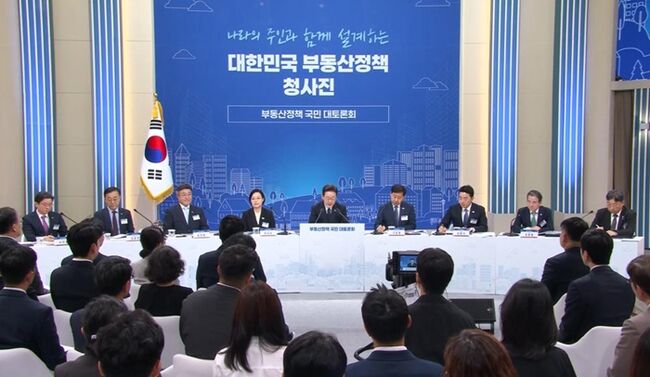 [Liberal Democratic Party Statement] Calling it a Grand Real Estate Debate… It Was Nothing More Than a Private Party Among Themselves
The 'National Grand Debate on Real Estate Policy' held on July 23rd and 27th. [Photo=Yonhap News]The 'National Grand Debate on Real Estate Policy,' hosted by the Lee Jae-myung administration under the
[Liberal Democratic Party Statement] Calling it a Grand Real Estate Debate… It Was Nothing More Than a Private Party Among Themselves
The 'National Grand Debate on Real Estate Policy' held on July 23rd and 27th. [Photo=Yonhap News]The 'National Grand Debate on Real Estate Policy,' hosted by the Lee Jae-myung administration under the
 [Photo] Evidence of Election Fraud Flooding U.S. Media… Trump Had 2.7 Million Votes Stolen
 [Video] U.S. Semiquincentennial Air Show... 'Art in the Sky' streaks across New York
 [Editorial Cartoon] A Draconian Law That Undermines Freedom of Expression

 List
List