Iranian crowd burning a picture of Ali Khamenei. [Photo: X]
Iran was not anti-American from the outset. From the 1940s to the early 1950s, the general perception in Iranian society was closer to the idea that "we can cooperate with the United States."
To understand Iran during this period, one must first examine who was actually wielding influence in the country.
In the first half of the 20th century, the external powers most deeply involved in Iran's politics and economy were not the United States. They were Britain and Russia, and later the Soviet Union. Britain's influence was particularly dominant concerning oil, while the pressure from Russia and the Soviet Union was felt much more directly regarding the northern borders and military/ideological issues.
① The Establishment of a Pro-American State (1941-1951)
The Anglo-Iranian Oil Company (AIOC), a British firm, effectively controlled oil production and refining facilities in the Khuzestan province of southwestern Iran.
The Abadan refinery was not merely a factory but the very heart of Iran's entire oil system. It is quite symbolic that this very Abadan was at the center of the crisis that would later lead to oil nationalization and blockade from 1951 to 1953.
While Britain already held a grip on oil and the Soviet Union was expanding its influence across the border, the United States had never directly ruled Iran and had not accumulated as much long-standing interest in the Middle East as Britain.
Therefore, the US was perceived not as the "most dangerous great power" but as a country with which Iran could maintain a relatively distant relationship.
In this context, Iran did not approach the US out of affection. Instead, it sought to leverage the US to broaden its options between Britain and the Soviet Union. The US, in turn, viewed Iran as a country to counterbalance the Soviet Union within the Cold War framework. Their interests aligned.
Following the ascension of Mohammad Reza Pahlavi in 1941, the monarchy needed external support for modernization, military enhancement, and administrative reform.
At this time, the US was chosen as the country that could provide technical and educational assistance, as well as military support. In practice, US aid to Iran was a package deal involving political protection, military supplies, and technical assistance.
US State Department diplomatic documents specify the scale of military aid provided to Iran in the early 1950s in concrete figures. Millions of dollars in arms loans and grants are mentioned, with the objective of making the Iranian military a reasonably capable force that the Soviet Union would not easily dare to provoke.
This aid was not merely a sign of goodwill; it served to solidify pro-American tendencies through state structure and military balance.
Technical assistance was similar. President Truman's Point Four Program in 1949 became a representative model for aid to developing countries, and it was indeed implemented in Iran in areas such as agriculture, health, and education. Through this process, the image of "the US as a country that helps modernization" was formed.
Pro-Americanism during this period was not an ideology. It was not out of love for the US. It was a pragmatic choice to counter Britain and block the Soviet Union. However, this calculation began to waver after 1951, following the issue of oil nationalization.
② Oil Nationalization and the 1953 Coup (1951-1954)
The 1953 coup in Tehran is an event that is always mentioned when explaining Iran's anti-American sentiment.
This event was not a mere regime change. It was an incident that left deep scars on the question of whether "Iran could protect its sovereignty through elections, parliament, and a prime ministerial system."
The prime minister at the time was Mohammad Mossadegh. From 1951 onwards, he sought to fundamentally change the oil structure. The key was oil nationalization. This was a declaration that Iran would reclaim control over oil, which was then dominated by the British AIOC.
Nationalization immediately led to international conflict. Britain did not stop at diplomatic protests; it pressured Iran economically by blocking its oil exports. This was done by isolating Iranian oil from the international market through maritime transport, insurance, and trade networks. This pressure significantly destabilized Iran's finances and imports.
The US stance was not firm from the beginning. The Truman administration was relatively cautious about the coup and did not want to fully follow Britain's hardline approach.
However, the atmosphere changed with the Eisenhower administration taking office in 1953. As Cold War logic took precedence, concerns grew that if the Mossadegh regime weakened, communist forces might gain strength.
Ultimately, a coup occurred in mid-August 1953. Pro-monarchy forces and the military mobilized in Tehran, and Mossadegh was ousted. Fazlollah Zahedi subsequently became prime minister, and the Shah's power transitioned from a nominal existence to one with real authority.
After 1954, Iran's oil system was fundamentally restructured. Iranian oil was no longer the exclusive domain of Britain but moved to an international consortium system that included American oil companies. While nationalization was maintained in form, substantial control again shifted externally.
The perception ingrained in Iranian society through this process was the reality that if it tried to regain sovereignty over its resources, external great powers might choose to change the regime instead of negotiating. This memory remained deeply embedded in Iranian society, becoming the soil for the formation of anti-American sentiment.
③ Intensification of Pro-Americanism and Concentration of Power (1954-1978)
After the 1953 coup, Iran appeared to regain stability on the surface. Relations with the US were quickly restored and, in fact, became stronger than before.
It was the height of the Cold War, and for the US, Iran was an indispensable country for blocking the Soviet Union. This was because it was one of the few countries bordering the Soviet Union that had not fallen to communism.
The Iranian monarchy also desired closer ties with the US. Following the coup, the Shah's power had significantly increased, and to maintain it, the military, intelligence agencies, and administrative organizations needed to function stably.
The US was the country that could assist in all these areas. It could provide weapons, military training, intelligence cooperation, and funding and technology for economic development simultaneously. The relationship between Iran and the US during this period was not a matter of ideology but a result of their mutual needs aligning.
The problem lay in the direction this alliance took. What the US prioritized in the Middle East was not democracy but stability. Countries that did not fall to communism were more important than countries with well-conducted elections. The Iranian monarchy accurately grasped this point.
The White Revolution of 1963 best exemplifies this trend. Measures such as land reform, educational expansion, industrial policies, and the expansion of women's suffrage appeared progressive on the surface.
Indeed, land reform distributed land to millions of households, and educational policies were expanded to reduce illiteracy rates. Iranian society was undoubtedly changing into something different from before.
However, this change came from the top down, not from the bottom up. The regime unilaterally determined the speed and direction of reforms, and there was almost no political space for expressing dissenting opinions.
Parliament was relegated to a nominal existence, and media and party activities were severely restricted. Political dissatisfaction could not be resolved within institutional channels and inevitably accumulated.
In this process, state power became increasingly concentrated in the central Pahlavi monarchy. The organizations to manage and monitor opposition forces were also strengthened.
For many citizens, the state became both "the state that speaks of change" and "the state where one must be careful about what one says." Life may have improved slightly, but the space for breathing did not expand.
This is where the meaning of pro-Americanism began to diverge. From the regime's perspective, pro-Americanism was clearly beneficial. The military became stronger, Iran was not isolated in the international community, and funds and technology for economic development continued to flow in. The relationship with the US was a safety net necessary for maintaining the regime.
However, for citizens, pro-Americanism looked different. On top of the memory of the 1953 coup, the subsequent political control and oppression were layered.
The US was no longer a distant country but began to appear as the background supporter of this Pahlavi monarchy regime. Even within the same pro-American stance, it was a method of survival for those at the top and a structure that suppressed dignity for those at the bottom.
This gap did not narrow over time. The faster economic growth and social change occurred, the faster political dissatisfaction also accumulated. Ultimately, this tension erupted all at once in the late 1970s.
④ The Explosion of Anti-Americanism (1979-1981)
The 1979 Iranian Revolution is often called a religious revolution. Of course, religion was a very important element of the revolution.
However, if the revolution is explained solely by religion, it does not explain why the direction of anger turned towards the United States. The revolution was the result of long-accumulated distrust and dissatisfaction erupting all at once.
After 1953, the perception spread throughout Iranian society that "the leaders we choose can be overthrown by foreign intervention." This perception did not disappear for decades.
On top of this, political control, economic imbalances, and social unrest due to rapid modernization were layered. People became more educated and had access to more information, but they had no path to participate in politics.
The figure who united this anger was Ruhollah Khomeini (1902-1989). He criticized the monarchy and strongly denounced foreign intervention.
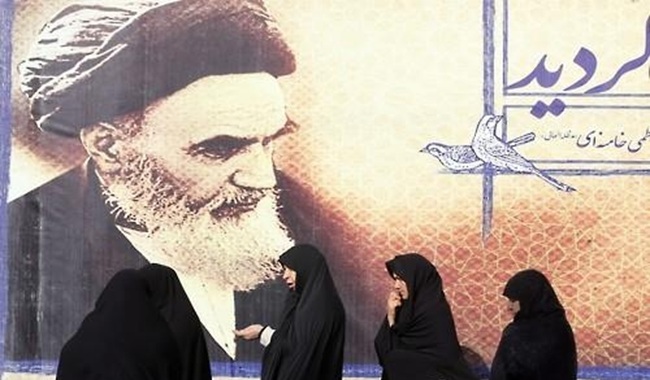 A mural of Ruhollah Khomeini in Tehran, the capital of Iran. [Photo: Yonhap News]
His words were not complex theories but easily understandable language. "This regime is not ours." This statement resonated with many people.
After the successful Khomeini Revolution, the new regime defined itself as an Islamic Republic. This regime needed to break with the past and required a symbol to clearly demonstrate that break.
The United States was the most suitable target for that symbol. The US was the closest country to the monarchy, and the memory of 1953 was still fresh.
The seizure of the US Embassy on November 4, 1979, was not an accidental event. It was an act that demonstrated anti-Americanism through action, not just words.
While the embassy was a diplomatic space, within Iran, it was perceived as a site where past interventions and humiliation converged. The extreme measure of taking hostages was a declaration to the world of what kind of country the new regime had become.
The hostage crisis, which lasted for 444 days, also served to consolidate the regime internally.
The period immediately after a revolution is always chaotic. Different factions vie for power. When there is a clear external enemy, internal conflicts can be temporarily set aside. Confrontation with the US was a very effective tool for the new regime to unite itself.
From this point onwards, anti-Americanism became an identity, not just a sentiment. The image of "a country that resists the US" became a core asset of the Islamic Republic.
⑤ Institutionalized Anti-Americanism and Pragmatic Calculations (1981-Present)
The end of the hostage crisis in 1981 did not mean the end of anti-Americanism. Quite the opposite.
Anti-Americanism had already become part of the regime. The new national identity was maintained through "what it opposes," and the US was placed at its center.
In Iran, anti-Americanism is not foreign policy. It is a symbol of domestic politics. The revolutionary regime continuously explained its existence through anti-Americanism. This is because weakening anti-Americanism would also shake the meaning of the revolution and the line of separation from the monarchy.
However, the real world does not operate solely on ideology. Iran could not completely disregard the US. In international finance, trade, sanctions, military balance, and the power structure of the Middle East, the US remained a decisive entity. The Iranian leadership was well aware of this.
Therefore, Iran had to pursue two things simultaneously. Outwardly, it had to be strongly hostile, and in its rhetoric, it could not back down an inch. At the same time, behind the scenes, it had to make calculations. While direct dialogue was avoided, contacts through third countries and indirect negotiations continued. This was not a contradiction but a method for the regime to survive.
Anti-Americanism had to be maintained, but the country had to function. To satisfy both, Iran continues to walk a tightrope to this day. The annual anti-American commemorative events and slogans are mechanisms for maintaining the symbols of this regime.
Iran's anti-Americanism is a structure created by the convergence of long-held memories, post-revolution institutions, and symbolic events. Without understanding this, Iran's actions will inevitably appear emotional and irrational. However, looking inside, there is always a pragmatic calculation of gains and losses with the US.

◆ Songsan
A poet and researcher of history and philosophy, he previously served as a director of the Rhee Syngman School and is currently an advisor for the Research Association of Korean Modern and Contemporary History and the representative of the Philosophy Forum Lyceion. He has published four poetry collections and co-translated "The Heroes of Hook Point." Songsan is a pen name.

 Trump pressures for rate cut again ahead of FOMC... "Should be the lowest in the world"
U.S. President Donald Trump. [Photo = The White House] U.S. President Donald Trump once again pressured the Federal Reserve, the U.S. central bank, to lower interest rates on the 27th (local time
Trump pressures for rate cut again ahead of FOMC... "Should be the lowest in the world"
U.S. President Donald Trump. [Photo = The White House] U.S. President Donald Trump once again pressured the Federal Reserve, the U.S. central bank, to lower interest rates on the 27th (local time
 “Ignoring crisp ballots and damaged seals”… Tongyeong mayoral recount concludes with ‘no change in outcome,’ leaving suspicions and public outrage behind
Suspected counterfeit ballots discovered in Tongyeong [GIF from social media of Representative Hwang Kyo-ahn / Attorney Park Joo-hyun]During a recount of the Tongyeong mayoral election in South Gyeong
“Ignoring crisp ballots and damaged seals”… Tongyeong mayoral recount concludes with ‘no change in outcome,’ leaving suspicions and public outrage behind
Suspected counterfeit ballots discovered in Tongyeong [GIF from social media of Representative Hwang Kyo-ahn / Attorney Park Joo-hyun]During a recount of the Tongyeong mayoral election in South Gyeong
 President Yoon, regarding the first-instance ruling on the Public Official Election Act: “An excessive political verdict that distorts the facts… We will appeal immediately.”
The first-instance sentencing hearing for President Yoon Suk Yeol regarding violations of the Public Official Election Act is being broadcast live at Seoul Station on the 27th. [Photo=Yonhap News]Pres
President Yoon, regarding the first-instance ruling on the Public Official Election Act: “An excessive political verdict that distorts the facts… We will appeal immediately.”
The first-instance sentencing hearing for President Yoon Suk Yeol regarding violations of the Public Official Election Act is being broadcast live at Seoul Station on the 27th. [Photo=Yonhap News]Pres
 WSJ: "SK Hynix ADR Premium Is a Sign of AI Trading Overheat"
Advertisement for SK Hynix ADR listing in New York's Times Square [Reuters=Yonhap News file photo]The Wall Street Journal (WSJ) has pointed out that the price of SK Hynix’s American Depositary Recei
WSJ: "SK Hynix ADR Premium Is a Sign of AI Trading Overheat"
Advertisement for SK Hynix ADR listing in New York's Times Square [Reuters=Yonhap News file photo]The Wall Street Journal (WSJ) has pointed out that the price of SK Hynix’s American Depositary Recei
 'Godfather of Japanese Mystery Novels' Keigo Higashino Passes Away After Battle with Cancer at 68
Famous Japanese mystery novelist Keigo Higashino [AFP=Yonhap News]It has been belatedly reported that Keigo Higashino, the "godfather of Japanese mystery novels" and author of bestsellers such as "The
'Godfather of Japanese Mystery Novels' Keigo Higashino Passes Away After Battle with Cancer at 68
Famous Japanese mystery novelist Keigo Higashino [AFP=Yonhap News]It has been belatedly reported that Keigo Higashino, the "godfather of Japanese mystery novels" and author of bestsellers such as "The
 [Park Pil-kyu Security Column] To the Ignorant Trying to Clothe a Beast in Sheep's Clothing
Rep. Kim Byung-joo of the Democratic Party of Korea [Photo=Yonhap News]“The Air Force Academy doesn't teach you how to fly a plane!” “The Army, Navy, and Air Force academies are exactly the
[Park Pil-kyu Security Column] To the Ignorant Trying to Clothe a Beast in Sheep's Clothing
Rep. Kim Byung-joo of the Democratic Party of Korea [Photo=Yonhap News]“The Air Force Academy doesn't teach you how to fly a plane!” “The Army, Navy, and Air Force academies are exactly the
 [Issue Diagnosis] Two Effects of the Election Petition Review
 [Photo] Evidence of Election Fraud Flooding U.S. Media… Trump Had 2.7 Million Votes Stolen
 [Video] U.S. Semiquincentennial Air Show... 'Art in the Sky' streaks across New York
 [Editorial Cartoon] A Draconian Law That Undermines Freedom of Expression

 List
List