Former President Yoon Suk-yeol [Photo=Yonhap News]
Questions about Process Raised by Former President Yoon Suk-yeol's Trial
The rule of law is not perfected by its outcome. The success or failure of the rule of law is always determined by its process.
Even if a guilty verdict is reached, if the process is not understandable, the law loses its authority. Even if an innocent verdict is reached, if distrust in the process remains, society will be divided.
The controversy surrounding former President Yoon Suk-yeol's trial begins precisely at this point.
The conflict surrounding this trial goes beyond the question of guilt or innocence.
This is because sufficient explanations have not been provided regarding whether law enforcement was carried out △ under the same standards, △ whether the timing and methods were just, and △ whether the process adhered to the principles of the rule of law.
The moment the law omits explanations, the judiciary begins to be misunderstood not as an adjudicative body but as an extension of power.
Allegations related to the emergency martial law are grave matters directly connected to the constitutional order. Therefore, they require even stricter procedures and more cautious legal interpretation.
However, there has been insufficient explanation as to why the most aggressive legal interpretations and investigative methods were employed for this matter, and what differences in standards existed compared to past similar cases.
When standards are not visible, law enforcement is perceived not as a neutral judgment but as a selection of targets.
The timing was also not explained.
Yoon Suk-yeol's trial is not a newly occurring event but a retrospective legal interpretation of already known political judgments and actions.
Nevertheless, as investigations and trials intensified after a sharp shift in the political landscape, the question of ‘why now?’ remains.
Law enforcement intertwined with a phase of political conflict demands legitimacy in its timing itself.
The issues in the execution process are even more fundamental.
Investigations must be conducted only within the scope of authority, and the exercise of that authority must be clearly explained in advance.
There has been insufficient explanation as to which investigative agency handled this matter under what legal basis, and whether the initiation and expansion of the investigation were consistent with jurisdiction and scope of duty.
The request and execution of warrants are similar.
A warrant is a last resort, permissible only when the alleged criminal charges are substantiated, and when necessity, proportionality, and the principle of minimal infringement are met.
Arrest and detention are not always viable options, but exceptional measures permitted only when other alternatives are ineffective.
Despite this, sufficient procedural explanations have not been provided as to why phased alternatives such as investigation without detention or a request for voluntary appearance were excluded.
Questions about procedural balance also remain at the trial stage.
The criterion for the right to defense is not whether it was formally granted but whether it was substantially guaranteed.
This is why questions arise as to whether the speed and scope of maintaining the prosecution's case overwhelmed the right to defense, and whether sufficient time for dispute over the issues was secured.
The more the execution process is left unexplained, the more the judiciary risks being perceived as an institution of retribution rather than adjudication.
Another overlooked point is the accountability structure.
Matters such as emergency martial law, which are national decisions, cannot be explained solely by the determination of a single individual.
Nevertheless, if responsibility is concentrated on a specific individual and a comprehensive review of the system and reporting structure is not conducted concurrently, the trial will inevitably appear to be an arrangement of individuals rather than a structural investigation.
The most important question left by Yoon Suk-yeol's trial is not about guilt or innocence.
After this trial concludes, will society say, "The law has worked," or will it remember, "Politics borrowed the form of the judiciary"?
The law does not prove itself through severe punishment. The law gains trust only when there are identical standards, explainable timing, restrained execution, and understandable procedures.
The moment the law ceases to explain, it can no longer persuade.
The moment politics borrows the form of the judiciary, it becomes not justice but revenge.
By Reporter Kim Young

 [Statement by the Seo-beo-kka Korea Military Academy Save-the-Nation Comrades Association] ㉛ Recount the Votes Publicly, as the Previous Recount Concealed Election Fraud
Tongyeong Mayoral Election Recount [Photo=Yonhap News]South Korea's liberal democracy is dying. The National Election Commission (NEC) and the judiciary, which have plummeted into criminal syndicates
[Statement by the Seo-beo-kka Korea Military Academy Save-the-Nation Comrades Association] ㉛ Recount the Votes Publicly, as the Previous Recount Concealed Election Fraud
Tongyeong Mayoral Election Recount [Photo=Yonhap News]South Korea's liberal democracy is dying. The National Election Commission (NEC) and the judiciary, which have plummeted into criminal syndicates
 What is the significance of the "Trump 2028" red hats that keep making a comeback?
It is noteworthy that President Donald Trump is "intentionally" fueling controversy over whether he can actually run in the 2028 presidential election, even though it is "highly likely he is seriously
What is the significance of the "Trump 2028" red hats that keep making a comeback?
It is noteworthy that President Donald Trump is "intentionally" fueling controversy over whether he can actually run in the 2028 presidential election, even though it is "highly likely he is seriously
 Jin Cummings: "North Korea says it will increase the number of spies, so what is the government doing?"
U.S. political columnist Gene Cummings has publicly questioned the South Korean government, asking, "North Korea is announcing plans to increase its number of spies, yet what is the South Korean
Jin Cummings: "North Korea says it will increase the number of spies, so what is the government doing?"
U.S. political columnist Gene Cummings has publicly questioned the South Korean government, asking, "North Korea is announcing plans to increase its number of spies, yet what is the South Korean
 Attorney Do Tae-woo: “Discrepancies in Voter Count and Improper Sealing Confirmed in Tongyeong Mayoral Recount… Official Request for Further Verification Filed with Gyeongnam Election Commission”
A bundle of out-of-district early voting ballots photographed by attorney Do Tae-woo at the Tongyeong mayoral election recount site. A clear, solid line visible on the side of the ballots raises suspi
Attorney Do Tae-woo: “Discrepancies in Voter Count and Improper Sealing Confirmed in Tongyeong Mayoral Recount… Official Request for Further Verification Filed with Gyeongnam Election Commission”
A bundle of out-of-district early voting ballots photographed by attorney Do Tae-woo at the Tongyeong mayoral election recount site. A clear, solid line visible on the side of the ballots raises suspi
 Stock Market Crash 'Black Tuesday'… KOSPI down 10.8%, KOSDAQ down 7.7%
The KOSPI fell by more than 5% in early trading on the 28th, triggering a sell-side sidecar.On the 28th, the KOSPI plunged by more than 10%.Due to the sharp decline, a sell-side sidecar—a temporary
Stock Market Crash 'Black Tuesday'… KOSPI down 10.8%, KOSDAQ down 7.7%
The KOSPI fell by more than 5% in early trading on the 28th, triggering a sell-side sidecar.On the 28th, the KOSPI plunged by more than 10%.Due to the sharp decline, a sell-side sidecar—a temporary
 [World Heritage Committee] 25 New World Heritage Sites Inscribed in Busan… South Korea Successfully Expands 'Getbol' Listing
The Chairperson of the World Heritage Committee speaks at the plenary session of the 48th session of the World Heritage Committee, held at BEXCO in Busan on the 20th. [Photo: Yonhap News]A total of 25
[World Heritage Committee] 25 New World Heritage Sites Inscribed in Busan… South Korea Successfully Expands 'Getbol' Listing
The Chairperson of the World Heritage Committee speaks at the plenary session of the 48th session of the World Heritage Committee, held at BEXCO in Busan on the 20th. [Photo: Yonhap News]A total of 25
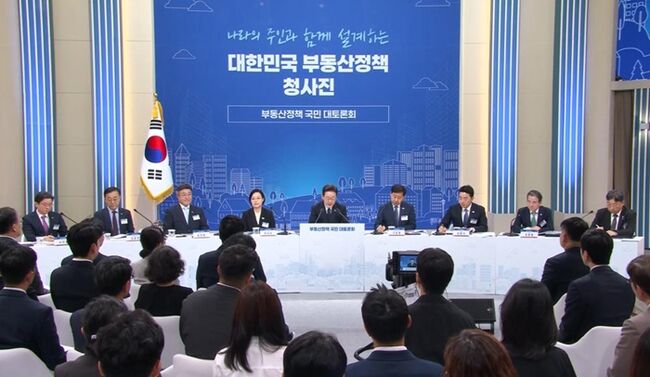 [Liberal Democratic Party Statement] Calling it a Grand Real Estate Debate… It Was Nothing More Than a Private Party Among Themselves
The 'National Grand Debate on Real Estate Policy' held on July 23rd and 27th. [Photo=Yonhap News]The 'National Grand Debate on Real Estate Policy,' hosted by the Lee Jae-myung administration under the
[Liberal Democratic Party Statement] Calling it a Grand Real Estate Debate… It Was Nothing More Than a Private Party Among Themselves
The 'National Grand Debate on Real Estate Policy' held on July 23rd and 27th. [Photo=Yonhap News]The 'National Grand Debate on Real Estate Policy,' hosted by the Lee Jae-myung administration under the
 [Photo] Evidence of Election Fraud Flooding U.S. Media… Trump Had 2.7 Million Votes Stolen
 [Video] U.S. Semiquincentennial Air Show... 'Art in the Sky' streaks across New York
 [Editorial Cartoon] A Draconian Law That Undermines Freedom of Expression

 List
List