이 연재는 불신을 감정이나 정치 문제가 아닌, 반복된 경험과 학습, 제도 설계의 결과로 분석한다. 정책 실패보다 설명 실패와 책임 없는 결정이 어떻게 사회적 불신을 구조화했는지를 추적한다. 본 시리즈는 해답을 제시하지 않고, 독자가 사회를 바라보는 판단의 기준선을 복원하는 데 목적이 있다.

Part 1. Dissecting the Structure of Distrust (Episodes 1-5)
① Distrust is Learned, Not an Emotion
② The Emergence of the Confirmation Bias Society
③ Policies as Risk Variables, Not Stabilizers
④ Five Signs of a Distrustful Society
⑤ The Solution: Not Restoring Trust, but Managing Distrust
When discussing a society rife with distrust, the most frequently proposed solution is 'restoring trust.'
This argument posits that governments must be more persuasive, institutions more transparent, and citizens must trust again.
However, this prescription does not align well with reality. Trust cannot be commanded, nor can it be fully restored through persuasion alone.
Trust is a result, not a starting point. The moment trust is demanded, it is highly likely that trust has already eroded.
In a society that has learned distrust through repeated experiences, the plea to "trust us" is easily perceived not as a solution, but as an additional warning sign.
Therefore, the question needs to be reframed.
Not whether distrust can be eliminated, but rather, whether society can function even in the presence of distrust.
Distrust was learned, not an emotion. If so, instead of trying to reverse that learning, we must design structures that can operate on top of that learned behavior.
The concept that is needed at this juncture is precisely distrust management.
Distrust management is not a declaration to restore trust. It is a method of designing institutions, explaining policies, and documenting accountability with the premise of distrust.
It is about creating conditions that allow for choices to still be made, even when the possibility of people not believing is factored in.
The first condition for distrust management is the pre-contractualization of policies.
Before a policy is implemented, its objectives, the conditions under which it will be revised, and the adjustments to be made in case of failure must be presented in advance. Only when there are prior commitments, not ex-post explanations, does distrust remain within predictable boundaries.
The second condition is predictability and a period of immutability.
The problem is not that policy directions change frequently, but that it is unclear how long they will be maintained. A signal that standards will remain in place for a certain period provides a basis for action without demanding trust.
The third condition is the institutionalization of external verification and record-keeping.
When the success or failure of a policy is left solely to internal evaluation, distrust is further amplified. Only when it is externally verifiable, and its processes and criteria are documented, can society transform failure into a learning asset.
What is important here is not the evaluation results, but whether the evaluation process is preserved. The record should state why a judgment was made, rather than simply concluding that it was done well. This enables future choices.
Distrust management is neither an ethical issue nor a matter of civic awareness. It is a matter of institutional design.
Appealing to morality is ineffective in a society of distrust. Instead, we must provide structures that can withstand distrust.
When these structures are in place, trust may or may not re-emerge. However, what is important is not the restoration of trust, but that society does not come to a standstill.
The goal of distrust management is sustainability, not reconciliation.
The episodes 1-5 examined so far do not condemn distrust. They explain it. They structurally outline why people have stopped believing and why that choice appears rational.
The next step is to examine how distrust spreads throughout society and becomes entrenched in various institutions. Distrust does not stop at individual attitudes. When it becomes a structure, it changes the way society as a whole operates.
The solution for a society of distrust lies not in regaining trust, but in structures that allow society to function even with distrust, that is, in distrust management.
Starting from **Part 2. How Distrust Spreads and Becomes Entrenched (Episodes 6-10)**, we will examine how distrust spreads and becomes entrenched in media, politics, economy, education, and labor, beginning with the loss of function in the media.

 [Statement by the Seo-beo-kka Korea Military Academy Save-the-Nation Comrades Association] ㉛ Recount the Votes Publicly, as the Previous Recount Concealed Election Fraud
Tongyeong Mayoral Election Recount [Photo=Yonhap News]South Korea's liberal democracy is dying. The National Election Commission (NEC) and the judiciary, which have plummeted into criminal syndicates
[Statement by the Seo-beo-kka Korea Military Academy Save-the-Nation Comrades Association] ㉛ Recount the Votes Publicly, as the Previous Recount Concealed Election Fraud
Tongyeong Mayoral Election Recount [Photo=Yonhap News]South Korea's liberal democracy is dying. The National Election Commission (NEC) and the judiciary, which have plummeted into criminal syndicates
 What is the significance of the "Trump 2028" red hats that keep making a comeback?
It is noteworthy that President Donald Trump is "intentionally" fueling controversy over whether he can actually run in the 2028 presidential election, even though it is "highly likely he is seriously
What is the significance of the "Trump 2028" red hats that keep making a comeback?
It is noteworthy that President Donald Trump is "intentionally" fueling controversy over whether he can actually run in the 2028 presidential election, even though it is "highly likely he is seriously
 Jin Cummings: "North Korea says it will increase the number of spies, so what is the government doing?"
U.S. political columnist Gene Cummings has publicly questioned the South Korean government, asking, "North Korea is announcing plans to increase its number of spies, yet what is the South Korean
Jin Cummings: "North Korea says it will increase the number of spies, so what is the government doing?"
U.S. political columnist Gene Cummings has publicly questioned the South Korean government, asking, "North Korea is announcing plans to increase its number of spies, yet what is the South Korean
 Attorney Do Tae-woo: “Discrepancies in Voter Count and Improper Sealing Confirmed in Tongyeong Mayoral Recount… Official Request for Further Verification Filed with Gyeongnam Election Commission”
A bundle of out-of-district early voting ballots photographed by attorney Do Tae-woo at the Tongyeong mayoral election recount site. A clear, solid line visible on the side of the ballots raises suspi
Attorney Do Tae-woo: “Discrepancies in Voter Count and Improper Sealing Confirmed in Tongyeong Mayoral Recount… Official Request for Further Verification Filed with Gyeongnam Election Commission”
A bundle of out-of-district early voting ballots photographed by attorney Do Tae-woo at the Tongyeong mayoral election recount site. A clear, solid line visible on the side of the ballots raises suspi
 Stock Market Crash 'Black Tuesday'… KOSPI down 10.8%, KOSDAQ down 7.7%
The KOSPI fell by more than 5% in early trading on the 28th, triggering a sell-side sidecar.On the 28th, the KOSPI plunged by more than 10%.Due to the sharp decline, a sell-side sidecar—a temporary
Stock Market Crash 'Black Tuesday'… KOSPI down 10.8%, KOSDAQ down 7.7%
The KOSPI fell by more than 5% in early trading on the 28th, triggering a sell-side sidecar.On the 28th, the KOSPI plunged by more than 10%.Due to the sharp decline, a sell-side sidecar—a temporary
 [World Heritage Committee] 25 New World Heritage Sites Inscribed in Busan… South Korea Successfully Expands 'Getbol' Listing
The Chairperson of the World Heritage Committee speaks at the plenary session of the 48th session of the World Heritage Committee, held at BEXCO in Busan on the 20th. [Photo: Yonhap News]A total of 25
[World Heritage Committee] 25 New World Heritage Sites Inscribed in Busan… South Korea Successfully Expands 'Getbol' Listing
The Chairperson of the World Heritage Committee speaks at the plenary session of the 48th session of the World Heritage Committee, held at BEXCO in Busan on the 20th. [Photo: Yonhap News]A total of 25
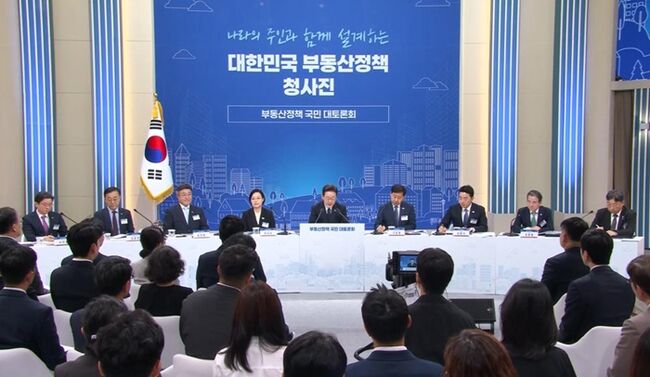 [Liberal Democratic Party Statement] Calling it a Grand Real Estate Debate… It Was Nothing More Than a Private Party Among Themselves
The 'National Grand Debate on Real Estate Policy' held on July 23rd and 27th. [Photo=Yonhap News]The 'National Grand Debate on Real Estate Policy,' hosted by the Lee Jae-myung administration under the
[Liberal Democratic Party Statement] Calling it a Grand Real Estate Debate… It Was Nothing More Than a Private Party Among Themselves
The 'National Grand Debate on Real Estate Policy' held on July 23rd and 27th. [Photo=Yonhap News]The 'National Grand Debate on Real Estate Policy,' hosted by the Lee Jae-myung administration under the
 [Photo] Evidence of Election Fraud Flooding U.S. Media… Trump Had 2.7 Million Votes Stolen
 [Video] U.S. Semiquincentennial Air Show... 'Art in the Sky' streaks across New York
 [Editorial Cartoon] A Draconian Law That Undermines Freedom of Expression

 List
List