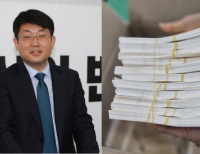
On the 12th (local time), Deputy Prime Minister for Economic Affairs and Minister of Economy and Finance Gu Yoon-chul (right) held a bilateral meeting with U.S. Treasury Secretary Scott Bessent to review cooperation on critical minerals, market trends, and the implementation status of the ROK-U.S. trade and investment agreement. [Photo=Ministry of Economy and Finance]
Following U.S. Treasury Secretary Scott Bessent's remark that the recent weakness of the Korean won is inconsistent with Korea's economic fundamentals, the foreign exchange market is interpreting this not as an evaluation of the exchange rate, but as a signal targeting the structure of investment into the U.S.
This is being assessed as a reprieve for exchange rate defense, while simultaneously being analyzed as a message reaffirming that the core of ROK-U.S. economic cooperation lies in investment.
Bessent's remarks were made during his meeting with Korean Deputy Prime Minister Gu Yoon-chul on the 12th (local time) and were disclosed through a press release on the 14th (local time). The meeting was held to review cooperation on critical minerals, market trends, and the implementation status of the ROK-U.S. trade and investment agreement.
Given that it is rare for a U.S. Treasury Secretary to directly mention the currency of an ally, the remarks are considered to be more focused on examining the structural consistency in the process of treaty implementation rather than the exchange rate level itself.
An expert in the foreign exchange market stated, "It is unusual for the U.S. Treasury Secretary to directly mention an ally's currency without discussing currency manipulation or foreign exchange market intervention. In the short term, it can be interpreted as a signal that the diplomatic burden on the Korean authorities for exchange rate defense has somewhat eased."
The recent trend in the U.S.'s trade and industrial policy is clear.
Through measures such as the CHIPS Act and the Inflation Reduction Act (IRA), the U.S. has prioritized direct investment accompanied by domestic production and job creation over expanding exports from allied countries to the U.S.
This is a strategy to reorganize supply chains within the U.S. through investment, rather than through tariffs or trade pressure. In this context, Korea has emerged as a key investment partner in the fields of semiconductors, batteries, and critical minerals.
In this context, the weakness of the Korean won acts as an inconvenient variable from the U.S. perspective.
While a weaker won may benefit Korean exports, it has the opposite effect on direct investment into the U.S.
Foreign direct investment (FDI) is structured such that both investment costs and returns are denominated in dollars. Therefore, a weaker won requires more Korean won for Korean companies to execute the same dollar investment.
The higher the exchange rate, the greater the burden of investment costs in the U.S. becomes.
An expert in international finance interpreted, "What the U.S. most values in its economic cooperation with allies recently is not export expansion, but investment within the U.S. Bessent's remarks are reasonably interpreted as a message conscious of the impact of the weak won on the structure of investment into the U.S., rather than on the exchange rate level itself."
Bessent's statement that "the weakness of the Korean won is inconsistent with fundamentals" also aligns with this structural background.
This is analyzed not as a question about the fundamental strength of the Korean economy, but rather as a point of concern that the exchange rate trend is deviating from the investment-centric cooperation structure agreed upon by the ROK and the U.S.
In fact, the remarks did not include terms such as 'currency manipulation' or 'unfair competition'.
Typically, when the U.S. Treasury Department raises concerns about foreign exchange market intervention, it has used standardized terms such as 'persistent one-sided intervention' or 'currency manipulation'.
A former trade official said, "The level of expression clearly changes when the U.S. raises concerns about foreign exchange market intervention. These remarks should be seen as a deferral during the treaty implementation phase, rather than an endorsement of intervention."
He added, "If the exchange rate trend leads to a contraction in investment or trade distortions, it could become an issue again at any time."
Accordingly, it is possible to assess that the diplomatic burden on Korea for exchange rate defense has somewhat eased in the short term.
However, there are also points that this should not be taken as immunity for foreign exchange market intervention.
This is because the situation could change if the weakness of the Korean won persists long-term, or if it leads to a contraction in investment into the U.S. or a structure skewed towards exports.
Ultimately, Bessent's remarks are interpreted as a dual signal reaffirming the shift in the focus of ROK-U.S. economic relations from trade to investment, rather than an evaluation of the exchange rate itself.
While there is some relief for Korea regarding exchange rate defense, market caution continues as it is still too early to conclude that foreign exchange market volatility has been resolved.
By Kim Young

 [Statement by the Seo-beo-kka Korea Military Academy Save-the-Nation Comrades Association] ㉛ Recount the Votes Publicly, as the Previous Recount Concealed Election Fraud
Tongyeong Mayoral Election Recount [Photo=Yonhap News]South Korea's liberal democracy is dying. The National Election Commission (NEC) and the judiciary, which have plummeted into criminal syndicates
[Statement by the Seo-beo-kka Korea Military Academy Save-the-Nation Comrades Association] ㉛ Recount the Votes Publicly, as the Previous Recount Concealed Election Fraud
Tongyeong Mayoral Election Recount [Photo=Yonhap News]South Korea's liberal democracy is dying. The National Election Commission (NEC) and the judiciary, which have plummeted into criminal syndicates
 What is the significance of the "Trump 2028" red hats that keep making a comeback?
It is noteworthy that President Donald Trump is "intentionally" fueling controversy over whether he can actually run in the 2028 presidential election, even though it is "highly likely he is seriously
What is the significance of the "Trump 2028" red hats that keep making a comeback?
It is noteworthy that President Donald Trump is "intentionally" fueling controversy over whether he can actually run in the 2028 presidential election, even though it is "highly likely he is seriously
 Jin Cummings: "North Korea says it will increase the number of spies, so what is the government doing?"
U.S. political columnist Gene Cummings has publicly questioned the South Korean government, asking, "North Korea is announcing plans to increase its number of spies, yet what is the South Korean
Jin Cummings: "North Korea says it will increase the number of spies, so what is the government doing?"
U.S. political columnist Gene Cummings has publicly questioned the South Korean government, asking, "North Korea is announcing plans to increase its number of spies, yet what is the South Korean
 Attorney Do Tae-woo: “Discrepancies in Voter Count and Improper Sealing Confirmed in Tongyeong Mayoral Recount… Official Request for Further Verification Filed with Gyeongnam Election Commission”
A bundle of out-of-district early voting ballots photographed by attorney Do Tae-woo at the Tongyeong mayoral election recount site. A clear, solid line visible on the side of the ballots raises suspi
Attorney Do Tae-woo: “Discrepancies in Voter Count and Improper Sealing Confirmed in Tongyeong Mayoral Recount… Official Request for Further Verification Filed with Gyeongnam Election Commission”
A bundle of out-of-district early voting ballots photographed by attorney Do Tae-woo at the Tongyeong mayoral election recount site. A clear, solid line visible on the side of the ballots raises suspi
 Stock Market Crash 'Black Tuesday'… KOSPI down 10.8%, KOSDAQ down 7.7%
The KOSPI fell by more than 5% in early trading on the 28th, triggering a sell-side sidecar.On the 28th, the KOSPI plunged by more than 10%.Due to the sharp decline, a sell-side sidecar—a temporary
Stock Market Crash 'Black Tuesday'… KOSPI down 10.8%, KOSDAQ down 7.7%
The KOSPI fell by more than 5% in early trading on the 28th, triggering a sell-side sidecar.On the 28th, the KOSPI plunged by more than 10%.Due to the sharp decline, a sell-side sidecar—a temporary
 [World Heritage Committee] 25 New World Heritage Sites Inscribed in Busan… South Korea Successfully Expands 'Getbol' Listing
The Chairperson of the World Heritage Committee speaks at the plenary session of the 48th session of the World Heritage Committee, held at BEXCO in Busan on the 20th. [Photo: Yonhap News]A total of 25
[World Heritage Committee] 25 New World Heritage Sites Inscribed in Busan… South Korea Successfully Expands 'Getbol' Listing
The Chairperson of the World Heritage Committee speaks at the plenary session of the 48th session of the World Heritage Committee, held at BEXCO in Busan on the 20th. [Photo: Yonhap News]A total of 25
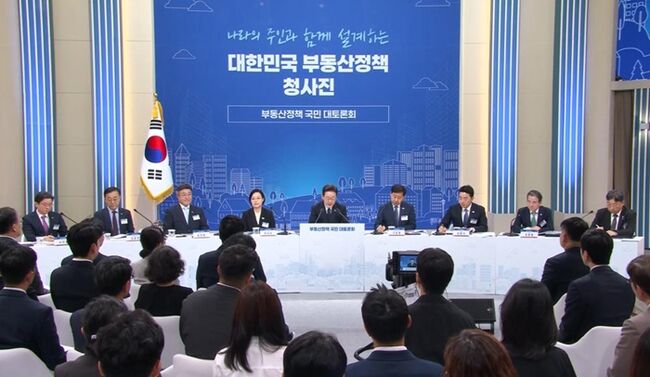 [Liberal Democratic Party Statement] Calling it a Grand Real Estate Debate… It Was Nothing More Than a Private Party Among Themselves
The 'National Grand Debate on Real Estate Policy' held on July 23rd and 27th. [Photo=Yonhap News]The 'National Grand Debate on Real Estate Policy,' hosted by the Lee Jae-myung administration under the
[Liberal Democratic Party Statement] Calling it a Grand Real Estate Debate… It Was Nothing More Than a Private Party Among Themselves
The 'National Grand Debate on Real Estate Policy' held on July 23rd and 27th. [Photo=Yonhap News]The 'National Grand Debate on Real Estate Policy,' hosted by the Lee Jae-myung administration under the
 [Photo] Evidence of Election Fraud Flooding U.S. Media… Trump Had 2.7 Million Votes Stolen
 [Video] U.S. Semiquincentennial Air Show... 'Art in the Sky' streaks across New York
 [Editorial Cartoon] A Draconian Law That Undermines Freedom of Expression

 List
List