Federal Communications Commission (FCC) Chairman Brendan Carr dodged a direct answer on whether the agency has the authority to change the cap on broadcast ownership during a House hearing on the 14th (local time).
Rep. Frank Pallone (D-N.J.), chairman of the House Energy and Commerce Subcommittee, pressed Carr on whether the FCC could increase the national TV ownership limit, currently set at 39%, without congressional approval.
Carr, avoiding a direct yes or no, stated that the FCC is "currently reviewing" the matter and noted that four previous FCC chairmen, from both parties, have treated the 39% cap as an FCC rule.
Pallone interrupted, demanding a clear answer: "Do you believe you have the authority, yes or no, to raise the cap yourselves?"
Carr again sidestepped the question, reiterating that the agency is looking into the matter and referencing past FCC practices.
FCC Commissioner Anna Gomez, a Democrat, provided a more direct answer, stating that the 39% cap is not merely an FCC rule but a statutory limit set by Congress.
Gomez warned the committee that "we do not have the authority to waive that," pointing out that further consolidation would empower "mega-corporation parent companies" to disenfranchise local broadcasters, dilute local news, and lower the level of community service.
Carr later suggested that the legal arguments were "not particularly compelling," but acknowledged that the issue had already been raised in the D.C. Circuit Court of Appeals and that the FCC was still considering whether to change its stance.
Newsmax reported that immense risks loom over local broadcasting and conservative media as a result.
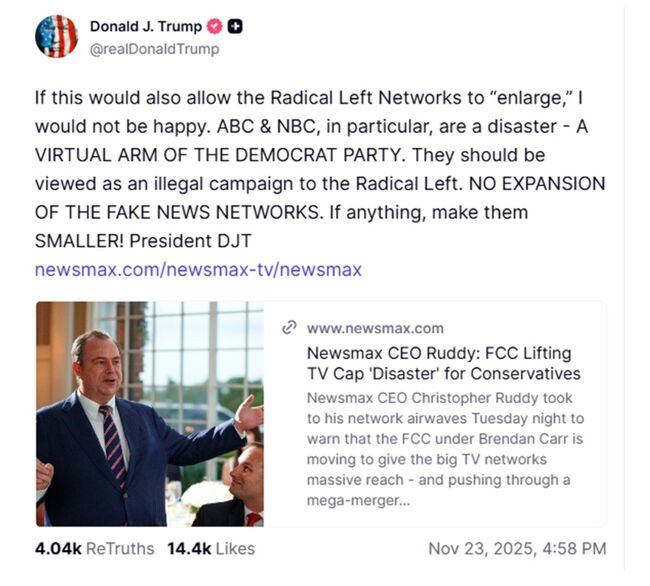
In a recently filed lawsuit, Newsmax urged the FCC to block the proposed $6.2 billion merger between the progressive Nexstar Media Group and TEGNA, arguing it violates federal law and would lead to a dangerous concentration of power over local news distribution.
If approved, the merged company would reach approximately 80% of U.S. television households, nearly double the national cap.
In a separate op-ed, Newsmax outlined the consequences if two or three giant media corporations were to control nearly all of the nation's TV stations, citing: ▲ increased cable bills ▲ higher local advertising costs ▲ higher costs being passed on to consumers by local stores, and ▲ media titans deciding what news gets reported.
Newsmax also pointed out that 78% of Nexstar employees' political donations in 2024 went to Kamala Harris and that Nexstar's cable channel, NewsNation, features left-leaning personalities like Chris Cuomo and Ashleigh Banfield, urging readers to "consider that."
Rep. Elise Stefanik (R-N.Y.) echoed similar concerns, warning that allowing major broadcast groups to exceed the cap would foster market concentration, increase retransmission fees passed on to consumers, and sacrifice "localism" for corporate logic.
She further argued that the expansion of large broadcast groups is the wrong response to the influence of big tech, especially if it empowers left-leaning networks.
President Donald Trump also publicly voiced his opposition to lifting the cap, warning on Truth Social, "The expansion of Fake News Networks must never be allowed. It should be cut down!"
Conservatives at CPAC (Conservative Political Action Conference) also urged regulators to maintain the limits, arguing that over-the-air broadcasting should be about diversity of viewpoints and community responsibility, not a few large corporations dominating what Americans watch.
By Hong Seong-gu, Chief Editor of NNP USA / Special Correspondent of this paper NNP info@newsandpost.com

 [Statement by the Seo-beo-kka Korea Military Academy Save-the-Nation Comrades Association] ㉛ Recount the Votes Publicly, as the Previous Recount Concealed Election Fraud
Tongyeong Mayoral Election Recount [Photo=Yonhap News]South Korea's liberal democracy is dying. The National Election Commission (NEC) and the judiciary, which have plummeted into criminal syndicates
[Statement by the Seo-beo-kka Korea Military Academy Save-the-Nation Comrades Association] ㉛ Recount the Votes Publicly, as the Previous Recount Concealed Election Fraud
Tongyeong Mayoral Election Recount [Photo=Yonhap News]South Korea's liberal democracy is dying. The National Election Commission (NEC) and the judiciary, which have plummeted into criminal syndicates
 What is the significance of the "Trump 2028" red hats that keep making a comeback?
It is noteworthy that President Donald Trump is "intentionally" fueling controversy over whether he can actually run in the 2028 presidential election, even though it is "highly likely he is seriously
What is the significance of the "Trump 2028" red hats that keep making a comeback?
It is noteworthy that President Donald Trump is "intentionally" fueling controversy over whether he can actually run in the 2028 presidential election, even though it is "highly likely he is seriously
 Jin Cummings: "North Korea says it will increase the number of spies, so what is the government doing?"
U.S. political columnist Gene Cummings has publicly questioned the South Korean government, asking, "North Korea is announcing plans to increase its number of spies, yet what is the South Korean
Jin Cummings: "North Korea says it will increase the number of spies, so what is the government doing?"
U.S. political columnist Gene Cummings has publicly questioned the South Korean government, asking, "North Korea is announcing plans to increase its number of spies, yet what is the South Korean
 Attorney Do Tae-woo: “Discrepancies in Voter Count and Improper Sealing Confirmed in Tongyeong Mayoral Recount… Official Request for Further Verification Filed with Gyeongnam Election Commission”
A bundle of out-of-district early voting ballots photographed by attorney Do Tae-woo at the Tongyeong mayoral election recount site. A clear, solid line visible on the side of the ballots raises suspi
Attorney Do Tae-woo: “Discrepancies in Voter Count and Improper Sealing Confirmed in Tongyeong Mayoral Recount… Official Request for Further Verification Filed with Gyeongnam Election Commission”
A bundle of out-of-district early voting ballots photographed by attorney Do Tae-woo at the Tongyeong mayoral election recount site. A clear, solid line visible on the side of the ballots raises suspi
 Stock Market Crash 'Black Tuesday'… KOSPI down 10.8%, KOSDAQ down 7.7%
The KOSPI fell by more than 5% in early trading on the 28th, triggering a sell-side sidecar.On the 28th, the KOSPI plunged by more than 10%.Due to the sharp decline, a sell-side sidecar—a temporary
Stock Market Crash 'Black Tuesday'… KOSPI down 10.8%, KOSDAQ down 7.7%
The KOSPI fell by more than 5% in early trading on the 28th, triggering a sell-side sidecar.On the 28th, the KOSPI plunged by more than 10%.Due to the sharp decline, a sell-side sidecar—a temporary
 [World Heritage Committee] 25 New World Heritage Sites Inscribed in Busan… South Korea Successfully Expands 'Getbol' Listing
The Chairperson of the World Heritage Committee speaks at the plenary session of the 48th session of the World Heritage Committee, held at BEXCO in Busan on the 20th. [Photo: Yonhap News]A total of 25
[World Heritage Committee] 25 New World Heritage Sites Inscribed in Busan… South Korea Successfully Expands 'Getbol' Listing
The Chairperson of the World Heritage Committee speaks at the plenary session of the 48th session of the World Heritage Committee, held at BEXCO in Busan on the 20th. [Photo: Yonhap News]A total of 25
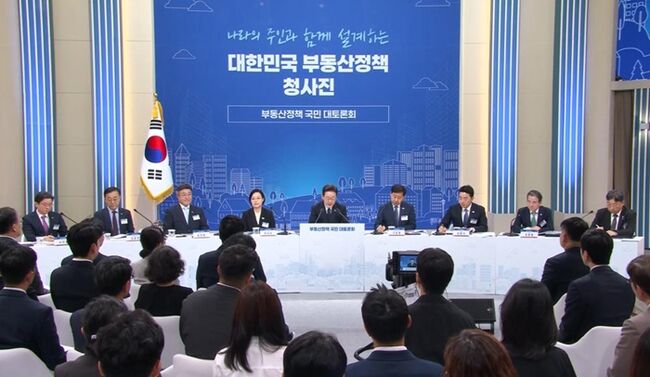 [Liberal Democratic Party Statement] Calling it a Grand Real Estate Debate… It Was Nothing More Than a Private Party Among Themselves
The 'National Grand Debate on Real Estate Policy' held on July 23rd and 27th. [Photo=Yonhap News]The 'National Grand Debate on Real Estate Policy,' hosted by the Lee Jae-myung administration under the
[Liberal Democratic Party Statement] Calling it a Grand Real Estate Debate… It Was Nothing More Than a Private Party Among Themselves
The 'National Grand Debate on Real Estate Policy' held on July 23rd and 27th. [Photo=Yonhap News]The 'National Grand Debate on Real Estate Policy,' hosted by the Lee Jae-myung administration under the
 [Photo] Evidence of Election Fraud Flooding U.S. Media… Trump Had 2.7 Million Votes Stolen
 [Video] U.S. Semiquincentennial Air Show... 'Art in the Sky' streaks across New York
 [Editorial Cartoon] A Draconian Law That Undermines Freedom of Expression

 List
List