U.S. Department of State '2026-2030 Strategic Plan' [U.S. Department of State Material]
The U.S. Department of State has included in a document outlining its diplomatic strategy for the next five years a plan to build a strong economic bloc of pro-American countries and thereby support the reindustrialization of the United States.
In its "Fiscal Years 2026-2030 Strategic Plan" released on the 15th (local time), the State Department stated, "We will promote commercial transactions in all bilateral relationships and negotiations to ensure allies and partners prioritize U.S. companies and solutions."
It further specified, "Through this, we will build a strong economic bloc of pro-American countries that leverage U.S. companies and exports."
The State Department added, "We will establish new economic security agreements across this bloc and create new industries and opportunities through key infrastructure projects."
It also stated that the pro-American economic bloc will "fund American reindustrialization by purchasing American technology stacks and defense systems, ensuring American economic and technological leadership throughout the 21st century."
The plan aims to maintain U.S. market dominance in advanced manufacturing and critical technology sectors that affect national security.
The State Department also announced that it will make 'commercial diplomacy' a core part of its economic strategy and plans to support U.S. companies in winning overseas projects. Instructions have also been issued to all overseas missions worldwide to actively counter China's bids in their respective countries.
Regarding the Indo-Pacific region, the State Department stated, "We pursue close economic and military ties with allies and partners that contribute to America's national strength without coming at the expense of American sacrifices."
It further reiterated the need for increased defense spending by allies, including South Korea, stating, "The Department of Defense will deepen relationships with allies and encourage them to increase their own military expenditures and invest in deterrence capabilities."
In return, the U.S. will expand access for allies to its revitalized defense industrial base, it said.
Mentioning its Indo-Pacific and European alliances, the State Department stated, "We advocate for trusted American defense contractors and support interoperability and cooperation in the defense industry."
It also emphasized, "An integrated defense industrial base will provide strategic depth of production for the United States and its allies in the event of conflict."
This appears to indicate a commitment to encouraging allies like South Korea to increase defense spending and, in turn, actively purchase U.S. weapons, parts, and technologies with that increased spending.
With the Lee Jae-myung administration in South Korea also making clear its intention to increase defense spending, the extent to which South Korea can receive relevant technology transfers from the U.S. if it expands its purchases of U.S. weapons is likely to become a task for South Korea's diplomatic and security lines.
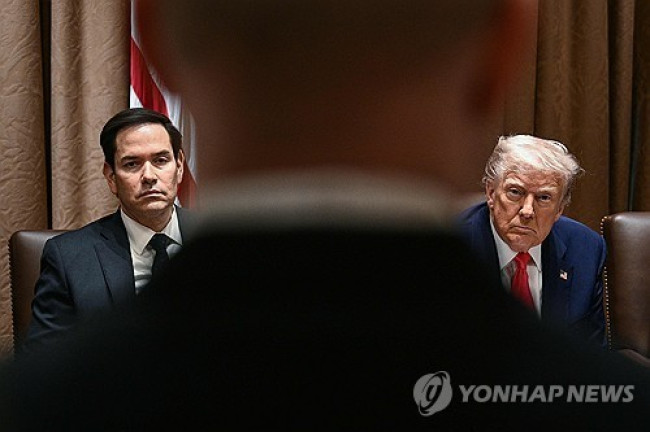 Secretary of State Antony Blinken and President Donald Trump [AFP=Yonhap News]
The State Department also reiterated its intention to militarily check China.
The State Department emphasized the importance of securing "military superiority," stating, "Over the past decade, China has pursued unprecedented military build-up, and the United States must be prepared to publicly highlight and respond to this."
However, the mention of "priority on Taiwan's defense" from the Trump administration's first 'National Security Strategy' (NSS) released in December was not discussed in this plan.
Nonetheless, it stated, "We make it clear that regional peace and stability are in America's interest, regardless of competition with countries like China."
In its Europe strategy section, the State Department stated, "China's economic influence over European countries weakens their credibility as U.S. allies," and announced a policy to "support the removal of Chinese hardware and software from critical infrastructure."
The State Department also presented the establishment of the 'Donro Doctrine' in the Western Hemisphere, including Latin America, as a major objective.
The Donro Doctrine is a portmanteau combining President Donald Trump's name with the 'Monroe Doctrine,' the foreign policy declared by U.S. President James Monroe in 1823, rejecting European interference in the Americas.
While this policy was included in the previously released NSS, the State Department's current strategic plan has elevated it to a clearer policy stance by using 'Donro Doctrine' as an official term.
Under the new 'Donro Doctrine,' the State Department made it clear its intention to counter the expanding influence of China, Russia, and others in the Western Hemisphere, stating, "Under the new 'Donro Doctrine,' the United States is subduing anti-American and rogue states and building new security and economic partnerships with like-minded countries."
The State Department also included in its strategic plan an opposition to foreign governments' attempts to censor Americans.
The State Department pointed out that foreign governments and international organizations are creating laws and regulations that restrict fundamental rights such as "freedom of expression" for American citizens, stating, "These laws not only affect American companies but can also target Americans both domestically and abroad."
It continued, "Foreign governments have imposed restrictions on freedom of expression for their domestic political purposes, which is unacceptable in the United States."
Therefore, it stated, "We oppose attempts by foreign governments, international organizations, non-governmental organizations (NGOs), and activist groups to censor Americans within their jurisdictions," and "We will respond to such attempts through all appropriate means, including visa and financial sanctions."
This policy comes at a notable time, as concerns about censorship and discrimination against American companies have been raised by parts of the U.S. administration and Congress regarding the amendment to the Information and Communications Network Act passed by the South Korean National Assembly last year and the proposed Online Platform Act.
In addition, the State Department specified that it will not participate in or fund international organizations that are contrary to U.S. national interests. The principle of prioritizing foreign aid to countries that align with U.S. interests has also been included.

 [Statement by the Seo-beo-kka Korea Military Academy Save-the-Nation Comrades Association] ㉛ Recount the Votes Publicly, as the Previous Recount Concealed Election Fraud
Tongyeong Mayoral Election Recount [Photo=Yonhap News]South Korea's liberal democracy is dying. The National Election Commission (NEC) and the judiciary, which have plummeted into criminal syndicates
[Statement by the Seo-beo-kka Korea Military Academy Save-the-Nation Comrades Association] ㉛ Recount the Votes Publicly, as the Previous Recount Concealed Election Fraud
Tongyeong Mayoral Election Recount [Photo=Yonhap News]South Korea's liberal democracy is dying. The National Election Commission (NEC) and the judiciary, which have plummeted into criminal syndicates
 What is the significance of the "Trump 2028" red hats that keep making a comeback?
It is noteworthy that President Donald Trump is "intentionally" fueling controversy over whether he can actually run in the 2028 presidential election, even though it is "highly likely he is seriously
What is the significance of the "Trump 2028" red hats that keep making a comeback?
It is noteworthy that President Donald Trump is "intentionally" fueling controversy over whether he can actually run in the 2028 presidential election, even though it is "highly likely he is seriously
 Jin Cummings: "North Korea says it will increase the number of spies, so what is the government doing?"
U.S. political columnist Gene Cummings has publicly questioned the South Korean government, asking, "North Korea is announcing plans to increase its number of spies, yet what is the South Korean
Jin Cummings: "North Korea says it will increase the number of spies, so what is the government doing?"
U.S. political columnist Gene Cummings has publicly questioned the South Korean government, asking, "North Korea is announcing plans to increase its number of spies, yet what is the South Korean
 Attorney Do Tae-woo: “Discrepancies in Voter Count and Improper Sealing Confirmed in Tongyeong Mayoral Recount… Official Request for Further Verification Filed with Gyeongnam Election Commission”
A bundle of out-of-district early voting ballots photographed by attorney Do Tae-woo at the Tongyeong mayoral election recount site. A clear, solid line visible on the side of the ballots raises suspi
Attorney Do Tae-woo: “Discrepancies in Voter Count and Improper Sealing Confirmed in Tongyeong Mayoral Recount… Official Request for Further Verification Filed with Gyeongnam Election Commission”
A bundle of out-of-district early voting ballots photographed by attorney Do Tae-woo at the Tongyeong mayoral election recount site. A clear, solid line visible on the side of the ballots raises suspi
 Stock Market Crash 'Black Tuesday'… KOSPI down 10.8%, KOSDAQ down 7.7%
The KOSPI fell by more than 5% in early trading on the 28th, triggering a sell-side sidecar.On the 28th, the KOSPI plunged by more than 10%.Due to the sharp decline, a sell-side sidecar—a temporary
Stock Market Crash 'Black Tuesday'… KOSPI down 10.8%, KOSDAQ down 7.7%
The KOSPI fell by more than 5% in early trading on the 28th, triggering a sell-side sidecar.On the 28th, the KOSPI plunged by more than 10%.Due to the sharp decline, a sell-side sidecar—a temporary
 [World Heritage Committee] 25 New World Heritage Sites Inscribed in Busan… South Korea Successfully Expands 'Getbol' Listing
The Chairperson of the World Heritage Committee speaks at the plenary session of the 48th session of the World Heritage Committee, held at BEXCO in Busan on the 20th. [Photo: Yonhap News]A total of 25
[World Heritage Committee] 25 New World Heritage Sites Inscribed in Busan… South Korea Successfully Expands 'Getbol' Listing
The Chairperson of the World Heritage Committee speaks at the plenary session of the 48th session of the World Heritage Committee, held at BEXCO in Busan on the 20th. [Photo: Yonhap News]A total of 25
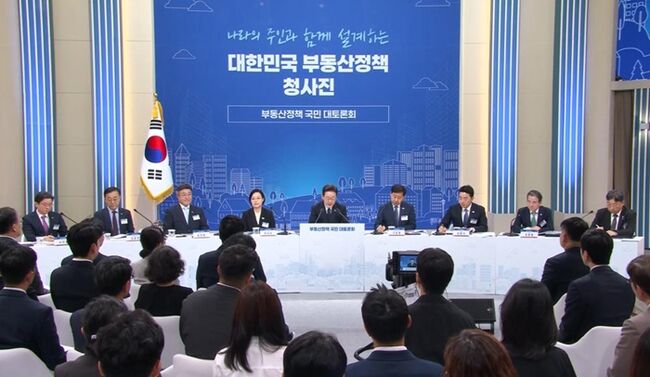 [Liberal Democratic Party Statement] Calling it a Grand Real Estate Debate… It Was Nothing More Than a Private Party Among Themselves
The 'National Grand Debate on Real Estate Policy' held on July 23rd and 27th. [Photo=Yonhap News]The 'National Grand Debate on Real Estate Policy,' hosted by the Lee Jae-myung administration under the
[Liberal Democratic Party Statement] Calling it a Grand Real Estate Debate… It Was Nothing More Than a Private Party Among Themselves
The 'National Grand Debate on Real Estate Policy' held on July 23rd and 27th. [Photo=Yonhap News]The 'National Grand Debate on Real Estate Policy,' hosted by the Lee Jae-myung administration under the
 [Photo] Evidence of Election Fraud Flooding U.S. Media… Trump Had 2.7 Million Votes Stolen
 [Video] U.S. Semiquincentennial Air Show... 'Art in the Sky' streaks across New York
 [Editorial Cartoon] A Draconian Law That Undermines Freedom of Expression

 List
List