The site of the Muan Airport disaster, where 179 people were killed after crashing into a concrete embankment upon landing. [Photo=KBS]
Accidents can happen. However, the extent to which losses can be minimized when an accident occurs depends on the country's capabilities. These capabilities are deeply related to the conscience of government officials. The Muan Airport disaster best illustrates the dynamic relationship between conscience and capability.
On December 29, 2024, an aircraft exploded at Muan International Airport in Jeollanam-do, killing 179 people. Only two survived. At the time of the disaster, the bereaved families had to rely solely on media reports, as they did not receive accurate information from the government.
The core of the incident is the 'cause of death.'
The Democratic Party, which held the majority in the National Assembly, blamed the 'pilot' and 'bird strikes' as the main culprits and shifted responsibility to the airline. The media reported that the pilot mistakenly shut down the intact left engine instead of the right engine, which was damaged by a bird strike, causing the plane to crash. One broadcaster even traveled to the United States to cover exemplary bird strike management practices at other airports.
The core of the incident is not bird strikes, aircraft defects, or pilot error.
The official results of a commissioned investigation by the Korea Association for Structural Engineering, officially requested by the Aviation and Railway Accident Investigation Board under the Ministry of Land, Infrastructure and Transport on March 2025, were released on January 8. These results, which had not been disclosed despite the families' requests, were obtained by SBS through the office of Member of Parliament Kim Eun-hye of the People Power Party.
The results were shocking, but as expected.
"If there had been no concrete embankment at Muan Airport, all passengers would have survived."
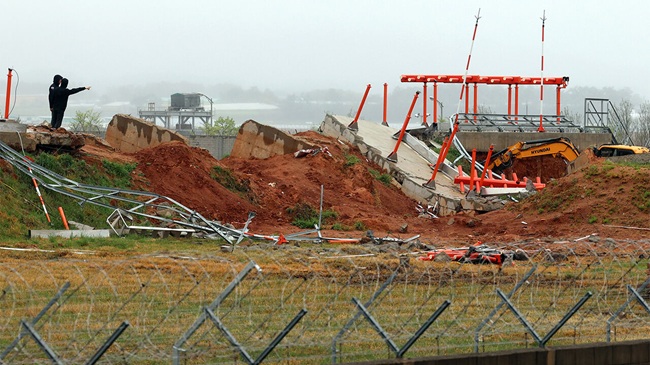 The concrete embankment that became the decisive cause of the Muan Airport disaster. [Photo=Yonhap News]
To arrive at this single conclusion, the association used supercomputers to conduct collision simulations and calculate impact forces and the number of seriously injured individuals for various scenarios. The analysis concluded that if the concrete embankment had not been present, the aircraft would have made a belly landing and stopped after skidding for 770 meters. (Do we really need an analysis to know this?)
179 lives vanished into thin air because the plane could not travel a mere 1 kilometer further.
Furthermore, the results indicated that if the localizer had been constructed with a frangible structure instead of concrete, there would have been no serious injuries. (Isn't that common sense?)
Everyone survived the Kai Tak Airport crash
Kai Tak Airport is often compared to Muan Airport.
Kai Tak Airport in Hong Kong (1925-1998), once the world's most dangerous airport, was notorious for its difficult landings due to the densely packed high-rise buildings, surrounding mountains, and the sea on all sides.
Pilots had to demonstrate near-acrobatic flying skills. To land on the runway, they first had to turn their aircraft northeast from near Lantau Island and gradually descend.
From this point, the aircraft would pass over Victoria Harbour, densely packed with ships and containers, and enter the western part of the Kowloon Peninsula, known for its high population density.
Pilots had to align the aircraft with the runway. Using guidance markers installed in Kowloon Tsai Park as a reference, they would make a 47-degree right turn from approximately 3.7 kilometers northwest of the runway and gradually descend.
The manual stipulated that the aircraft's altitude should be below 1,000 feet (300 meters) at this point. Pilots typically made the right turn at an altitude of 650 feet (200 meters) and then aligned the aircraft with the runway at an altitude of 140 feet (43 meters) for landing.
This scene remains a famous photograph of an aircraft flying between buildings and was also featured in the movie 'City on Fire'. The aircraft approached so closely that one could discern the detailed structure and components of the fuselage, giving the impression that one could jump and board it.
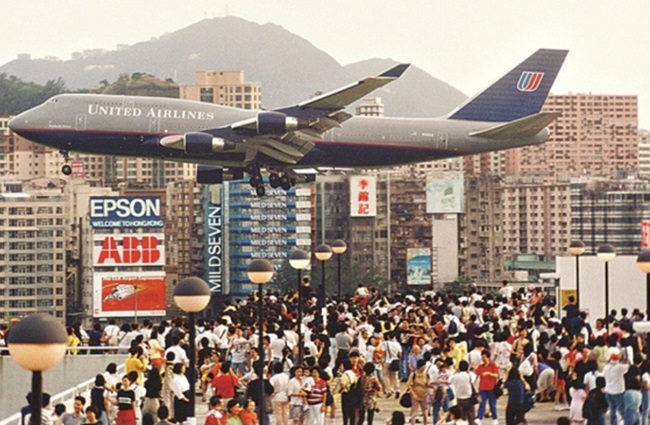 Hong Kong citizens gather to watch the last flight entering Kai Tak Airport on July 5, 1998. [Photo=South China Morning Post]
Despite the constant anxiety of landing, an accident eventually occurred. In 1993, a Boeing 747 went off the runway and crashed into the sea. What is surprising is that all 296 people on board survived, even though the aircraft plunged into the sea.
Kai Tak Airport was worse off than Muan Airport in many respects. While Muan Airport was situated on mudflats, Kai Tak Airport was located in the heart of a city densely populated with high-rise buildings.
However, the reason for the survival of everyone in such a major accident is very simple: there was no concrete embankment. The Hong Kong government, under British rule, was conscientious, and its political parties were fair.
Concrete Embankment Existed Since Initial Design in 1999
Muan International Airport broke ground in 1999 with full government support during the Kim Dae-jung administration.
The concrete embankment existed since the initial design in 1999 and was deemed compliant with regulations at the time of its opening in 2007. There was another opportunity to correct this. If it had been addressed during the 2020 renovation project, this tragedy might not have occurred.
Who built this concrete embankment, and who approved its construction? Who failed to conduct proper inspections? The Ministry of Land, Infrastructure and Transport, Korea Airports Corporation, and the construction companies involved are all unable to provide accurate answers.
Even if, as they claim, the pilot made a mistake, the passengers could have survived. A national facility killed people. This is not a simple mistake by one or two individuals, but a massive crime involving power.
Power is adept at framing narratives. The name 'Muan Airport Disaster,' which was used at the time of the accident, was changed to 'Jeju Air Passenger Plane Accident' in a press release from the Ministry of Land, Infrastructure and Transport within a day.
This suggests that someone was behind this to protect the entity that built the airport and to shift blame to the airline. Who authorized the inclusion of 'Jeju Air Accident' in the Ministry of Land, Infrastructure and Transport's press release? Find that person. That's where the investigation should start.
Reporter Im Yo-hee
[Response and Correction]
In our Opinion section on January 18, our newspaper published an article titled '[Im Yo-hee's Hanmi Shilon] The Backbone of the Muan Airport Disaster Must Be Revealed,' stating that the Democratic Party blamed pilots and bird strikes for the Jeju Air disaster and shifted responsibility to the airline.
In response, the Democratic Party stated, "There has been no assertion that pilots and bird strikes were the primary cause of the Jeju Air disaster. As a special committee for the 12-29 passenger plane disaster investigation is currently in progress, we plan to do our utmost to investigate and determine the cause."
This correction is made in accordance with the mediation of the Korea Media Arbitration Commission.

 [Statement by the Seo-beo-kka Korea Military Academy Save-the-Nation Comrades Association] ㉛ Recount the Votes Publicly, as the Previous Recount Concealed Election Fraud
Tongyeong Mayoral Election Recount [Photo=Yonhap News]South Korea's liberal democracy is dying. The National Election Commission (NEC) and the judiciary, which have plummeted into criminal syndicates
[Statement by the Seo-beo-kka Korea Military Academy Save-the-Nation Comrades Association] ㉛ Recount the Votes Publicly, as the Previous Recount Concealed Election Fraud
Tongyeong Mayoral Election Recount [Photo=Yonhap News]South Korea's liberal democracy is dying. The National Election Commission (NEC) and the judiciary, which have plummeted into criminal syndicates
 What is the significance of the "Trump 2028" red hats that keep making a comeback?
It is noteworthy that President Donald Trump is "intentionally" fueling controversy over whether he can actually run in the 2028 presidential election, even though it is "highly likely he is seriously
What is the significance of the "Trump 2028" red hats that keep making a comeback?
It is noteworthy that President Donald Trump is "intentionally" fueling controversy over whether he can actually run in the 2028 presidential election, even though it is "highly likely he is seriously
 Jin Cummings: "North Korea says it will increase the number of spies, so what is the government doing?"
U.S. political columnist Gene Cummings has publicly questioned the South Korean government, asking, "North Korea is announcing plans to increase its number of spies, yet what is the South Korean
Jin Cummings: "North Korea says it will increase the number of spies, so what is the government doing?"
U.S. political columnist Gene Cummings has publicly questioned the South Korean government, asking, "North Korea is announcing plans to increase its number of spies, yet what is the South Korean
 Attorney Do Tae-woo: “Discrepancies in Voter Count and Improper Sealing Confirmed in Tongyeong Mayoral Recount… Official Request for Further Verification Filed with Gyeongnam Election Commission”
A bundle of out-of-district early voting ballots photographed by attorney Do Tae-woo at the Tongyeong mayoral election recount site. A clear, solid line visible on the side of the ballots raises suspi
Attorney Do Tae-woo: “Discrepancies in Voter Count and Improper Sealing Confirmed in Tongyeong Mayoral Recount… Official Request for Further Verification Filed with Gyeongnam Election Commission”
A bundle of out-of-district early voting ballots photographed by attorney Do Tae-woo at the Tongyeong mayoral election recount site. A clear, solid line visible on the side of the ballots raises suspi
 Stock Market Crash 'Black Tuesday'… KOSPI down 10.8%, KOSDAQ down 7.7%
The KOSPI fell by more than 5% in early trading on the 28th, triggering a sell-side sidecar.On the 28th, the KOSPI plunged by more than 10%.Due to the sharp decline, a sell-side sidecar—a temporary
Stock Market Crash 'Black Tuesday'… KOSPI down 10.8%, KOSDAQ down 7.7%
The KOSPI fell by more than 5% in early trading on the 28th, triggering a sell-side sidecar.On the 28th, the KOSPI plunged by more than 10%.Due to the sharp decline, a sell-side sidecar—a temporary
 [World Heritage Committee] 25 New World Heritage Sites Inscribed in Busan… South Korea Successfully Expands 'Getbol' Listing
The Chairperson of the World Heritage Committee speaks at the plenary session of the 48th session of the World Heritage Committee, held at BEXCO in Busan on the 20th. [Photo: Yonhap News]A total of 25
[World Heritage Committee] 25 New World Heritage Sites Inscribed in Busan… South Korea Successfully Expands 'Getbol' Listing
The Chairperson of the World Heritage Committee speaks at the plenary session of the 48th session of the World Heritage Committee, held at BEXCO in Busan on the 20th. [Photo: Yonhap News]A total of 25
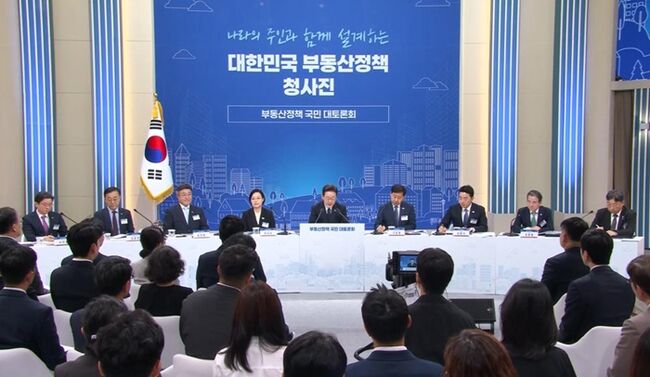 [Liberal Democratic Party Statement] Calling it a Grand Real Estate Debate… It Was Nothing More Than a Private Party Among Themselves
The 'National Grand Debate on Real Estate Policy' held on July 23rd and 27th. [Photo=Yonhap News]The 'National Grand Debate on Real Estate Policy,' hosted by the Lee Jae-myung administration under the
[Liberal Democratic Party Statement] Calling it a Grand Real Estate Debate… It Was Nothing More Than a Private Party Among Themselves
The 'National Grand Debate on Real Estate Policy' held on July 23rd and 27th. [Photo=Yonhap News]The 'National Grand Debate on Real Estate Policy,' hosted by the Lee Jae-myung administration under the
 [Photo] Evidence of Election Fraud Flooding U.S. Media… Trump Had 2.7 Million Votes Stolen
 [Video] U.S. Semiquincentennial Air Show... 'Art in the Sky' streaks across New York
 [Editorial Cartoon] A Draconian Law That Undermines Freedom of Expression

 List
List