U.S. Secretary of Commerce Gina Raimondo. [Photo: Yonhap News]
The United States has delivered a message to South Korea that is close to an ultimatum.
U.S. Secretary of Commerce Howard Rutnik issued a public warning on the 16th (local time) that "major semiconductor producing countries, including South Korea, could face a 100% semiconductor tariff if they do not invest in the United States."
According to Bloomberg News, Secretary Rutnik told reporters at the groundbreaking ceremony for a new plant by U.S. semiconductor company Micron near Syracuse, New York, "Everyone who wants to make memory semiconductors has two options: pay a 100% tariff or produce in the United States."
These remarks clearly show that the U.S. pressure for semiconductor tariffs is not just an empty threat but is being actively used as a bargaining chip.
The market interprets this as the official opening signal for "Tariff Negotiations Round 2," where the trade dispute between South Korea and the U.S., which was postponed last year, has resurfaced.
Signal to End Postponement... Entering Round 2 of Negotiations
There are clear grounds for defining this phase as "Round 2."
Round 1, which took place during the South Korea-U.S. summit last year, was essentially a provisional agreement to postpone the imposition of tariffs. At the time, the U.S. presented the principle of "not treating South Korea disadvantageously," but concluded the negotiations without finalizing specific conditions and scope of application.
Therefore, the recent U.S. proclamation regarding semiconductor tariffs is interpreted as a measure to notify the end of the postponed state. This is because the legal basis for actual tariff imposition has been established, and the policy of conducting separate negotiations by country has been formalized, rather than it being a mere warning.
The fact that the U.S. has already reached an agreement with Taiwan linking tariffs and investment conditions also indicates that the U.S. has entered a full-fledged second phase of negotiations.
In particular, while last year's Round 1 was diplomatic negotiations centered on summit talks, this phase is entirely different in nature, being a stage of working-level negotiations employing item-specific and country-specific pressure.
This is why the market defines the current situation, which has shifted from tariff postponement to consideration of tariff implementation, as "Tariff Negotiations Round 2."
Investment Transfer to Taiwan, Trade Re-adjustment Pressure on South Korea
The most significant characteristic of this phase is that the U.S. is treating Taiwan and South Korea with different logic. Although it appears to be the same "semiconductor tariff card," the objectives towards the two countries are clearly distinct.
The U.S. demand towards Taiwan is relatively straightforward: "Move more advanced processes to the United States."
Taiwan is an absolute powerhouse in system semiconductor foundries, and there is an excessive global dependence on TSMC in particular.
From the U.S. perspective, the greatest risk factor is the potential collapse of the semiconductor supply chain in the event of a crisis in Taiwan.
The actual goal is not the imposition of tariffs but additional investment and production relocation within the U.S.
The fact that the U.S. and Taiwan recently coordinated tariff preferences and investment expansion conditions through separate semiconductor negotiations is also within this context.
In contrast, the nature of the pressure on South Korea is different.
South Korea is already making large-scale investments in the U.S. Semiconductor plants by Samsung Electronics and SK Hynix, and even electric vehicle plants by Hyundai Motor Group are being established in the U.S. one after another.
Despite this, the reason the U.S. is bringing out the tariff card again is simple: the judgment that "while investments are sufficient, the trade balance structure remains unfavorable."
In recent trends, the proportion of automobiles is absolute in South Korea's trade surplus structure with the U.S.
Although semiconductors are also major surplus items, what the U.S. practically wants to adjust is the trade imbalance centered on automobiles.
Therefore, the tariff pressure on South Korea, unlike that on Taiwan, has a stronger character of pressuring for the resumption of actual trade negotiations. The intention to re-adjust market access conditions and trade structures is more distinct than the demand for investment relocation.
It is as if the same semiconductor card is being used as an investment pressure on Taiwan and negotiation pressure on South Korea.
Taiwan and South Korea, "Different Semiconductors" in Reality
To understand this phase, one must clearly see the difference in the semiconductor industry structures of Taiwan and South Korea.
Taiwan is centered on system semiconductor foundries, while South Korea is centered on memory semiconductors.
From the U.S. perspective, Taiwan is a "hard-to-replace production base," and South Korea is closer to a "partner whose conditions can be adjusted through negotiation."
Therefore, even the same semiconductor tariff card operates differently. The message to Taiwan is a supply chain restructuring strategy, and the message to South Korea is a signal to resume trade negotiations.
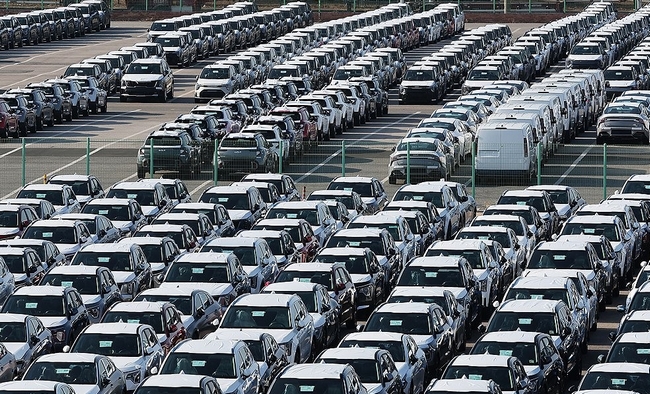 Export vehicles are parked at Pyeongtaek Port in Gyeonggi Province on January 14. [Photo: Yonhap News]
The Final Target is Automobiles
The reason market experts see automobiles as the endpoint of this negotiation is clear.
This is because automobiles account for an overwhelming proportion of South Korea's trade surplus with the U.S.
From the U.S. perspective, automobiles are a card that can simultaneously meet three objectives: short-term employment expansion, reduction of trade deficit, and demonstration of manufacturing sector performance.
Especially when considering the U.S. midterm elections scheduled for November of this year, the automotive industry becomes the most politically effective negotiation tool.
Ultimately, the analysis that semiconductors are the card that opens the door to negotiations, and the actual victory will likely be fought over automobiles, is gaining traction.
Employment, Inflation, and Midterm Elections as Variables
The direction of this negotiation is intertwined with several variables. U.S. inflation and employment indicators, the midterm election schedule, the technology supremacy competition with China, and the global supply chain restructuring all have an impact.
In particular, the worse the employment indicators in the U.S. become, the greater the likelihood of intensified tariff pressure.
The fact that Secretary Rutnik's remarks were made at an event emphasizing the creation of manufacturing jobs in the U.S. also indicates that this message was delivered with clear political calculations.
South Korea's Limited Options
South Korea has few options.
While compromise through increased investment, partial concessions and buying time, and retaliatory tariffs are mentioned, realistic options are limited due to the industrial structure's high dependence on the U.S.
Ultimately, the most likely path is to minimize the shock through negotiations.
From Postponement to Implementation
This measure signifies that the postponed conflict has entered the implementation stage, not just a one-off dispute.
Secretary Rutnik's remarks are akin to a starting gun that formalized this transition.
The U.S. strategy is clear.
Two-pronged strategies are operating simultaneously: structural pressure demanding investment relocation from Taiwan, and trade pressure compelling a re-adjustment of trade conditions from South Korea.
A trade expert commented:
"Semiconductors are the preview, and the main feature is automobiles. This negotiation is likely to be a long-term battle, not a short one."
Ultimately, one question remains.
"What is the South Korean government preparing for in this Round 2 of tariff negotiations?"
By Kim Young

 [Statement by the Seo-beo-kka Korea Military Academy Save-the-Nation Comrades Association] ㉛ Recount the Votes Publicly, as the Previous Recount Concealed Election Fraud
Tongyeong Mayoral Election Recount [Photo=Yonhap News]South Korea's liberal democracy is dying. The National Election Commission (NEC) and the judiciary, which have plummeted into criminal syndicates
[Statement by the Seo-beo-kka Korea Military Academy Save-the-Nation Comrades Association] ㉛ Recount the Votes Publicly, as the Previous Recount Concealed Election Fraud
Tongyeong Mayoral Election Recount [Photo=Yonhap News]South Korea's liberal democracy is dying. The National Election Commission (NEC) and the judiciary, which have plummeted into criminal syndicates
 What is the significance of the "Trump 2028" red hats that keep making a comeback?
It is noteworthy that President Donald Trump is "intentionally" fueling controversy over whether he can actually run in the 2028 presidential election, even though it is "highly likely he is seriously
What is the significance of the "Trump 2028" red hats that keep making a comeback?
It is noteworthy that President Donald Trump is "intentionally" fueling controversy over whether he can actually run in the 2028 presidential election, even though it is "highly likely he is seriously
 Jin Cummings: "North Korea says it will increase the number of spies, so what is the government doing?"
U.S. political columnist Gene Cummings has publicly questioned the South Korean government, asking, "North Korea is announcing plans to increase its number of spies, yet what is the South Korean
Jin Cummings: "North Korea says it will increase the number of spies, so what is the government doing?"
U.S. political columnist Gene Cummings has publicly questioned the South Korean government, asking, "North Korea is announcing plans to increase its number of spies, yet what is the South Korean
 Attorney Do Tae-woo: “Discrepancies in Voter Count and Improper Sealing Confirmed in Tongyeong Mayoral Recount… Official Request for Additional Verification Submitted to Gyeongnam Election Commission”
A bundle of mail-in early voting ballots captured by lawyer Do Tae-woo at the Tongyeong mayoral election recount site. A clear solid line, raising suspicions of election fraud, is visible on the side
Attorney Do Tae-woo: “Discrepancies in Voter Count and Improper Sealing Confirmed in Tongyeong Mayoral Recount… Official Request for Additional Verification Submitted to Gyeongnam Election Commission”
A bundle of mail-in early voting ballots captured by lawyer Do Tae-woo at the Tongyeong mayoral election recount site. A clear solid line, raising suspicions of election fraud, is visible on the side
 Stock Market Crash 'Black Tuesday'… KOSPI down 10.8%, KOSDAQ down 7.7%
The KOSPI fell by more than 5% in early trading on the 28th, triggering a sell-side sidecar.On the 28th, the KOSPI plunged by more than 10%.Due to the sharp decline, a sell-side sidecar—a temporary
Stock Market Crash 'Black Tuesday'… KOSPI down 10.8%, KOSDAQ down 7.7%
The KOSPI fell by more than 5% in early trading on the 28th, triggering a sell-side sidecar.On the 28th, the KOSPI plunged by more than 10%.Due to the sharp decline, a sell-side sidecar—a temporary
 [World Heritage Committee] 25 New World Heritage Sites Inscribed in Busan… South Korea Successfully Expands 'Getbol' Listing
The Chairperson of the World Heritage Committee speaks at the plenary session of the 48th session of the World Heritage Committee, held at BEXCO in Busan on the 20th. [Photo: Yonhap News]A total of 25
[World Heritage Committee] 25 New World Heritage Sites Inscribed in Busan… South Korea Successfully Expands 'Getbol' Listing
The Chairperson of the World Heritage Committee speaks at the plenary session of the 48th session of the World Heritage Committee, held at BEXCO in Busan on the 20th. [Photo: Yonhap News]A total of 25
 [Liberal Democratic Party Statement] Calling it a Grand Real Estate Debate… It Was Nothing More Than a Private Party Among Themselves
The 'National Grand Debate on Real Estate Policy' held on July 23rd and 27th. [Photo=Yonhap News]The 'National Grand Debate on Real Estate Policy,' hosted by the Lee Jae-myung administration under the
[Liberal Democratic Party Statement] Calling it a Grand Real Estate Debate… It Was Nothing More Than a Private Party Among Themselves
The 'National Grand Debate on Real Estate Policy' held on July 23rd and 27th. [Photo=Yonhap News]The 'National Grand Debate on Real Estate Policy,' hosted by the Lee Jae-myung administration under the
 [Photo] Evidence of Election Fraud Flooding U.S. Media… Trump Had 2.7 Million Votes Stolen
 [Video] U.S. Semiquincentennial Air Show... 'Art in the Sky' streaks across New York
 [Editorial Cartoon] A Draconian Law That Undermines Freedom of Expression

 List
List