- James Kim "Suggests the ROK-US alliance is transitioning to a more asymmetrical form"
 President Trump [AFP=Yonhap News]
A new defense strategy (NDS) announced by the U.S. Trump administration on January 23 (local time) suggests that the ROK-U.S. alliance is shifting to a more asymmetric form, according to U.S. expert analysis.
In an analysis distributed to the press on the 25th, James Kim, Director of the Korea Program at the Stimson Center, a U.S. think tank, stated, "This NDS suggests that the ROK-U.S. alliance is transitioning to a more asymmetric form, with an expansion of Korea's responsibilities while the U.S. reduces its military role in the region under a broader strategy of selective engagement."
The NDS, released by the U.S. Department of Defense on January 23, stated, "Korea has the capacity to take the lead in deterring North Korea, backed by a strong military, high levels of defense spending, a robust defense industry, and mandatory military conscription."
Furthermore, it described the U.S. support in this process as "important yet more limited."
The NDS also stated, "This recalibration of responsibility [for deterring North Korea] aligns with U.S. interests in updating its military posture on the Korean Peninsula."
Kim commented, "While it is still unclear how the new military posture will be implemented, the core point is that the new U.S. strategy demands significant changes to the status quo on the Korean Peninsula."
He added, "There are already signs indicating that this transition is underway in South Korea," citing the ongoing work to transfer wartime operational control (OPCON) as an example. The Lee Jae-myung administration aims to achieve OPCON transfer during its term.
Kim further pointed out that the U.S. reassessment of its geopolitical priorities "suggests a potential for limited U.S. engagement in regions outside the Western Hemisphere."
This implies that the Trump administration's prioritization of security in the Western Hemisphere, encompassing the U.S. mainland and Latin America, could lead to changes related to the role and scale of U.S. Forces Korea.
Kim also noted that the "revitalization of the domestic defense industrial base" was addressed as a major objective in the NDS. He stated that South Korea, now the world's 10th largest arms exporter, could "reconfigure the alliance by expanding the types and scope of defense industry cooperation."
Kim evaluated, "South Korea, like other allies, will be asked to take on greater responsibility in its own security domain, while the U.S. will focus on securing its homeland and Western Hemisphere, continuing to strengthen 'deterrence by denial' in the Indo-Pacific region. The ROK-U.S. alliance, with its 70-year history, has finally reached a significant turning point."
He added, "How South Korea navigates this transition strategically, operationally, industrially, and diplomatically will determine the future of the alliance, as well as the future of the Northeast Asian security structure."
What do you think of this article?

 [Statement by the Seo-beo-kka Korea Military Academy Save-the-Nation Comrades Association] ㉛ Recount the Votes Publicly, as the Previous Recount Concealed Election Fraud
Tongyeong Mayoral Election Recount [Photo=Yonhap News]South Korea's liberal democracy is dying. The National Election Commission (NEC) and the judiciary, which have plummeted into criminal syndicates
[Statement by the Seo-beo-kka Korea Military Academy Save-the-Nation Comrades Association] ㉛ Recount the Votes Publicly, as the Previous Recount Concealed Election Fraud
Tongyeong Mayoral Election Recount [Photo=Yonhap News]South Korea's liberal democracy is dying. The National Election Commission (NEC) and the judiciary, which have plummeted into criminal syndicates
 What is the significance of the "Trump 2028" red hats that keep making a comeback?
It is noteworthy that President Donald Trump is "intentionally" fueling controversy over whether he can actually run in the 2028 presidential election, even though it is "highly likely he is seriously
What is the significance of the "Trump 2028" red hats that keep making a comeback?
It is noteworthy that President Donald Trump is "intentionally" fueling controversy over whether he can actually run in the 2028 presidential election, even though it is "highly likely he is seriously
 Jin Cummings: "North Korea says it will increase the number of spies, so what is the government doing?"
U.S. political columnist Gene Cummings has publicly questioned the South Korean government, asking, "North Korea is announcing plans to increase its number of spies, yet what is the South Korean
Jin Cummings: "North Korea says it will increase the number of spies, so what is the government doing?"
U.S. political columnist Gene Cummings has publicly questioned the South Korean government, asking, "North Korea is announcing plans to increase its number of spies, yet what is the South Korean
 Attorney Do Tae-woo: “Discrepancies in Voter Count and Improper Sealing Confirmed in Tongyeong Mayoral Recount… Official Request for Additional Verification Submitted to Gyeongnam Election Commission”
A bundle of mail-in early voting ballots captured by lawyer Do Tae-woo at the Tongyeong mayoral election recount site. A clear solid line, raising suspicions of election fraud, is visible on the side
Attorney Do Tae-woo: “Discrepancies in Voter Count and Improper Sealing Confirmed in Tongyeong Mayoral Recount… Official Request for Additional Verification Submitted to Gyeongnam Election Commission”
A bundle of mail-in early voting ballots captured by lawyer Do Tae-woo at the Tongyeong mayoral election recount site. A clear solid line, raising suspicions of election fraud, is visible on the side
 Stock Market Crash 'Black Tuesday'… KOSPI down 10.8%, KOSDAQ down 7.7%
The KOSPI fell by more than 5% in early trading on the 28th, triggering a sell-side sidecar.On the 28th, the KOSPI plunged by more than 10%.Due to the sharp decline, a sell-side sidecar—a temporary
Stock Market Crash 'Black Tuesday'… KOSPI down 10.8%, KOSDAQ down 7.7%
The KOSPI fell by more than 5% in early trading on the 28th, triggering a sell-side sidecar.On the 28th, the KOSPI plunged by more than 10%.Due to the sharp decline, a sell-side sidecar—a temporary
 [World Heritage Committee] 25 New World Heritage Sites Inscribed in Busan… South Korea Successfully Expands 'Getbol' Listing
The Chairperson of the World Heritage Committee speaks at the plenary session of the 48th session of the World Heritage Committee, held at BEXCO in Busan on the 20th. [Photo: Yonhap News]A total of 25
[World Heritage Committee] 25 New World Heritage Sites Inscribed in Busan… South Korea Successfully Expands 'Getbol' Listing
The Chairperson of the World Heritage Committee speaks at the plenary session of the 48th session of the World Heritage Committee, held at BEXCO in Busan on the 20th. [Photo: Yonhap News]A total of 25
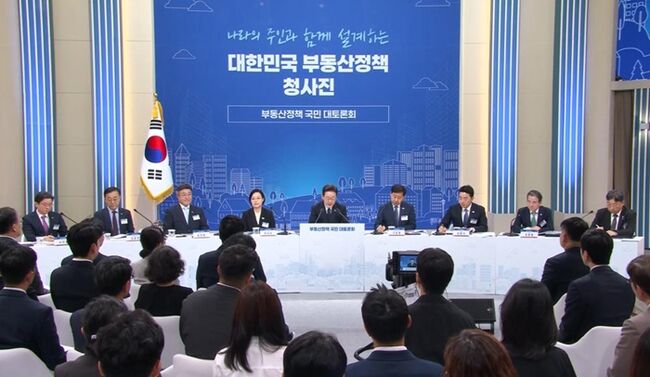 [Liberal Democratic Party Statement] Calling it a Grand Real Estate Debate… It Was Nothing More Than a Private Party Among Themselves
The 'National Grand Debate on Real Estate Policy' held on July 23rd and 27th. [Photo=Yonhap News]The 'National Grand Debate on Real Estate Policy,' hosted by the Lee Jae-myung administration under the
[Liberal Democratic Party Statement] Calling it a Grand Real Estate Debate… It Was Nothing More Than a Private Party Among Themselves
The 'National Grand Debate on Real Estate Policy' held on July 23rd and 27th. [Photo=Yonhap News]The 'National Grand Debate on Real Estate Policy,' hosted by the Lee Jae-myung administration under the
 [Photo] Evidence of Election Fraud Flooding U.S. Media… Trump Had 2.7 Million Votes Stolen
 [Video] U.S. Semiquincentennial Air Show... 'Art in the Sky' streaks across New York
 [Editorial Cartoon] A Draconian Law That Undermines Freedom of Expression

 List
List