화재는 여전히 대표적인 ‘돌발 사고’로 인식되지만, 실제로는 전력 이상, 환경 변화, 누적된 구조적 문제라는 신호가 사전에 존재하는 경우가 많다. AI 기반 예측 기술은 이러한 미세한 변화를 실시간으로 분석해 위험을 점수화하고, 사고가 발생하기 전 개입할 수 있는 여지를 만든다. 이는 화재를 사건이 아닌 관리 과정으로 취급하는 접근 방식이다.
 Gyeonggi Province Fire & Disaster Headquarters announced on the 20th that they conducted a 'Fire Evacuation and Safety Education Training for Super-tall Buildings' on the afternoon of the 19th in 19 buildings across 4 complexes housing super-tall buildings, including Metapolis in Hwaseong. [Photo: Yonhap News, Gyeonggi Province Fire & Disaster Headquarters]
The meaning of safety is changing with Artificial Intelligence (AI) based technology.
Rapid response after an incident is no longer sufficient to protect people's lives and property. The ability to recognize risks in advance and lower the possibility of them occurring is becoming a new international competitive edge. Data-driven forecasting and prediction technologies are elevating 'safety' from the realm of welfare or cost to that of a national strategic asset.
Safety Industry Based on Post-Incident Response... Increased Social Costs
Up to now, the safety industry has developed on the premise of post-incident response. The structure has been to detect a fire, dispatch responders, and extinguish it. However, with climate change, urban densification, and the increasing complexity of industrial facilities, the nature of disasters is rapidly changing. Malicious accidents are occurring in more complex and unpredictable ways. In this environment, a system focused on post-incident response demands ever-greater sacrifices and social costs.
Against this backdrop, the global safety industry has begun to redefine safety as a 'prediction problem'.
Data is not just information but a tool to eliminate future uncertainties. Those in charge of risk management can decide where to allocate resources, which means gaining a temporal advantage. The ability to predict is thus becoming a structure of dominance in industrial fields.
Predictive Data for Incidents, etc... A Key Asset on Par with National Security
Japan's Society 5.0, a national vision aiming to achieve economic growth and solve social problems simultaneously by highly integrating cyberspace and physical space with the goal of a super-smart society, demonstrates this trend at a national strategic level. This vision regards predictive data as a key asset on par with national security.
Research into digital twins and preemptive recognition technology is actively underway, centered around the Massachusetts Institute of Technology (MIT), a world-class university and research institution in AI, robotics, computer engineering, urban engineering, and bio-research. The perception is spreading that 'seeing accidents in advance' can lead to a restructuring of social systems.
This change is expanding across industries.
Insurance is evolving from post-accident compensation to behavior modification services that reduce the likelihood of accidents. In the real estate market, the precise management of safety data is becoming a criterion for asset value. In the energy and infrastructure sectors, attempts to prevent large-scale accidents by analyzing power consumption patterns and structural fatigue are increasing.
Fire safety is a particularly noteworthy area.
Fires are still perceived as representative 'sudden accidents,' but in reality, there are often prior signals such as electrical anomalies, environmental changes, or accumulated structural issues. AI-based prediction technology analyzes these subtle changes in real-time, assigns risk scores, and creates opportunities for intervention before an accident occurs. This is an approach that treats fire not as an incident, but as a management process.
Future of Complex Industrial Power... Predictable Data is Essential
New power structures are also emerging in this process. Entities that possess the most and most precise safety data define the standards. 'Near-miss' data, representing situations close to an accident, is becoming a key asset for next-generation technologies, and companies or institutions that accumulate this data influence entire industries. Data from failed cases becomes the blueprint for success.
Of course, these changes are accompanied by ethical questions.
As prediction becomes more sophisticated, who owns and controls the data becomes crucial. If AI predicts a 99% or higher probability of an accident, who bears the responsibility if that judgment is not followed? Furthermore, the possibility that algorithms will make value judgments on which lives to prioritize in emergency situations cannot be ruled out.
Nevertheless, one fact is clear.
Safety is no longer a matter of post-incident processing. The extent to which the future can be determined through data is becoming the standard differentiating the competitiveness of nations and corporations. While past industrial power stemmed from physical strength and capital, future complex industrial power will stem from predictable data.
Technologies that reduce uncertainty are not just about convenience; they are a force that reshapes social structures. Data-driven safety forecasting and prediction systems are establishing themselves not only as tools for cost reduction but as means to redesign the order of industries, cities, and ultimately, nations.
In an era where safety is the paramount principle, the change has already begun. We reveal a part of our dream to lead the global market as a 'global leading disaster solution AI company'.
Yeongjin Cho, CEO of Rose AI

 [Statement by the Seo-beo-kka Korea Military Academy Save-the-Nation Comrades Association] ㉛ Recount the Votes Publicly, as the Previous Recount Concealed Election Fraud
Tongyeong Mayoral Election Recount [Photo=Yonhap News]South Korea's liberal democracy is dying. The National Election Commission (NEC) and the judiciary, which have plummeted into criminal syndicates
[Statement by the Seo-beo-kka Korea Military Academy Save-the-Nation Comrades Association] ㉛ Recount the Votes Publicly, as the Previous Recount Concealed Election Fraud
Tongyeong Mayoral Election Recount [Photo=Yonhap News]South Korea's liberal democracy is dying. The National Election Commission (NEC) and the judiciary, which have plummeted into criminal syndicates
 What is the significance of the "Trump 2028" red hats that keep making a comeback?
It is noteworthy that President Donald Trump is "intentionally" fueling controversy over whether he can actually run in the 2028 presidential election, even though it is "highly likely he is seriously
What is the significance of the "Trump 2028" red hats that keep making a comeback?
It is noteworthy that President Donald Trump is "intentionally" fueling controversy over whether he can actually run in the 2028 presidential election, even though it is "highly likely he is seriously
 Jin Cummings: "North Korea says it will increase the number of spies, so what is the government doing?"
U.S. political columnist Gene Cummings has publicly questioned the South Korean government, asking, "North Korea is announcing plans to increase its number of spies, yet what is the South Korean
Jin Cummings: "North Korea says it will increase the number of spies, so what is the government doing?"
U.S. political columnist Gene Cummings has publicly questioned the South Korean government, asking, "North Korea is announcing plans to increase its number of spies, yet what is the South Korean
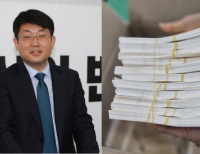
 Attorney Do Tae-woo: “Discrepancies in Voter Count and Improper Sealing Confirmed in Tongyeong Mayoral Recount… Official Request for Additional Verification Submitted to Gyeongnam Election Commission”
A bundle of mail-in early voting ballots captured by lawyer Do Tae-woo at the Tongyeong mayoral election recount site. A clear solid line, raising suspicions of election fraud, is visible on the side
Attorney Do Tae-woo: “Discrepancies in Voter Count and Improper Sealing Confirmed in Tongyeong Mayoral Recount… Official Request for Additional Verification Submitted to Gyeongnam Election Commission”
A bundle of mail-in early voting ballots captured by lawyer Do Tae-woo at the Tongyeong mayoral election recount site. A clear solid line, raising suspicions of election fraud, is visible on the side
 Stock Market Crash 'Black Tuesday'… KOSPI down 10.8%, KOSDAQ down 7.7%
The KOSPI fell by more than 5% in early trading on the 28th, triggering a sell-side sidecar.On the 28th, the KOSPI plunged by more than 10%.Due to the sharp decline, a sell-side sidecar—a temporary
Stock Market Crash 'Black Tuesday'… KOSPI down 10.8%, KOSDAQ down 7.7%
The KOSPI fell by more than 5% in early trading on the 28th, triggering a sell-side sidecar.On the 28th, the KOSPI plunged by more than 10%.Due to the sharp decline, a sell-side sidecar—a temporary
 [World Heritage Committee] 25 New World Heritage Sites Inscribed in Busan… South Korea Successfully Expands 'Getbol' Listing
The Chairperson of the World Heritage Committee speaks at the plenary session of the 48th session of the World Heritage Committee, held at BEXCO in Busan on the 20th. [Photo: Yonhap News]A total of 25
[World Heritage Committee] 25 New World Heritage Sites Inscribed in Busan… South Korea Successfully Expands 'Getbol' Listing
The Chairperson of the World Heritage Committee speaks at the plenary session of the 48th session of the World Heritage Committee, held at BEXCO in Busan on the 20th. [Photo: Yonhap News]A total of 25
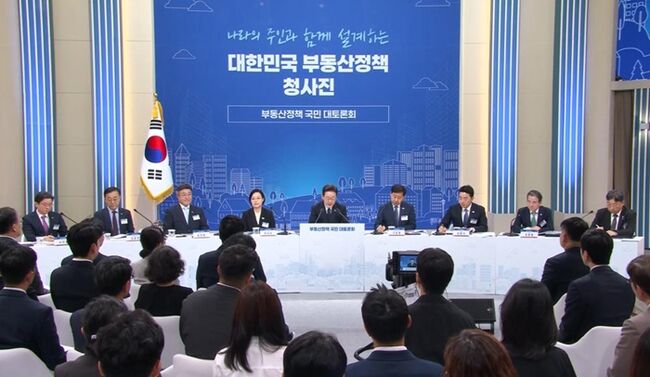 [Liberal Democratic Party Statement] Calling it a Grand Real Estate Debate… It Was Nothing More Than a Private Party Among Themselves
The 'National Grand Debate on Real Estate Policy' held on July 23rd and 27th. [Photo=Yonhap News]The 'National Grand Debate on Real Estate Policy,' hosted by the Lee Jae-myung administration under the
[Liberal Democratic Party Statement] Calling it a Grand Real Estate Debate… It Was Nothing More Than a Private Party Among Themselves
The 'National Grand Debate on Real Estate Policy' held on July 23rd and 27th. [Photo=Yonhap News]The 'National Grand Debate on Real Estate Policy,' hosted by the Lee Jae-myung administration under the
 [Photo] Evidence of Election Fraud Flooding U.S. Media… Trump Had 2.7 Million Votes Stolen
 [Video] U.S. Semiquincentennial Air Show... 'Art in the Sky' streaks across New York
 [Editorial Cartoon] A Draconian Law That Undermines Freedom of Expression

 List
List