지금은 안보를 경비와 감정으로 말할 때가 아니다. 숫자와 구호가 아니라 구조와 시스템으로 판단해야 한다. 미국의 국방 전략 변화는 피할 수 없는 조건이다. 그러나 조건은 언제나 전략을 다시 설계할 기회를 동반한다. 지금이 바로 자주 국방으로 도약할 수 있는 현실적인 기회다. 준비된 국가는 위기 앞에서 움츠러들지 않는다. 위기를 통해 다음 단계로 이동한다.
 Elbridge Colby, U.S. Deputy Assistant Secretary of Defense for Strategy, Planning, and Capabilities (center), visited Camp Humphreys, a U.S. Army base in Pyeongtaek, Gyeonggi Province, on the afternoon of the 26th. He was reportedly briefed on plans for the transition of wartime operational control, the readiness of U.S. Forces Korea, and operational plans. [Photo = Yonhap News, Screenshot from X by JB Bronson, Commander of U.S. Forces Korea]
The United States' defense strategy is changing. This is not a declaration or rhetoric, but a structural change confirmed through documents, budgets, and force deployments.
The core of the defense strategy recently adopted by the United States is clear.
First, China is designated as the primary threat, and forces are concentrated on the U.S. homeland and the core axis of the Indo-Pacific.
Second, allies are asked to take primary responsibility for conventional forces and regional deterrence.
Third, the U.S. military will focus on strategic assets such as nuclear, space, cyber, and precision strike capabilities, rather than large-scale ground troop deployments. This is not just an issue for the Korean Peninsula, but a new standard that the United States is applying uniformly to all its allies.
This Change is Both a Crisis for Korean Security and an Opportunity for Autonomous Defense
Autonomous defense is closer to a political and emotional concept of taking responsibility for national defense without relying on external powers. It is easily misunderstood as a reduction in alliances or an emphasis on independence, and often conflicts with the reality of joint structures.
In contrast, autonomous defense refers to the structural capability to independently exercise leadership in selection, decision-making, and deterrence within alliances. It is a defense strategy that designs the conditions of dependence rather than severing it.
The nature of U.S. Forces Korea is shifting from a "full-scale defense force" to a "strategic support and linkage force." Ground troop numbers are decreasing, and the proportion of advanced assets such as air force, intelligence, space, and missile defense is increasing. In other words, it is a structure where South Korea handles conventional combat on the front lines of war, and the United States provides strategic power at critical moments. This is a redistribution of roles rather than a weakening of the alliance.
Let's Find Autonomous Alternatives Instead of Comparing to the Past
Troop reduction is already a reality. The time to maintain the existing military structure while waiting for a rebound in birth rates has passed. Therefore, the questions must change. The question we must ask now is not how to increase troop numbers, but how to maintain and strengthen deterrence under conditions of declining troop numbers. The answer lies not in the number of people, but in the transformation of systems.
The keywords in the U.S. defense strategy are "speed of decision-making" and "connected battlefield." This provides a clear direction for South Korea as well. We must move away from the method of defending the front lines with people and transition to a digital battlefield where surveillance, detection, tracking, and strike capabilities are connected in one network. It is a structure where threats are detected and exposed early through unmanned sensors, drones, and AI-based analysis systems, and humans focus on decision-making and control. The moment we acknowledge the troop cliff, an opportunity to change the mode of warfare opens up.
Another Alternative is to Redesign the Concept of Defense Personnel
Conscription and service must be transformed from disconnected sacrifices into a national-level technical training process. In fields such as cyber defense, unmanned system operation, and data analysis, the military can become the most intensive educational institution. This not only solves morale issues but also creates a virtuous cycle that leads to industrial competitiveness after discharge.
Autonomous defense does not conflict with alliances. Rather, it is a condition that makes alliances sustainable. The more South Korea secures leadership in conventional deterrence, the more the United States will treat South Korea as a strategic partner, not a protectorate. The U.S. Department of Defense's strategic changes are not a transfer of responsibility, but an expansion of the space for choice. Whether this choice is made into an opportunity or borne as a burden depends on South Korea's decision.
Now is not the time to speak of security in terms of guarding and emotion. We must judge based on structures and systems, not numbers and slogans. The changes in the U.S. defense strategy are inevitable conditions. However, conditions always accompany opportunities to redesign strategies. This is the realistic opportunity to leap forward to autonomous defense. Prepared nations do not shrink in the face of crisis. They move to the next stage through crisis.
The History of Warfare States That Crisis is Opportunity
It is not strong nations that survive, but nations that redesign crisis into opportunity. The world's instructive war history highlights moments when crisis was turned into opportunity. France, despite its numerical inferiority, changed the subject of war to the citizen army, and Britain turned its continental weakness into naval hegemony. Prussia overturned defeat through a revolution in its general staff, and Japan defeated the Allied powers by concentrating on critical points. Israel overcame its population disadvantage with technological and informational superiority.
There is one commonality. Only those nations that changed the structure of warfare, not troop numbers, survived.
Personnel shortages, alliance changes, and technological transitions are not signals of decline but signals of transformation. Crisis always demands the biggest choices. And only those nations that make choices can maintain peace through strength and contribute to human culture.
Public and military sentiment demands that the military redefine its security concept for national survival and recognize China's threat as a present and immediate challenge. The "Five Columns" (spies or internal enemies who secretly infiltrate and destabilize from within, using the "24 tactics of the Chohan War") must be rooted out. Furthermore, we urge the establishment of a comprehensive security posture involving civil, government, and military cooperation, and the identification of autonomous defense tasks that can be implemented immediately.
Park Phil-gyu, Editor

 [Statement by the Seo-beo-kka Korea Military Academy Save-the-Nation Comrades Association] ㉛ Recount the Votes Publicly, as the Previous Recount Concealed Election Fraud
Tongyeong Mayoral Election Recount [Photo=Yonhap News]South Korea's liberal democracy is dying. The National Election Commission (NEC) and the judiciary, which have plummeted into criminal syndicates
[Statement by the Seo-beo-kka Korea Military Academy Save-the-Nation Comrades Association] ㉛ Recount the Votes Publicly, as the Previous Recount Concealed Election Fraud
Tongyeong Mayoral Election Recount [Photo=Yonhap News]South Korea's liberal democracy is dying. The National Election Commission (NEC) and the judiciary, which have plummeted into criminal syndicates
 What is the significance of the "Trump 2028" red hats that keep making a comeback?
It is noteworthy that President Donald Trump is "intentionally" fueling controversy over whether he can actually run in the 2028 presidential election, even though it is "highly likely he is seriously
What is the significance of the "Trump 2028" red hats that keep making a comeback?
It is noteworthy that President Donald Trump is "intentionally" fueling controversy over whether he can actually run in the 2028 presidential election, even though it is "highly likely he is seriously
 Jin Cummings: "North Korea says it will increase the number of spies, so what is the government doing?"
U.S. political columnist Gene Cummings has publicly questioned the South Korean government, asking, "North Korea is announcing plans to increase its number of spies, yet what is the South Korean
Jin Cummings: "North Korea says it will increase the number of spies, so what is the government doing?"
U.S. political columnist Gene Cummings has publicly questioned the South Korean government, asking, "North Korea is announcing plans to increase its number of spies, yet what is the South Korean
 Attorney Do Tae-woo: “Discrepancies in Voter Count and Improper Sealing Confirmed in Tongyeong Mayoral Recount… Official Request for Additional Verification Submitted to Gyeongnam Election Commission”
A bundle of mail-in early voting ballots captured by lawyer Do Tae-woo at the Tongyeong mayoral election recount site. A clear solid line, raising suspicions of election fraud, is visible on the side
Attorney Do Tae-woo: “Discrepancies in Voter Count and Improper Sealing Confirmed in Tongyeong Mayoral Recount… Official Request for Additional Verification Submitted to Gyeongnam Election Commission”
A bundle of mail-in early voting ballots captured by lawyer Do Tae-woo at the Tongyeong mayoral election recount site. A clear solid line, raising suspicions of election fraud, is visible on the side
 Stock Market Crash 'Black Tuesday'… KOSPI down 10.8%, KOSDAQ down 7.7%
The KOSPI fell by more than 5% in early trading on the 28th, triggering a sell-side sidecar.On the 28th, the KOSPI plunged by more than 10%.Due to the sharp decline, a sell-side sidecar—a temporary
Stock Market Crash 'Black Tuesday'… KOSPI down 10.8%, KOSDAQ down 7.7%
The KOSPI fell by more than 5% in early trading on the 28th, triggering a sell-side sidecar.On the 28th, the KOSPI plunged by more than 10%.Due to the sharp decline, a sell-side sidecar—a temporary
 [World Heritage Committee] 25 New World Heritage Sites Inscribed in Busan… South Korea Successfully Expands 'Getbol' Listing
The Chairperson of the World Heritage Committee speaks at the plenary session of the 48th session of the World Heritage Committee, held at BEXCO in Busan on the 20th. [Photo: Yonhap News]A total of 25
[World Heritage Committee] 25 New World Heritage Sites Inscribed in Busan… South Korea Successfully Expands 'Getbol' Listing
The Chairperson of the World Heritage Committee speaks at the plenary session of the 48th session of the World Heritage Committee, held at BEXCO in Busan on the 20th. [Photo: Yonhap News]A total of 25
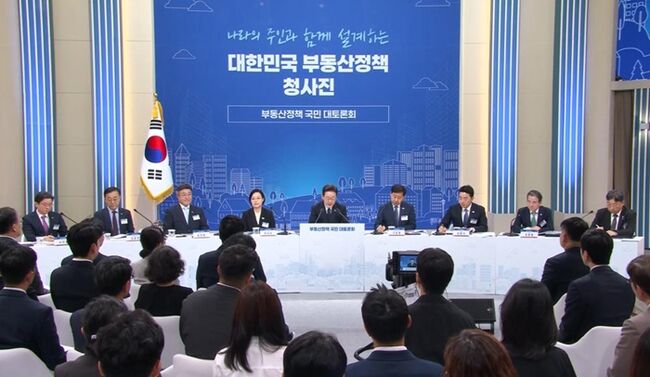 [Liberal Democratic Party Statement] Calling it a Grand Real Estate Debate… It Was Nothing More Than a Private Party Among Themselves
The 'National Grand Debate on Real Estate Policy' held on July 23rd and 27th. [Photo=Yonhap News]The 'National Grand Debate on Real Estate Policy,' hosted by the Lee Jae-myung administration under the
[Liberal Democratic Party Statement] Calling it a Grand Real Estate Debate… It Was Nothing More Than a Private Party Among Themselves
The 'National Grand Debate on Real Estate Policy' held on July 23rd and 27th. [Photo=Yonhap News]The 'National Grand Debate on Real Estate Policy,' hosted by the Lee Jae-myung administration under the
 [Photo] Evidence of Election Fraud Flooding U.S. Media… Trump Had 2.7 Million Votes Stolen
 [Video] U.S. Semiquincentennial Air Show... 'Art in the Sky' streaks across New York
 [Editorial Cartoon] A Draconian Law That Undermines Freedom of Expression

 List
List