2026년 1월 다보스 포럼을 전후로 불거진 도널드 트럼프 대통령의 이른바 ‘그린란드 구상’은 짧은 기간 국제정치의 핵심 쟁점으로 부상했다가 빠르게 수면 아래로 가라앉았다. 결과적으로 이 구상은 정책으로 구체화되지 못했고, 트럼프 대통령 본인도 “군사적 수단은 고려하지 않는다”는 입장을 밝히며 한발 물러섰다. 그러나 이 사안은 단순한 해프닝으로 치부할 것이 아니다. 미국의 동맹 인식과 향후 전략 구상을 엿볼 수 있는 단서를 남겼기 때문이다.
 NATO Secretary General Mark Rutte (right) pushed back on the idea of European strategic autonomy on the 26th (local time), stating, "Europe cannot defend itself without the United States." [Photo=EPA-Yonhap News]
The so-called "Greenland Initiative" from President Donald Trump, which emerged around the Davos Forum in January 2026, quickly rose to become a key issue in international politics before just as rapidly fading into the background. Ultimately, the initiative failed to materialize into concrete policy, and President Trump himself took a step back, stating that he was "not considering military means." However, this matter should not be dismissed as a mere incident, as it left clues offering insight into the United States' perception of its alliances and its future strategic framework.
Greenland… A Key Hub for Arctic Defense
The starting point of the discussions surrounding the Greenland issue is not entirely clear. President Trump had already publicly mentioned the possibility of purchasing Greenland during his first term in 2019, an idea the Danish government dismissed at the time. The resurfacing of this issue in early 2026 is better interpreted not as a spontaneous remark, but as being tied to long-term military and geopolitical strategies that presume potential questions about the sustainability of the North Atlantic Treaty Organization (NATO) system.
During the Cold War, Greenland was a critical hub for Arctic defense. At the height of the Cold War, the U.S. military operated over 100 military and supply facilities across Greenland, and it still operates about 30 today. Under the NATO system, U.S. military bases can be expanded if necessary, subject to agreements with Denmark.
Viewed from this perspective, there is limited practical benefit or reason for the U.S. to necessarily incorporate Greenland as "U.S. territory" for military necessity within the current alliance structure.
Therefore, some analysts suggest that President Trump's interest in Greenland was closer to a scenario assuming a "post-NATO" world than the current NATO framework. If NATO were to dissolve or become overly conciliatory toward China, U.S. forces stationed on the territory of alliance members could face pressure to withdraw.
However, the idea that incorporating Greenland into U.S. territory would allow for the maintenance of an Arctic defense hub regardless of the security structure and political landscape of Europe aligns to some extent with President Trump's worldview. Reports suggesting that President Trump brought up the ownership of the land at the U.S. military base in Pyeongtaek during the South Korea-U.S. summit in August 2025 can also be interpreted within this context.
Limitations of U.S. Defense Capabilities… Another Backdrop to the Greenland Discussion
Changes in the military technological environment are also an indispensable element in this discussion.
For a long time, the U.S. has maintained the perception that its homeland could be defended through its Missile Defense (MD) system.
However, it has yet to reach a level capable of fully defending against Russia’s hypersonic missiles reaching Mach 5–20, such as Zircon, Avangard, Kinzhal, Oreshnik, and the Sarmat ICBM, as well as China’s DF-17, 27, 31, and 41 series. U.S. defensive capabilities remain significantly dependent on future technological development.
To overcome these limitations, the U.S. is pushing for next-generation defense technologies and the expansion of its defense network. This includes high-performance radars from Raytheon, space-based sensors, and a space-based defense initiative often referred to as the "Golden Dome."
Yet, these systems remain in the development stage, and due to technical, financial, and political constraints, full operational deployment and the construction of a comprehensive defense network are expected to take considerable time. Because of these limitations, a defense initiative centered on Greenland is also unlikely to transcend symbolic significance.
In this process, President Trump’s perception of Europe is also receiving renewed attention. He has repeatedly criticized Europe for being a "security freeloader," arguing that the U.S. bears an excessive burden. The fact that he has applied the same logic to South Korea, pressuring for an increase in defense cost-sharing, confirms the consistency of his view on alliances.
Assessing Economic Realities of Rare Earths and Defense Cost Negotiations… The Background of the ‘Greenland Initiative’
Rare earths were also discussed, but this aspect is often exaggerated or misunderstood. It is known that Greenland holds a variety of mineral resources, including rare earths. However, the problem is that mining costs in Greenland, a permafrost region, are 4 to 6 times higher than in China. Furthermore, since China controls 85–90% of the global rare earth refining and processing market, it is realistically difficult to secure economic viability in the short term.
Around the Davos Forum in January, President Trump pressured NATO and the European Union (EU) by emphasizing the military and geopolitical value of Greenland. However, due to the immediate backlash from Denmark and the EU, warnings of impeachment from within the Republican Party, and the limitations regarding military and economic benefits, he has stepped back, stating that he is "not considering military means."
Consequently, the remarks regarding the incorporation of Greenland are interpreted less as a feasible policy and more as a negotiation tactic intended to demand that NATO and other allies take on a larger share of the security burden and expand their roles. In the same vein, it is reasonable to view the comments about the incorporation of the Pyeongtaek base into U.S. territory as an extension of Trump-style transactional diplomacy aimed at demanding greater defense cost-sharing from South Korea.
Editorial Department of Han-Mi-Il Ilbo

 [Statement by the Seo-beo-kka Korea Military Academy Save-the-Nation Comrades Association] ㉛ Recount the Votes Publicly, as the Previous Recount Concealed Election Fraud
Tongyeong Mayoral Election Recount [Photo=Yonhap News]South Korea's liberal democracy is dying. The National Election Commission (NEC) and the judiciary, which have plummeted into criminal syndicates
[Statement by the Seo-beo-kka Korea Military Academy Save-the-Nation Comrades Association] ㉛ Recount the Votes Publicly, as the Previous Recount Concealed Election Fraud
Tongyeong Mayoral Election Recount [Photo=Yonhap News]South Korea's liberal democracy is dying. The National Election Commission (NEC) and the judiciary, which have plummeted into criminal syndicates
 What is the significance of the "Trump 2028" red hats that keep making a comeback?
It is noteworthy that President Donald Trump is "intentionally" fueling controversy over whether he can actually run in the 2028 presidential election, even though it is "highly likely he is seriously
What is the significance of the "Trump 2028" red hats that keep making a comeback?
It is noteworthy that President Donald Trump is "intentionally" fueling controversy over whether he can actually run in the 2028 presidential election, even though it is "highly likely he is seriously
 Jin Cummings: "North Korea says it will increase the number of spies, so what is the government doing?"
U.S. political columnist Gene Cummings has publicly questioned the South Korean government, asking, "North Korea is announcing plans to increase its number of spies, yet what is the South Korean
Jin Cummings: "North Korea says it will increase the number of spies, so what is the government doing?"
U.S. political columnist Gene Cummings has publicly questioned the South Korean government, asking, "North Korea is announcing plans to increase its number of spies, yet what is the South Korean
 Attorney Do Tae-woo: “Discrepancies in Voter Count and Improper Sealing Confirmed in Tongyeong Mayoral Recount… Official Request for Further Verification Filed with Gyeongnam Election Commission”
A bundle of out-of-district early voting ballots photographed by attorney Do Tae-woo at the Tongyeong mayoral election recount site. A clear, solid line visible on the side of the ballots raises suspi
Attorney Do Tae-woo: “Discrepancies in Voter Count and Improper Sealing Confirmed in Tongyeong Mayoral Recount… Official Request for Further Verification Filed with Gyeongnam Election Commission”
A bundle of out-of-district early voting ballots photographed by attorney Do Tae-woo at the Tongyeong mayoral election recount site. A clear, solid line visible on the side of the ballots raises suspi
 Stock Market Crash 'Black Tuesday'… KOSPI down 10.8%, KOSDAQ down 7.7%
The KOSPI fell by more than 5% in early trading on the 28th, triggering a sell-side sidecar.On the 28th, the KOSPI plunged by more than 10%.Due to the sharp decline, a sell-side sidecar—a temporary
Stock Market Crash 'Black Tuesday'… KOSPI down 10.8%, KOSDAQ down 7.7%
The KOSPI fell by more than 5% in early trading on the 28th, triggering a sell-side sidecar.On the 28th, the KOSPI plunged by more than 10%.Due to the sharp decline, a sell-side sidecar—a temporary
 [World Heritage Committee] 25 New World Heritage Sites Inscribed in Busan… South Korea Successfully Expands 'Getbol' Listing
The Chairperson of the World Heritage Committee speaks at the plenary session of the 48th session of the World Heritage Committee, held at BEXCO in Busan on the 20th. [Photo: Yonhap News]A total of 25
[World Heritage Committee] 25 New World Heritage Sites Inscribed in Busan… South Korea Successfully Expands 'Getbol' Listing
The Chairperson of the World Heritage Committee speaks at the plenary session of the 48th session of the World Heritage Committee, held at BEXCO in Busan on the 20th. [Photo: Yonhap News]A total of 25
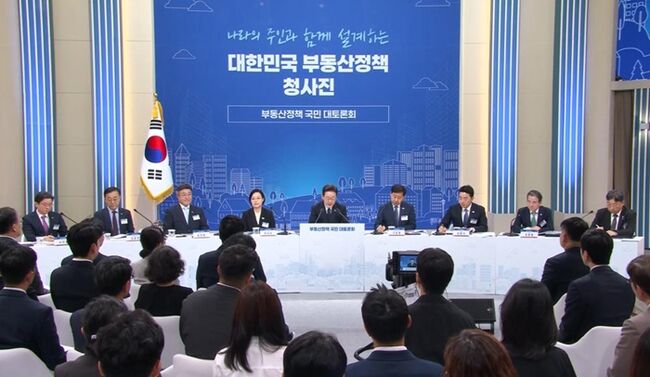 [Liberal Democratic Party Statement] Calling it a Grand Real Estate Debate… It Was Nothing More Than a Private Party Among Themselves
The 'National Grand Debate on Real Estate Policy' held on July 23rd and 27th. [Photo=Yonhap News]The 'National Grand Debate on Real Estate Policy,' hosted by the Lee Jae-myung administration under the
[Liberal Democratic Party Statement] Calling it a Grand Real Estate Debate… It Was Nothing More Than a Private Party Among Themselves
The 'National Grand Debate on Real Estate Policy' held on July 23rd and 27th. [Photo=Yonhap News]The 'National Grand Debate on Real Estate Policy,' hosted by the Lee Jae-myung administration under the
 [Photo] Evidence of Election Fraud Flooding U.S. Media… Trump Had 2.7 Million Votes Stolen
 [Video] U.S. Semiquincentennial Air Show... 'Art in the Sky' streaks across New York
 [Editorial Cartoon] A Draconian Law That Undermines Freedom of Expression

 List
List