대만을 둘러싼 동아시아 안보 환경이 다시 요동치고 있다. 다카이치 사나에 일본 총리가 대만 유사시 미·일 공동 행동 가능성을 언급하며 중국의 강한 반발을 불러온 가운데, 대만이 미국산 무기 도입 지연 문제로 한국산 무기 체계에 관심을 보이고 있다는 사실이 구체적으로 드러나면서 역내 안보 셈법이 한층 복잡해지고 있다는 분석이 나온다.
 Amid China's ongoing military pressure on Taiwan, Taiwan's Ministry of National Defense (pictured) recently established a Joint Firepower Coordination Center in the Boai Unit in the Dazhi area of northern Taipei. This center will be responsible for coordinating the deployment of firepower across the military at the highest level, according to Taiwanese media reports, including the United Daily News, on the 26th. [Photo=Yonhap News]
The East Asian security environment surrounding Taiwan is once again in flux.
As Japanese Prime Minister Sanae Takaichi's remarks on potential joint US-Japan action in the event of a Taiwan contingency have drawn strong condemnation from China, analyses suggest that the regional security calculus is becoming increasingly complex with the revelation that Taiwan is showing interest in South Korean weapon systems due to delays in acquiring US-made weapons.
Takaichi: "Joint Action with the US in Case of Taiwan Contingency"
In a TV appearance on the 26th, Prime Minister Takaichi stated that in the event of a Taiwan contingency, Japanese and American citizens residing there must be rescued, and depending on the situation, joint action with the United States could be taken.
She added, "If the US military is attacked and Japan does nothing, the US-Japan alliance could crumble."
While Takaichi clarified that her remarks were not a premise for military intervention, the possibility of provoking China, which is sensitive to the Taiwan issue, remains.
Last November, she commented in the Diet that a Taiwan contingency could constitute a "crisis of existence" situation where collective self-defense rights could be exercised, which led to strong backlash from China. Subsequently, China announced export controls on certain goods, including rare earths, further chilling Sino-Japanese relations.
Amidst this tense situation, signs of change are also emerging in Taiwan's arms procurement strategy. Taiwan has traditionally relied heavily on US-made weapons, but concerns about defense capability gaps are growing due to successive delays in the delivery of major weapon systems.
The 66 F-16V Block 70/72 fighter jets that Taiwan requested to purchase from the US were initially scheduled for delivery between 2024-26, but due to production delays, there are concerns that some aircraft may be delivered after 2026.
The AGM-154C precision-guided gliding bomb, which will be equipped on these fighter jets, is also being discussed for delivery between 2027-28, several years later than originally planned.
The situation is similar for naval assets. The delivery of 24 MK-48 heavy torpedoes and training torpedoes that Taiwan sought to acquire is likely to be delayed until after 2026-28 due to supply chain issues. Furthermore, the delivery of over 60 US-made M109 self-propelled howitzers, requested to strengthen ground forces, has been postponed to after 2026 due to production bottlenecks.
As the deployment of these core assets is being delayed, there are reports of growing internal demand in Taiwan for "forces that can be immediately utilized in case of an emergency."
Taiwan Considers K-Weapon Systems Amid US Arms Delivery Delays
In this context, Taiwan has been considering South Korean weapon systems as an alternative.
According to reports in early January, Taiwan was reportedly considering acquiring approximately 40 K9 self-propelled howitzers, about 100 K2 Black Panther tanks, and around 20 K239 Chunmoo multiple rocket launchers as options to rapidly bolster its forces amidst escalating Chinese military pressure.
The Chunmoo multiple rocket launcher, in particular, garnered attention as a means to suppress landing forces at long range, given the geographical characteristics of the Taiwan Strait.
Analyses suggest that Taiwan's focus on South Korean weapons stems from issues such as the political approval process for US-made weapons, uncertainty in delivery timelines, and high cost burdens.
In contrast, South Korean weapons are considered relatively cost-competitive, have established reliability through combat experience and export cases, and can be deployed relatively quickly.
However, the prevailing view is that the likelihood of this interest translating into actual contracts is limited. The South Korean government and the Defense Acquisition Program Administration are handling the issue of arms exports to Taiwan with great caution.
This is because selling weapons to Taiwan could invite backlash and economic pressure from China, and there is also a risk of technology leakage by Taiwanese military officials to China, as well as indirect impacts on the security environment of the Korean Peninsula that must be considered.
Indeed, the proposed South Korean arms procurements mentioned in the reports remained at the discussion stage and did not lead to official contracts.
Experts analyze that while the Japanese Prime Minister's remarks, US arms delivery delays, and Taiwan's moves to diversify arms procurement may seem like independent issues, they are in fact closely linked within the broader framework of US-China strategic competition.
As tensions around the Taiwan Strait escalate, neighboring countries' statements and arms deal discussions are not merely diplomatic rhetoric but matters that will inevitably have a long-term impact on the overall security environment of the Korean Peninsula.
As tensions surrounding the Taiwan Strait increase, each country's calculations become more complex.
Hanmiilbo Editorial Department

 [Statement by the Seo-beo-kka Korea Military Academy Save-the-Nation Comrades Association] ㉛ Recount the Votes Publicly, as the Previous Recount Concealed Election Fraud
Tongyeong Mayoral Election Recount [Photo=Yonhap News]South Korea's liberal democracy is dying. The National Election Commission (NEC) and the judiciary, which have plummeted into criminal syndicates
[Statement by the Seo-beo-kka Korea Military Academy Save-the-Nation Comrades Association] ㉛ Recount the Votes Publicly, as the Previous Recount Concealed Election Fraud
Tongyeong Mayoral Election Recount [Photo=Yonhap News]South Korea's liberal democracy is dying. The National Election Commission (NEC) and the judiciary, which have plummeted into criminal syndicates
 What is the significance of the "Trump 2028" red hats that keep making a comeback?
It is noteworthy that President Donald Trump is "intentionally" fueling controversy over whether he can actually run in the 2028 presidential election, even though it is "highly likely he is seriously
What is the significance of the "Trump 2028" red hats that keep making a comeback?
It is noteworthy that President Donald Trump is "intentionally" fueling controversy over whether he can actually run in the 2028 presidential election, even though it is "highly likely he is seriously
 Jin Cummings: "North Korea says it will increase the number of spies, so what is the government doing?"
U.S. political columnist Gene Cummings has publicly questioned the South Korean government, asking, "North Korea is announcing plans to increase its number of spies, yet what is the South Korean
Jin Cummings: "North Korea says it will increase the number of spies, so what is the government doing?"
U.S. political columnist Gene Cummings has publicly questioned the South Korean government, asking, "North Korea is announcing plans to increase its number of spies, yet what is the South Korean
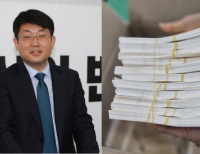
 Attorney Do Tae-woo: “Discrepancies in Voter Count and Improper Sealing Confirmed in Tongyeong Mayoral Recount… Official Request for Additional Verification Submitted to Gyeongnam Election Commission”
A bundle of mail-in early voting ballots captured by lawyer Do Tae-woo at the Tongyeong mayoral election recount site. A clear solid line, raising suspicions of election fraud, is visible on the side
Attorney Do Tae-woo: “Discrepancies in Voter Count and Improper Sealing Confirmed in Tongyeong Mayoral Recount… Official Request for Additional Verification Submitted to Gyeongnam Election Commission”
A bundle of mail-in early voting ballots captured by lawyer Do Tae-woo at the Tongyeong mayoral election recount site. A clear solid line, raising suspicions of election fraud, is visible on the side
 Stock Market Crash 'Black Tuesday'… KOSPI down 10.8%, KOSDAQ down 7.7%
The KOSPI fell by more than 5% in early trading on the 28th, triggering a sell-side sidecar.On the 28th, the KOSPI plunged by more than 10%.Due to the sharp decline, a sell-side sidecar—a temporary
Stock Market Crash 'Black Tuesday'… KOSPI down 10.8%, KOSDAQ down 7.7%
The KOSPI fell by more than 5% in early trading on the 28th, triggering a sell-side sidecar.On the 28th, the KOSPI plunged by more than 10%.Due to the sharp decline, a sell-side sidecar—a temporary
 [World Heritage Committee] 25 New World Heritage Sites Inscribed in Busan… South Korea Successfully Expands 'Getbol' Listing
The Chairperson of the World Heritage Committee speaks at the plenary session of the 48th session of the World Heritage Committee, held at BEXCO in Busan on the 20th. [Photo: Yonhap News]A total of 25
[World Heritage Committee] 25 New World Heritage Sites Inscribed in Busan… South Korea Successfully Expands 'Getbol' Listing
The Chairperson of the World Heritage Committee speaks at the plenary session of the 48th session of the World Heritage Committee, held at BEXCO in Busan on the 20th. [Photo: Yonhap News]A total of 25
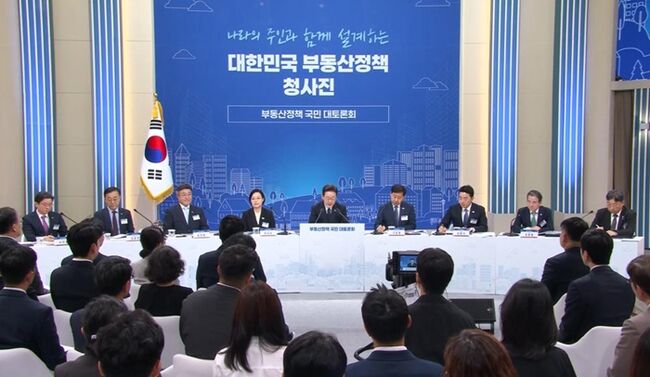 [Liberal Democratic Party Statement] Calling it a Grand Real Estate Debate… It Was Nothing More Than a Private Party Among Themselves
The 'National Grand Debate on Real Estate Policy' held on July 23rd and 27th. [Photo=Yonhap News]The 'National Grand Debate on Real Estate Policy,' hosted by the Lee Jae-myung administration under the
[Liberal Democratic Party Statement] Calling it a Grand Real Estate Debate… It Was Nothing More Than a Private Party Among Themselves
The 'National Grand Debate on Real Estate Policy' held on July 23rd and 27th. [Photo=Yonhap News]The 'National Grand Debate on Real Estate Policy,' hosted by the Lee Jae-myung administration under the
 [Photo] Evidence of Election Fraud Flooding U.S. Media… Trump Had 2.7 Million Votes Stolen
 [Video] U.S. Semiquincentennial Air Show... 'Art in the Sky' streaks across New York
 [Editorial Cartoon] A Draconian Law That Undermines Freedom of Expression

 List
List