Chinese oil tanker [Xinhua/Yonhap News]
A U.S. think tank has warned that if the United States does not move to weaken China's strategic oil reserves and long-range precision weapon capabilities, it will not only be unable to prevent a Chinese attack on Taiwan in the event of a U.S.-China conflict but could also see Japan fall.
According to the Hong Kong-based South China Morning Post (SCMP), the Heritage Foundation, a prominent conservative think tank in the United States, recently released a report analyzing the fuel and ammunition vulnerabilities of both countries based on scenarios of a 365-day conflict between the U.S. and China in the Western Pacific.
The foundation viewed the U.S. as facing significant risks in terms of "combat sustainability," which could lead to a swift defeat in a conflict with China, SCMP reported.
"If we do not move now to weaken China’s strategic oil reserves and long-range precision strike capabilities and prioritize disrupting them in the initial stages of an attack, we will not be able to prevent a Taiwan invasion or the fall of other countries within the First Island Chain, including Japan," the report warned.
It further assessed, "If we do not fundamentally expand the production of long-range precision weapons for the U.S. and its allies, we will be unable to project and sustain military power in the Indo-Pacific."
The First Island Chain is a line connecting Okinawa, Japan, Taiwan, and the Philippines. South Korea is located inside this chain but was not separately mentioned in the relevant paragraph.
The report pointed out that the U.S. tanker fleet is aging and insufficient for at-sea refueling, and strategic maritime transport originating from the U.S. West Coast is too slow and vulnerable.
It also stated that the U.S. is excessively reliant on fuel and ammunition resupply for a few 'mega hubs,' including Guam, and these areas are certain to become targets in a conflict. Bottlenecks due to centralization were also cited as a problem.
The content also included that the inventory levels of U.S. military weapons, such as long-range precision-guided missiles and torpedoes, are a more urgent issue, and they are certain to be insufficient in a high-intensity conflict.
The report projected that during the first year of a conflict, U.S. defense industry bases would be unable to produce major weapons at the speed required during wartime, nor would they be able to rapidly increase production capacity.
Regarding South Korea, the report mentioned that as of 2024, 71% of the U.S.'s jet fuel imports were from South Korea, and there is a high dependence on advanced semiconductors.
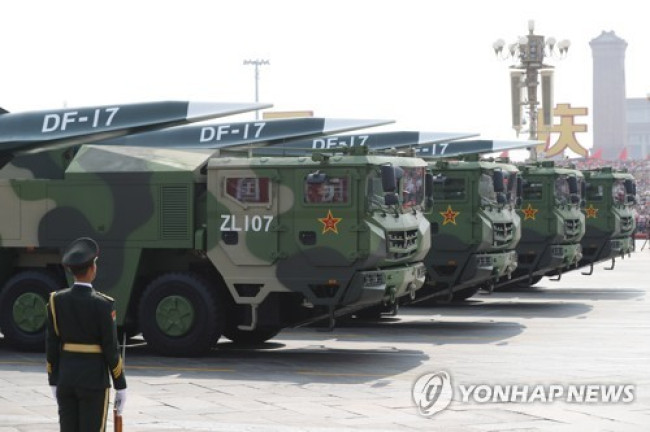 China's Dongfeng (DF)-17 missile [EPA/Yonhap News]
Meanwhile, the report also pointed out vulnerabilities in China's fuel and ammunition systems.
In China's case, there is a high dependence on the Strait of Malacca for crude oil imports. Approximately 70% of China's total domestic supply is imported, and 80% of this passes through the Strait of Malacca.
Therefore, it advised that simply blocking or disrupting the Strait of Malacca could severely damage China's crude oil imports and rapidly deplete its strategic reserves.
Furthermore, it assessed that China's military weapon production and stockpiling are vulnerable to precise U.S. strikes as they occur in fixed locations. China's digital supply management system could be a target for U.S. cyberattacks.
The report emphasized that the top priority should be to exploit China's vulnerabilities and systematically disrupt its infrastructure and key resources.
For example, it suggested that in the event of a conflict, the U.S. could have a secret agreement with allied suppliers to completely cut off China's oil and natural gas imports.
Other measures mentioned included leveraging the dollar's dominance to target China's coercive foreign policy and strengthening export controls to China on key raw materials.
It then recommended that the U.S. should increase its strategic oil reserves while also increasing its stockpile of strategic weapons to a level sufficient to win even in a simultaneous conflict with Russia and China.
Additionally, while this study assumes a one-year conflict, it suggested that the U.S. should prepare for a longer war, citing the example of Japan during World War II. It noted that the scale of the Chinese military's readiness appears to be more than just for a Taiwan invasion.
The title of the report is 'Tidal Wave.' During World War II, in 1943, the U.S. military carried out Operation Tidal Wave, bombing German oil refineries in Romania, which hastened the end of the war.
This study used artificial intelligence (AI) to simulate scenarios based on over 7,000 data sources and concluded that even if a U.S.-China conflict were to occur in the Taiwan Strait, it would not be limited to that location.

 [Statement by the Seo-beo-kka Korea Military Academy Save-the-Nation Comrades Association] ㉛ Recount the Votes Publicly, as the Previous Recount Concealed Election Fraud
Tongyeong Mayoral Election Recount [Photo=Yonhap News]South Korea's liberal democracy is dying. The National Election Commission (NEC) and the judiciary, which have plummeted into criminal syndicates
[Statement by the Seo-beo-kka Korea Military Academy Save-the-Nation Comrades Association] ㉛ Recount the Votes Publicly, as the Previous Recount Concealed Election Fraud
Tongyeong Mayoral Election Recount [Photo=Yonhap News]South Korea's liberal democracy is dying. The National Election Commission (NEC) and the judiciary, which have plummeted into criminal syndicates
 What is the significance of the "Trump 2028" red hats that keep making a comeback?
It is noteworthy that President Donald Trump is "intentionally" fueling controversy over whether he can actually run in the 2028 presidential election, even though it is "highly likely he is seriously
What is the significance of the "Trump 2028" red hats that keep making a comeback?
It is noteworthy that President Donald Trump is "intentionally" fueling controversy over whether he can actually run in the 2028 presidential election, even though it is "highly likely he is seriously
 Jin Cummings: "North Korea says it will increase the number of spies, so what is the government doing?"
U.S. political columnist Gene Cummings has publicly questioned the South Korean government, asking, "North Korea is announcing plans to increase its number of spies, yet what is the South Korean
Jin Cummings: "North Korea says it will increase the number of spies, so what is the government doing?"
U.S. political columnist Gene Cummings has publicly questioned the South Korean government, asking, "North Korea is announcing plans to increase its number of spies, yet what is the South Korean
 Attorney Do Tae-woo: “Discrepancies in Voter Count and Improper Sealing Confirmed in Tongyeong Mayoral Recount… Official Request for Additional Verification Submitted to Gyeongnam Election Commission”
A bundle of mail-in early voting ballots captured by lawyer Do Tae-woo at the Tongyeong mayoral election recount site. A clear solid line, raising suspicions of election fraud, is visible on the side
Attorney Do Tae-woo: “Discrepancies in Voter Count and Improper Sealing Confirmed in Tongyeong Mayoral Recount… Official Request for Additional Verification Submitted to Gyeongnam Election Commission”
A bundle of mail-in early voting ballots captured by lawyer Do Tae-woo at the Tongyeong mayoral election recount site. A clear solid line, raising suspicions of election fraud, is visible on the side
 Stock Market Crash 'Black Tuesday'… KOSPI down 10.8%, KOSDAQ down 7.7%
The KOSPI fell by more than 5% in early trading on the 28th, triggering a sell-side sidecar.On the 28th, the KOSPI plunged by more than 10%.Due to the sharp decline, a sell-side sidecar—a temporary
Stock Market Crash 'Black Tuesday'… KOSPI down 10.8%, KOSDAQ down 7.7%
The KOSPI fell by more than 5% in early trading on the 28th, triggering a sell-side sidecar.On the 28th, the KOSPI plunged by more than 10%.Due to the sharp decline, a sell-side sidecar—a temporary
 [World Heritage Committee] 25 New World Heritage Sites Inscribed in Busan… South Korea Successfully Expands 'Getbol' Listing
The Chairperson of the World Heritage Committee speaks at the plenary session of the 48th session of the World Heritage Committee, held at BEXCO in Busan on the 20th. [Photo: Yonhap News]A total of 25
[World Heritage Committee] 25 New World Heritage Sites Inscribed in Busan… South Korea Successfully Expands 'Getbol' Listing
The Chairperson of the World Heritage Committee speaks at the plenary session of the 48th session of the World Heritage Committee, held at BEXCO in Busan on the 20th. [Photo: Yonhap News]A total of 25
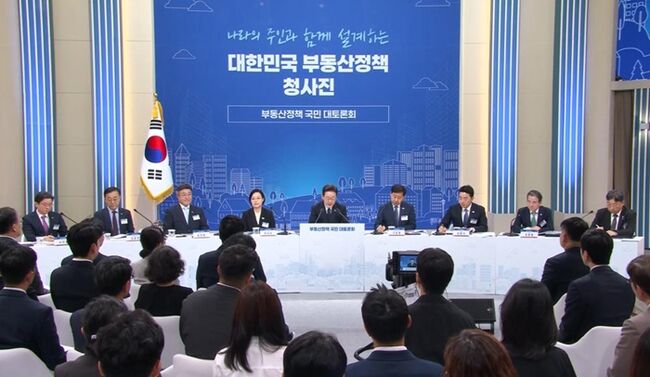 [Liberal Democratic Party Statement] Calling it a Grand Real Estate Debate… It Was Nothing More Than a Private Party Among Themselves
The 'National Grand Debate on Real Estate Policy' held on July 23rd and 27th. [Photo=Yonhap News]The 'National Grand Debate on Real Estate Policy,' hosted by the Lee Jae-myung administration under the
[Liberal Democratic Party Statement] Calling it a Grand Real Estate Debate… It Was Nothing More Than a Private Party Among Themselves
The 'National Grand Debate on Real Estate Policy' held on July 23rd and 27th. [Photo=Yonhap News]The 'National Grand Debate on Real Estate Policy,' hosted by the Lee Jae-myung administration under the
 [Photo] Evidence of Election Fraud Flooding U.S. Media… Trump Had 2.7 Million Votes Stolen
 [Video] U.S. Semiquincentennial Air Show... 'Art in the Sky' streaks across New York
 [Editorial Cartoon] A Draconian Law That Undermines Freedom of Expression

 List
List