There is no need to downplay the significance of the Texas special election. However, to conclude that "public sentiment in the U.S. has drastically changed" or "the erosion of grassroots support has become visible just one year into Trump's presidency" is premature, distorting, and akin to incitement. [Photo=White House]
Taylor LeMaster, a Democrat, secured a victory by a significant margin over Republican candidate Lee Williams in the runoff election for the Texas State Senate in Tarrant County on the 31st of last month (local time).
Following this special election result, both Korean and American legacy media outlets simultaneously reported interpretations such as "a crushing defeat in a Republican stronghold" and "the erosion of grassroots support for President Trump has become visible."
Furthermore, based solely on the fact that a Democratic candidate won the special election for the Texas State Senate, they hastily concluded that "public sentiment in the U.S. is changing significantly, and the reason is that Latinos and Hispanics have turned away from the Republican Party due to Trump's immigration crackdowns through ICE."
Low Interest in Special Elections Leads to Low Voter Turnout
Special elections typically have low interest and voter turnout. Interpreting their results immediately as a barometer of national public sentiment deviates from the fundamentals of political analysis.
Despite this, major domestic media outlets, including JoongAng Ilbo, Yonhap News, and Kyunghyang Shinmun, as well as major American broadcasters, repeatedly used expressions such as "the erosion of public sentiment against President Trump has been revealed even in the heart of the Republican Party."
The district in question was won by President Trump by a margin of about 17 percentage points in the 2024 presidential election. Seen in isolation, the statement "votes have been completely reversed in just 1 year and 3 months" might seem plausible.
However, this election went to a runoff because no candidate secured a majority in the first round of voting.
In the first round, the Democratic candidate received 47.57% of the vote, while two Republican candidates received 35.94% and 16.49% respectively. The combined vote share of the two Republican candidates exceeded 52%. If it had been a single-candidate race, it is highly probable that the Republican would have won.
The core of the change seen in the runoff election is not "vote shifting" but "voter abstention."
In the first round of voting in November 2024, approximately 118,000 voters participated, but this decreased to about 94,000 in the runoff. This means about 24,000 fewer people went to the polls.
The Democratic candidate's vote share decreased slightly from about 56,000 votes in the first round to about 54,000 in the runoff, a decrease of only about 2,000 votes.
Conversely, a significant portion of the votes that went to the two Republican candidates in the first round did not translate into votes in the runoff. Consequently, approximately 20,000 Republican-leaning voters abstained from voting, resulting in a victory margin of 14-15 percentage points that appeared to be a "landslide."
Can we truly say that "public sentiment has shifted to the Democratic Party" based on this phenomenon?
Looking at the numbers alone, the conclusion is no. This is a result created by a decline in voter turnout, specifically an abstention from voting within a particular bloc, rather than a shift in votes.
The analysis that a combination of factors, such as the cold snap and adverse weather in the Texas region on election day, the Republican candidate's weak local ties, and the Democratic candidate's background as a former military member who presented relatively centrist policies and advocated for improved worker conditions, which could be accepted by Republican voters without objection, is more persuasive.
Despite this, legacy media outlets barely covered these contextual factors. Instead, they appended explanations such as "backlash against Trump's ICE policy" and "defection of Hispanic voters due to immigration crackdowns" to the results.
However, there is no clear evidence that Hispanic voters collectively shifted to the Democratic Party in this election. Rather, a considerable number of Republican-leaning voters abstained from voting in the runoff.
Democratic Seat Retained by Democrats
The 18th Congressional District of Texas, which held elections at the same time, is a traditional Democratic stronghold centered around Houston. This special election was held because the incumbent, Sylvester Turner (Democrat), passed away in 2024, leaving the seat vacant.
In other words, this was not an election where the Democrats took a seat from the Republicans, but an election where the Democrats retained their own seat.
The reporting on the special election for the 18th Congressional District of Texas also shows similar distortions.
When a Democratic candidate was elected, the media reported, "Democrats win again in Texas" and "Republican seats have decreased." However, this district was originally held by a Democratic congressman, and the special election was held due to his death.
In essence, it was simply a case of a Democrat returning to a Democratic seat. Both candidates who faced each other in the runoff were Democrats.
This reporting practice is not aimed at objectively conveying the results of the Texas special election but rather at constructing a narrative of "Republican crisis" and "Trump crisis."
However, looking at the political fundraising status released at the same time, the Republican National Committee raised approximately $95 million, while the Democratic National Committee's fundraising was around $14 million, and it is known to be burdened with considerable debt.
There are significant evaluations that the Democratic Party is experiencing structural difficulties in both its finances and leadership.
There is no need to downplay the significance of the Texas special election. However, to conclude that "public sentiment in the U.S. has drastically changed" or "the erosion of grassroots support has become visible just one year into Trump's presidency" is premature, distorting, and akin to incitement.
The two special elections in Texas do not prove a Republican defeat. One was a result manufactured by voter abstention, and the other was a simple succession in a district that was originally Democratic.
Despite this, legacy media outlets packaged them as a "shocking defeat" and a "major shift in public sentiment." The problem, more serious than the election results themselves, is the very practice of reporting that distorts public opinion by magnifying and reproducing isolated incidents.
Editorial Department, Hankookilbo

 [Statement by the Seo-beo-kka Korea Military Academy Save-the-Nation Comrades Association] ㉛ Recount the Votes Publicly, as the Previous Recount Concealed Election Fraud
Tongyeong Mayoral Election Recount [Photo=Yonhap News]South Korea's liberal democracy is dying. The National Election Commission (NEC) and the judiciary, which have plummeted into criminal syndicates
[Statement by the Seo-beo-kka Korea Military Academy Save-the-Nation Comrades Association] ㉛ Recount the Votes Publicly, as the Previous Recount Concealed Election Fraud
Tongyeong Mayoral Election Recount [Photo=Yonhap News]South Korea's liberal democracy is dying. The National Election Commission (NEC) and the judiciary, which have plummeted into criminal syndicates
 What is the significance of the "Trump 2028" red hats that keep making a comeback?
It is noteworthy that President Donald Trump is "intentionally" fueling controversy over whether he can actually run in the 2028 presidential election, even though it is "highly likely he is seriously
What is the significance of the "Trump 2028" red hats that keep making a comeback?
It is noteworthy that President Donald Trump is "intentionally" fueling controversy over whether he can actually run in the 2028 presidential election, even though it is "highly likely he is seriously
 Jin Cummings: "North Korea says it will increase the number of spies, so what is the government doing?"
U.S. political columnist Gene Cummings has publicly questioned the South Korean government, asking, "North Korea is announcing plans to increase its number of spies, yet what is the South Korean
Jin Cummings: "North Korea says it will increase the number of spies, so what is the government doing?"
U.S. political columnist Gene Cummings has publicly questioned the South Korean government, asking, "North Korea is announcing plans to increase its number of spies, yet what is the South Korean
 Attorney Do Tae-woo: “Discrepancies in Voter Count and Improper Sealing Confirmed in Tongyeong Mayoral Recount… Official Request for Further Verification Filed with Gyeongnam Election Commission”
A bundle of out-of-district early voting ballots photographed by attorney Do Tae-woo at the Tongyeong mayoral election recount site. A clear, solid line visible on the side of the ballots raises suspi
Attorney Do Tae-woo: “Discrepancies in Voter Count and Improper Sealing Confirmed in Tongyeong Mayoral Recount… Official Request for Further Verification Filed with Gyeongnam Election Commission”
A bundle of out-of-district early voting ballots photographed by attorney Do Tae-woo at the Tongyeong mayoral election recount site. A clear, solid line visible on the side of the ballots raises suspi
 Stock Market Crash 'Black Tuesday'… KOSPI down 10.8%, KOSDAQ down 7.7%
The KOSPI fell by more than 5% in early trading on the 28th, triggering a sell-side sidecar.On the 28th, the KOSPI plunged by more than 10%.Due to the sharp decline, a sell-side sidecar—a temporary
Stock Market Crash 'Black Tuesday'… KOSPI down 10.8%, KOSDAQ down 7.7%
The KOSPI fell by more than 5% in early trading on the 28th, triggering a sell-side sidecar.On the 28th, the KOSPI plunged by more than 10%.Due to the sharp decline, a sell-side sidecar—a temporary
 [World Heritage Committee] 25 New World Heritage Sites Inscribed in Busan… South Korea Successfully Expands 'Getbol' Listing
The Chairperson of the World Heritage Committee speaks at the plenary session of the 48th session of the World Heritage Committee, held at BEXCO in Busan on the 20th. [Photo: Yonhap News]A total of 25
[World Heritage Committee] 25 New World Heritage Sites Inscribed in Busan… South Korea Successfully Expands 'Getbol' Listing
The Chairperson of the World Heritage Committee speaks at the plenary session of the 48th session of the World Heritage Committee, held at BEXCO in Busan on the 20th. [Photo: Yonhap News]A total of 25
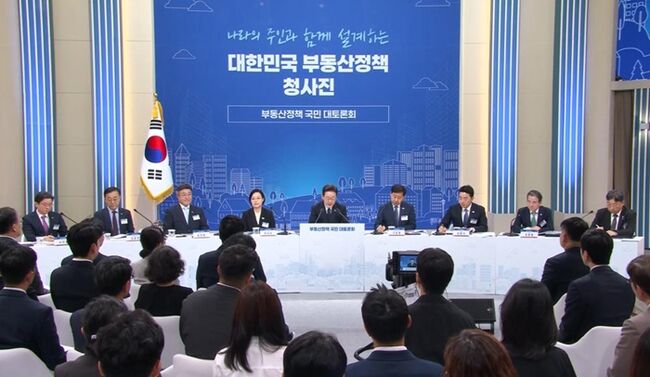 [Liberal Democratic Party Statement] Calling it a Grand Real Estate Debate… It Was Nothing More Than a Private Party Among Themselves
The 'National Grand Debate on Real Estate Policy' held on July 23rd and 27th. [Photo=Yonhap News]The 'National Grand Debate on Real Estate Policy,' hosted by the Lee Jae-myung administration under the
[Liberal Democratic Party Statement] Calling it a Grand Real Estate Debate… It Was Nothing More Than a Private Party Among Themselves
The 'National Grand Debate on Real Estate Policy' held on July 23rd and 27th. [Photo=Yonhap News]The 'National Grand Debate on Real Estate Policy,' hosted by the Lee Jae-myung administration under the
 [Photo] Evidence of Election Fraud Flooding U.S. Media… Trump Had 2.7 Million Votes Stolen
 [Video] U.S. Semiquincentennial Air Show... 'Art in the Sky' streaks across New York
 [Editorial Cartoon] A Draconian Law That Undermines Freedom of Expression

 List
List