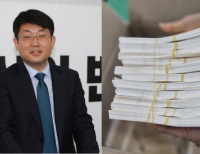
Chung Sye-kyun, leader of the Democratic Party, listens to opinions on a merger with the Cho Kuk Innovation Party after meeting with second-term lawmakers at the National Assembly Members' Office Building on February 10. [Photo=Yonhap News]
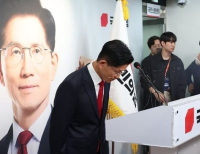
Following controversy surrounding the second special prosecutor candidate recommended by the Democratic Party, Chung Sye-kyun, leader of the Democratic Party, bowed his head in public.
The apology was framed as an acknowledgment that the vetting process was insufficient, and as a result, it placed a political burden on the President.
However, amidst mixed interpretations both inside and outside the political arena, the scene has sparked debate over whether it was a simple admission of responsibility or an unavoidable political gesture following a strong expression of dissatisfaction from the President.
The direct trigger for the apology was Lee Jae-myung's public expression of dissatisfaction with the special prosecutor candidate recommended by the Democratic Party.
The President, mentioning the political burden that arose during the special prosecutor recommendation process, essentially questioned the judgment of the party leadership, after which Representative Chung immediately issued an apology.
Instead of an explanation or political defense of the party's independent decision-making, the situation was resolved through an apology, leading to an assessment that the dynamics of the party-presidency relationship were fully revealed.
This scene is particularly noteworthy due to the conflict with the 'horizontal relationship between the party and the presidency' principle that the Democratic Party has emphasized.
The Democratic Party has repeatedly stated its stance that the President does not interfere in party affairs and that the party makes independent decisions.
However, in this case, a sequence of events unfolded where the party leader issued a public apology after the President expressed his displeasure.
Critics pointed out that this scene could not help but be interpreted as hierarchical rather than horizontal.
Reactions within the party did not subside even after the apology.
Supreme Council members not aligned with the current leadership questioned the very selection of the special prosecutor candidate recommended by the Democratic Party, attributing the responsibility to the political judgment of the Chung Sye-kyun faction leadership.
In particular, criticism was publicly raised that the decision to nominate a lawyer who was perceived as being connected to the trial of Lee Hwa-young, former Deputy Governor of Gyeonggi Province for Peace, placed a severe political burden on the President.
Some Supreme Council members went so far as to describe it as "no different from an attempt to pass the second arrest warrant motion," defining it not as a simple mistake but as a major political accident.
At the center of the controversy is Jeon Jun-cheol, whom the Democratic Party recommended as a special prosecutor candidate.
Within some factions of the party, the judgment to select Jeon Jun-cheol as a candidate is being interpreted not as a 'mistake' but as a deliberate provocation, a choice made with awareness of the political repercussions.
The argument is that by willingly embracing the context connected to the Kim Sung-tae case, which has been perceived as a symbol of the Lee Hwa-young trial phase, it ultimately resulted in shifting the burden to the President.
Consequently, questions surrounding the process of the decision and responsibility remain unresolved.
Representative Chung Sye-kyun's apology had the effect of calming the immediate controversy, but it did not resolve the issues raised regarding the party's power structure and decision-making processes.
While the Chung Sye-kyun faction insists that the situation should be settled through an apology, the Lee Jae-myung faction believes that an apology alone cannot absolve responsibility for political misjudgments.
Their argument is that an explanation of why such a choice was possible and a clarification of responsibility should come before the sincerity of the apology.
This dynamic is now extending to discussions about a merger with the Cho Kuk Innovation Party.
Some in the political sphere are interpreting that Representative Chung is shifting towards postponing the merger with the Cho Kuk Innovation Party until after the local elections.
A merger is not merely about expanding influence but is directly linked to the nomination structure for local elections. If a preemptive merger occurs, it could enable a tactical alliance between the Chung Sye-kyun and pro-Moon factions, which analysts suggest could create a structure that excludes the influence of the Lee Jae-myung faction during the local election nomination phase.
This dynamic could further amplify internal party conflicts, leading to speculation that Representative Chung is opting for management and reconciliation over expansion. However, some interpret this as a capitulation by the Chung Sye-kyun faction.
Ultimately, the debate surrounding Representative Chung Sye-kyun's apology transcends the issue of personal sincerity and boils down to the Democratic Party's decision-making structure and power distribution.
However, if the practice of the party leader apologizing after the President expresses dissatisfaction is repeated, future party decisions are likely to be based on the President's political burden rather than institutional validity.
This carries the risk of weakening the party's autonomy in critical political decisions like special prosecutor recommendations and reducing the principle of a horizontal party-presidency relationship to a mere slogan.
The sincerity of Representative Chung's apology will ultimately be judged by his subsequent actions.
Beyond the special prosecutor controversy, the true test of this situation will be how the Democratic Party makes decisions regarding the larger political agendas of mergers and nominations, and how it sets the party-presidency relationship and internal power balance in that process.

 [Statement by the Seo-beo-kka Korea Military Academy Save-the-Nation Comrades Association] ㉛ Recount the Votes Publicly, as the Previous Recount Concealed Election Fraud
Tongyeong Mayoral Election Recount [Photo=Yonhap News]South Korea's liberal democracy is dying. The National Election Commission (NEC) and the judiciary, which have plummeted into criminal syndicates
[Statement by the Seo-beo-kka Korea Military Academy Save-the-Nation Comrades Association] ㉛ Recount the Votes Publicly, as the Previous Recount Concealed Election Fraud
Tongyeong Mayoral Election Recount [Photo=Yonhap News]South Korea's liberal democracy is dying. The National Election Commission (NEC) and the judiciary, which have plummeted into criminal syndicates
 What is the significance of the "Trump 2028" red hats that keep making a comeback?
It is noteworthy that President Donald Trump is "intentionally" fueling controversy over whether he can actually run in the 2028 presidential election, even though it is "highly likely he is seriously
What is the significance of the "Trump 2028" red hats that keep making a comeback?
It is noteworthy that President Donald Trump is "intentionally" fueling controversy over whether he can actually run in the 2028 presidential election, even though it is "highly likely he is seriously
 Jin Cummings: "North Korea says it will increase the number of spies, so what is the government doing?"
U.S. political columnist Gene Cummings has publicly questioned the South Korean government, asking, "North Korea is announcing plans to increase its number of spies, yet what is the South Korean
Jin Cummings: "North Korea says it will increase the number of spies, so what is the government doing?"
U.S. political columnist Gene Cummings has publicly questioned the South Korean government, asking, "North Korea is announcing plans to increase its number of spies, yet what is the South Korean
 Attorney Do Tae-woo: “Discrepancies in Voter Count and Improper Sealing Confirmed in Tongyeong Mayoral Recount… Official Request for Further Verification Filed with Gyeongnam Election Commission”
A bundle of out-of-district early voting ballots photographed by attorney Do Tae-woo at the Tongyeong mayoral election recount site. A clear, solid line visible on the side of the ballots raises suspi
Attorney Do Tae-woo: “Discrepancies in Voter Count and Improper Sealing Confirmed in Tongyeong Mayoral Recount… Official Request for Further Verification Filed with Gyeongnam Election Commission”
A bundle of out-of-district early voting ballots photographed by attorney Do Tae-woo at the Tongyeong mayoral election recount site. A clear, solid line visible on the side of the ballots raises suspi
 Stock Market Crash 'Black Tuesday'… KOSPI down 10.8%, KOSDAQ down 7.7%
The KOSPI fell by more than 5% in early trading on the 28th, triggering a sell-side sidecar.On the 28th, the KOSPI plunged by more than 10%.Due to the sharp decline, a sell-side sidecar—a temporary
Stock Market Crash 'Black Tuesday'… KOSPI down 10.8%, KOSDAQ down 7.7%
The KOSPI fell by more than 5% in early trading on the 28th, triggering a sell-side sidecar.On the 28th, the KOSPI plunged by more than 10%.Due to the sharp decline, a sell-side sidecar—a temporary
 [World Heritage Committee] 25 New World Heritage Sites Inscribed in Busan… South Korea Successfully Expands 'Getbol' Listing
The Chairperson of the World Heritage Committee speaks at the plenary session of the 48th session of the World Heritage Committee, held at BEXCO in Busan on the 20th. [Photo: Yonhap News]A total of 25
[World Heritage Committee] 25 New World Heritage Sites Inscribed in Busan… South Korea Successfully Expands 'Getbol' Listing
The Chairperson of the World Heritage Committee speaks at the plenary session of the 48th session of the World Heritage Committee, held at BEXCO in Busan on the 20th. [Photo: Yonhap News]A total of 25
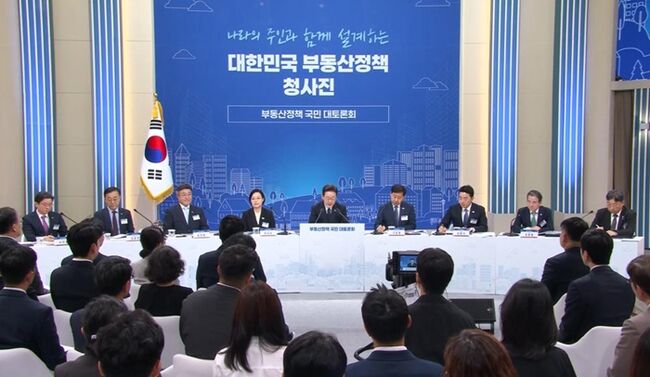 [Liberal Democratic Party Statement] Calling it a Grand Real Estate Debate… It Was Nothing More Than a Private Party Among Themselves
The 'National Grand Debate on Real Estate Policy' held on July 23rd and 27th. [Photo=Yonhap News]The 'National Grand Debate on Real Estate Policy,' hosted by the Lee Jae-myung administration under the
[Liberal Democratic Party Statement] Calling it a Grand Real Estate Debate… It Was Nothing More Than a Private Party Among Themselves
The 'National Grand Debate on Real Estate Policy' held on July 23rd and 27th. [Photo=Yonhap News]The 'National Grand Debate on Real Estate Policy,' hosted by the Lee Jae-myung administration under the
 [Photo] Evidence of Election Fraud Flooding U.S. Media… Trump Had 2.7 Million Votes Stolen
 [Video] U.S. Semiquincentennial Air Show... 'Art in the Sky' streaks across New York
 [Editorial Cartoon] A Draconian Law That Undermines Freedom of Expression

 List
List