- "War in the Indo-Pacific can only be deterred through strength."
 Herbert McMaster (left), former National Security Advisor in the first Trump administration, speaks at a roundtable discussion at the Asia Society in New York on Feb. 9 (local time). [Yonhap News]
Herbert McMaster, a senior fellow at the Hoover Institution and former National Security Advisor in the first Donald Trump administration, predicted on Feb. 9 (local time) that the United States would support Japanese Prime Minister Sanae Takaichi's bid to revise the peace constitution from the perspective of Donald Trump's "peace through strength" global security doctrine.
At a roundtable discussion hosted by the Asia Society in New York, McMaster said, "We (the U.S.) will support the Self-Defense Forces in Japan building up their defense capabilities, and if Prime Minister Takaichi goes beyond reinterpreting the constitution and attempts to revise it, we will likely support it," adding, "Because that is peace through strength."
The Liberal Democratic Party government led by Prime Minister Takaichi secured more than two-thirds of the seats on its own in the general election (House of Representatives election) held on the 8th, paving the way for constitutional revision, a long-held aspiration of the Japanese right wing.
Prime Minister Takaichi has expressed her intention to pursue constitutional revision, including enshrining the "Self-Defense Forces" in the constitution.
McMaster pointed out, "The most important thing for us right now is to ensure that we are not drawn into major work happening in the Indo-Pacific region. This can only be prevented through strength."
His argument is that potential adversaries like China must be made unable to achieve their goals through the use of force, making the costs and risks of using force unbearable.
Regarding Russia's invasion of Ukraine, McMaster also stated, "They (Russia) saw a weakness in Ukraine," pointing out that recognizing weakness leads to provocation.
Daniel Russell, former Assistant Secretary of State for East Asian and Pacific Affairs and current Vice President of the Asia Society Policy Institute, who participated in the discussion, said, "I think the term 'strategic ambiguity' is a misnomer. It means the final decision on war or peace is made by the commander-in-chief based on the circumstances at the time, not that there should be ambiguity regarding America's commitments or capabilities."
In this regard, McMaster expressed his agreement, saying, "I used to use the situation in Korea in June 1950 as an example with our counterparts on the Chinese side. That the misjudgment that the U.S. would not be willing to defend South Korea led to countless casualties in North Korea and China."
McMaster, a retired Army general, served as National Security Advisor in the early days of the first Trump administration when tensions between the U.S. and North Korea escalated over the North Korean nuclear issue. He resigned from his position after about 13 months due to conflicts with President Trump during his tenure as National Security Advisor.
What do you think of this article?

 [Statement by the Seo-beo-kka Korea Military Academy Save-the-Nation Comrades Association] ㉛ Recount the Votes Publicly, as the Previous Recount Concealed Election Fraud
Tongyeong Mayoral Election Recount [Photo=Yonhap News]South Korea's liberal democracy is dying. The National Election Commission (NEC) and the judiciary, which have plummeted into criminal syndicates
[Statement by the Seo-beo-kka Korea Military Academy Save-the-Nation Comrades Association] ㉛ Recount the Votes Publicly, as the Previous Recount Concealed Election Fraud
Tongyeong Mayoral Election Recount [Photo=Yonhap News]South Korea's liberal democracy is dying. The National Election Commission (NEC) and the judiciary, which have plummeted into criminal syndicates
 What is the significance of the "Trump 2028" red hats that keep making a comeback?
It is noteworthy that President Donald Trump is "intentionally" fueling controversy over whether he can actually run in the 2028 presidential election, even though it is "highly likely he is seriously
What is the significance of the "Trump 2028" red hats that keep making a comeback?
It is noteworthy that President Donald Trump is "intentionally" fueling controversy over whether he can actually run in the 2028 presidential election, even though it is "highly likely he is seriously
 Jin Cummings: "North Korea says it will increase the number of spies, so what is the government doing?"
U.S. political columnist Gene Cummings has publicly questioned the South Korean government, asking, "North Korea is announcing plans to increase its number of spies, yet what is the South Korean
Jin Cummings: "North Korea says it will increase the number of spies, so what is the government doing?"
U.S. political columnist Gene Cummings has publicly questioned the South Korean government, asking, "North Korea is announcing plans to increase its number of spies, yet what is the South Korean
 Attorney Do Tae-woo: “Discrepancies in Voter Count and Improper Sealing Confirmed in Tongyeong Mayoral Recount… Official Request for Further Verification Filed with Gyeongnam Election Commission”
A bundle of out-of-district early voting ballots photographed by attorney Do Tae-woo at the Tongyeong mayoral election recount site. A clear, solid line visible on the side of the ballots raises suspi
Attorney Do Tae-woo: “Discrepancies in Voter Count and Improper Sealing Confirmed in Tongyeong Mayoral Recount… Official Request for Further Verification Filed with Gyeongnam Election Commission”
A bundle of out-of-district early voting ballots photographed by attorney Do Tae-woo at the Tongyeong mayoral election recount site. A clear, solid line visible on the side of the ballots raises suspi
 Stock Market Crash 'Black Tuesday'… KOSPI down 10.8%, KOSDAQ down 7.7%
The KOSPI fell by more than 5% in early trading on the 28th, triggering a sell-side sidecar.On the 28th, the KOSPI plunged by more than 10%.Due to the sharp decline, a sell-side sidecar—a temporary
Stock Market Crash 'Black Tuesday'… KOSPI down 10.8%, KOSDAQ down 7.7%
The KOSPI fell by more than 5% in early trading on the 28th, triggering a sell-side sidecar.On the 28th, the KOSPI plunged by more than 10%.Due to the sharp decline, a sell-side sidecar—a temporary
 [World Heritage Committee] 25 New World Heritage Sites Inscribed in Busan… South Korea Successfully Expands 'Getbol' Listing
The Chairperson of the World Heritage Committee speaks at the plenary session of the 48th session of the World Heritage Committee, held at BEXCO in Busan on the 20th. [Photo: Yonhap News]A total of 25
[World Heritage Committee] 25 New World Heritage Sites Inscribed in Busan… South Korea Successfully Expands 'Getbol' Listing
The Chairperson of the World Heritage Committee speaks at the plenary session of the 48th session of the World Heritage Committee, held at BEXCO in Busan on the 20th. [Photo: Yonhap News]A total of 25
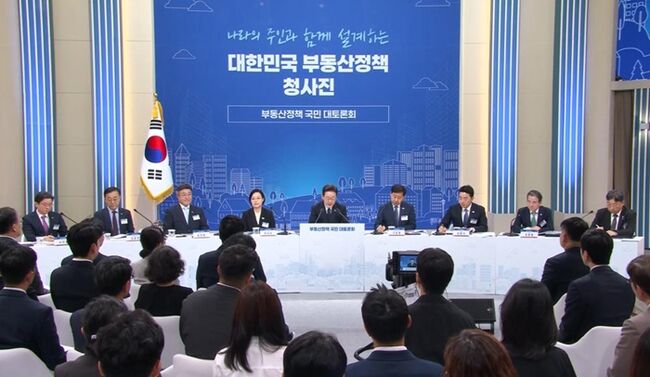 [Liberal Democratic Party Statement] Calling it a Grand Real Estate Debate… It Was Nothing More Than a Private Party Among Themselves
The 'National Grand Debate on Real Estate Policy' held on July 23rd and 27th. [Photo=Yonhap News]The 'National Grand Debate on Real Estate Policy,' hosted by the Lee Jae-myung administration under the
[Liberal Democratic Party Statement] Calling it a Grand Real Estate Debate… It Was Nothing More Than a Private Party Among Themselves
The 'National Grand Debate on Real Estate Policy' held on July 23rd and 27th. [Photo=Yonhap News]The 'National Grand Debate on Real Estate Policy,' hosted by the Lee Jae-myung administration under the
 [Photo] Evidence of Election Fraud Flooding U.S. Media… Trump Had 2.7 Million Votes Stolen
 [Video] U.S. Semiquincentennial Air Show... 'Art in the Sky' streaks across New York
 [Editorial Cartoon] A Draconian Law That Undermines Freedom of Expression

 List
List