① General Principles
② Identity Verification
③ Electronic Systems
④ Ballot Box Movement and Storage
⑤ Record Retention Authority
As Long As Electronic Systems Are Used, They Must Be Verified
The most frequently used term in election fraud controversies is "electronic manipulation." While this phrase might sound exaggerated, the core of the issue is not whether manipulation occurred, but rather the lack of external methods to confirm whether it did or did not.
Advance voting utilizes electronic systems for efficiency and speed. The entire process, from voter registration lookup, casting completion, duplicate prevention, to closing, is handled electronically. This in itself is unavoidable. The problem lies in the fact that this electronic process relies solely on the explanations provided by the managing authority.
"No problem" has been repeatedly stated, but no structure has been presented to prove that there are no problems.
The issue with using electronic systems is not "access," but "records."
Discussions surrounding electronic systems often veer towards the possibility of hacking or insider intervention. However, the core issue precedes these concerns. The critical question is whether a continuous record exists of who, when, with what authority, and what actions were taken.
Currently, the advance voting electronic system operates on the premise of internal audits and self-inspections. However, an immutable log that can be requested externally, meaning a continuous record (Chain of Custody, CoC) of the entire process of receipt, storage, and transport, is not institutionally fixed.
Consequently, while the electronic system is efficient, it simultaneously creates a structure that breeds distrust.
'Chain of Custody' is Not Just a Logistics Concept
Chain of Custody is often understood as the management of physical item movement, but its essence is different. It is a continuous record of responsibility and status. The same principle applies to financial systems, public data management, and the management of investigative evidence.
Applying CoC to an electronic system does not mean a complex undertaking.
At a minimum, the following are necessary:
• Identification of the entity accessing the system (account/privileges)
• Automatic recording of access and processing times
• Preservation of modification history for processed actions
• Generation of an immutable log that can be submitted later
These records are not linked to the voting content. They do not record who voted for whom, but only who did what to the system.
This allows for the verification of the integrity of electronic processing without infringing upon the principle of secret ballots.
The Only Way to Move Beyond "Please Trust Us"
The National Election Commission's response to electronic systems has been consistent to date.
"External manipulation is impossible," "The system is secure."
However, explanations are just explanations. The more they are repeated, the less persuasive they become.
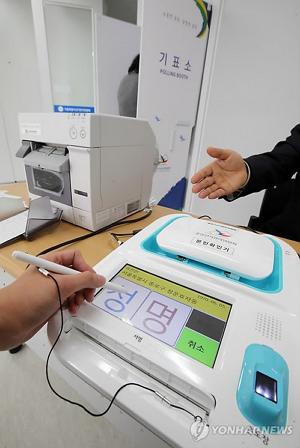 Identity verification device used by the National Election Commission. It lacks functions for verifying ID authenticity or fingerprint recognition. [Photo=Yonhap News]
Only Records Can Replace Explanations.
If electronic CoC exists, suspicions of electronic manipulation do not remain in the realm of claims or conspiracy theories. It becomes a matter of opening the records. If there are no records, the suspicions will persist.
Electronic Verification Does Not Assume Distrust of the National Election Commission.
Demanding electronic records is not out of suspicion towards the National Election Commission.
Quite the opposite. It is a safeguard to protect the National Election Commission.
In the absence of verifiable records, all responsibility falls on the party providing explanations. When records exist, responsibility is distributed across the system. This is a reasonable structure even for the managing authority.
The Choice to Use Electronic Systems Comes with Conditions.
As long as electronic systems are used in advance voting, one condition is clear.
They must be used in a verifiable manner.
Electronic systems are tools for convenience, but they are also the foundation of public trust. When that foundation is built not on explanations but on records, electronic systems will no longer be a subject of controversy.
④ Ballot Box Movement and Storage — A Matter of 'Records,' Not 'Trust'
Why do the out-of-district advance voting, post office sorting, and transportation segments remain the longest periods of absence?
This section will cover how to apply electronic seals, GPS, and chain of custody to physical routes.

 Iranian Foreign Ministry: "Continuing Message Exchanges with the U.S. and Activities of Mediating Countries"
Esmaeil Baghaei, Spokesperson for the Iranian Ministry of Foreign Affairs [Xinhua, Yonhap News file photo]Esmaeil Baghaei, spokesperson for the Iranian Ministry of Foreign Affairs, stated on the 26th
Iranian Foreign Ministry: "Continuing Message Exchanges with the U.S. and Activities of Mediating Countries"
Esmaeil Baghaei, Spokesperson for the Iranian Ministry of Foreign Affairs [Xinhua, Yonhap News file photo]Esmaeil Baghaei, spokesperson for the Iranian Ministry of Foreign Affairs, stated on the 26th
 President Yoon: "Do You Think You Are Safe from the Special Counsel?"... Final Statement Video Released
President Yoon Suk Yeol rebuking the special prosecutor on the 24th. [Court video / @birds_justice X account subtitle GIF] A video of President Yoon Suk Yeol's closing statement at his trial rega
President Yoon: "Do You Think You Are Safe from the Special Counsel?"... Final Statement Video Released
President Yoon Suk Yeol rebuking the special prosecutor on the 24th. [Court video / @birds_justice X account subtitle GIF] A video of President Yoon Suk Yeol's closing statement at his trial rega
 President Yoon, regarding the first-instance ruling on the Public Official Election Act: “An excessive political verdict that distorts the facts… We will appeal immediately.”
The first-instance sentencing hearing for President Yoon Suk Yeol regarding violations of the Public Official Election Act is being broadcast live at Seoul Station on the 27th. [Photo=Yonhap News]Pres
President Yoon, regarding the first-instance ruling on the Public Official Election Act: “An excessive political verdict that distorts the facts… We will appeal immediately.”
The first-instance sentencing hearing for President Yoon Suk Yeol regarding violations of the Public Official Election Act is being broadcast live at Seoul Station on the 27th. [Photo=Yonhap News]Pres
 WSJ: "SK Hynix ADR Premium Is a Sign of AI Trading Overheat"
Advertisement for SK Hynix ADR listing in New York's Times Square [Reuters=Yonhap News file photo]The Wall Street Journal (WSJ) has pointed out that the price of SK Hynix’s American Depositary Recei
WSJ: "SK Hynix ADR Premium Is a Sign of AI Trading Overheat"
Advertisement for SK Hynix ADR listing in New York's Times Square [Reuters=Yonhap News file photo]The Wall Street Journal (WSJ) has pointed out that the price of SK Hynix’s American Depositary Recei
 'Godfather of Japanese Mystery Novels' Keigo Higashino Passes Away After Battle with Cancer at 68
Famous Japanese mystery novelist Keigo Higashino [AFP=Yonhap News]It has been belatedly reported that Keigo Higashino, the "godfather of Japanese mystery novels" and author of bestsellers such as "The
'Godfather of Japanese Mystery Novels' Keigo Higashino Passes Away After Battle with Cancer at 68
Famous Japanese mystery novelist Keigo Higashino [AFP=Yonhap News]It has been belatedly reported that Keigo Higashino, the "godfather of Japanese mystery novels" and author of bestsellers such as "The
 [Park Pil-kyu Security Column] To the Ignorant Trying to Clothe a Beast in Sheep's Clothing
Rep. Kim Byung-joo of the Democratic Party of Korea [Photo=Yonhap News]“The Air Force Academy doesn't teach you how to fly a plane!” “The Army, Navy, and Air Force academies are exactly the
[Park Pil-kyu Security Column] To the Ignorant Trying to Clothe a Beast in Sheep's Clothing
Rep. Kim Byung-joo of the Democratic Party of Korea [Photo=Yonhap News]“The Air Force Academy doesn't teach you how to fly a plane!” “The Army, Navy, and Air Force academies are exactly the
 [Issue Diagnosis] Two Effects of the Election Petition Review
 [Photo] Evidence of Election Fraud Flooding U.S. Media… Trump Had 2.7 Million Votes Stolen
 [Video] U.S. Semiquincentennial Air Show... 'Art in the Sky' streaks across New York
 [Editorial Cartoon] A Draconian Law That Undermines Freedom of Expression

 List
List










