The first-instance verdict sentencing President Yoon Suk Yeol to life imprisonment has significantly expanded the legal framework of sedition, going beyond a simple guilty verdict.
The court focused on the "purpose of subverting the constitution" rather than whether martial law actually collapsed state functions, and deemed the deployment of troops to the National Assembly and the National Election Commission as sufficient force to pressure constitutional bodies.
This is an interpretation that prioritizes directionality over outcome, and potentiality over actualized violence.
The significance of this ruling stems precisely from this expanded criterion.
Sedition has traditionally been understood as the most serious crime that fundamentally destabilizes the state order.
However, this ruling has broadened the threshold for sedition from actual acts of destruction to the stage of purpose and potential force.
Legally, this may be a consistent interpretation.
The issue is whether this criterion is being applied equally to all branches of power.
If purpose is the criterion, then the direction of the exercise of power should be questioned not only for the executive branch but also for the legislative and judicial branches.
The National Assembly, based on its overwhelming majority, has repeatedly pursued impeachment proceedings against the executive branch. Impeachment is a power granted by the constitution.
However, the more it is repeated, the more the executive branch is placed in a state of constant political distrust, and policy implementation is delayed.
If the court recognized the mere deployment of troops as a form of force, then repeated impeachments that structurally pressure the functions of constitutional bodies should also be subject to review from the perspective of how power is exercised.
The moment an act is justified solely by the existence of authority, the balance of legal principles begins to crumble.
The debate over increasing the number of Supreme Court justices can be understood in the same context.
The situation where legislation altering the composition of the judiciary is pursued without consultation with the opposition party is not merely a matter of political speed.
Asking whether there is a tendency to exert long-term influence on the judicial structure is the minimum question to protect the constitutional order.
If "potential intent" has entered the realm of legal judgment in the determination of sedition, then legislation that reshapes the judicial structure should also be subject to the same criteria.
The debates surrounding elections reveal deep distrust in Korean society.
Regardless of the truth of allegations of election fraud, it is also true that the verification demanded by a significant portion of the public has been repeatedly excluded under political stigma.
Trust is not restored by mere declarations of "no issues." The debate only ends when a verifiable structure is created.
If the concept of force includes not only the exercise of physical power but also the structure that pressures constitutional bodies, then a political environment that institutionally blocks demands for verification should also be evaluated as a method of power exercise.
The most paradoxical scene left by this ruling is that the weight of sedition seems to have become lighter.
While the deployment of troops to the National Assembly and the National Election Commission was recognized as force, the legislative branch's repeated pressure on executive functions and attempts to alter the judicial structure based on majority rule still remain in the realm of politics.
If only sedition is expanded, without even raising the debate of abuse of power, the message felt by the public is simple: the perception that the most serious crime is being interpreted most broadly.
History shows that majority rule does not always protect democracy.
There have been instances worldwide where elected legislatures have shifted the balance of power through legitimate procedures.
There is no need to conclude that Korea is following the same path.
However, if the most stringent legal principles are applied to the executive branch solely on the basis of "potential," while only "politics" is given as an explanation for the directionality of legislative power, then the scales of the rule of law may have already begun to tilt.
If sedition is a crime of intent, then abuse of power is also a matter of intent.
If force is a structure that pressures constitutional bodies rather than the realization of physical power, then that criterion should not be limited to a specific branch of power.
If martial law became sedition, we must ask whether legislative excesses can also be exempted with the mere label of "democracy."
The rule of law does not begin with severe punishment.
It is only when we ask questions with the same criteria that balance is restored.

 [Statement by the Seo-beo-kka Korea Military Academy Save-the-Nation Comrades Association] ㉛ Recount the Votes Publicly, as the Previous Recount Concealed Election Fraud
Tongyeong Mayoral Election Recount [Photo=Yonhap News]South Korea's liberal democracy is dying. The National Election Commission (NEC) and the judiciary, which have plummeted into criminal syndicates
[Statement by the Seo-beo-kka Korea Military Academy Save-the-Nation Comrades Association] ㉛ Recount the Votes Publicly, as the Previous Recount Concealed Election Fraud
Tongyeong Mayoral Election Recount [Photo=Yonhap News]South Korea's liberal democracy is dying. The National Election Commission (NEC) and the judiciary, which have plummeted into criminal syndicates
 What is the significance of the "Trump 2028" red hats that keep making a comeback?
It is noteworthy that President Donald Trump is "intentionally" fueling controversy over whether he can actually run in the 2028 presidential election, even though it is "highly likely he is seriously
What is the significance of the "Trump 2028" red hats that keep making a comeback?
It is noteworthy that President Donald Trump is "intentionally" fueling controversy over whether he can actually run in the 2028 presidential election, even though it is "highly likely he is seriously
 Jin Cummings: "North Korea says it will increase the number of spies, so what is the government doing?"
U.S. political columnist Gene Cummings has publicly questioned the South Korean government, asking, "North Korea is announcing plans to increase its number of spies, yet what is the South Korean
Jin Cummings: "North Korea says it will increase the number of spies, so what is the government doing?"
U.S. political columnist Gene Cummings has publicly questioned the South Korean government, asking, "North Korea is announcing plans to increase its number of spies, yet what is the South Korean
 Attorney Do Tae-woo: “Discrepancies in Voter Count and Improper Sealing Confirmed in Tongyeong Mayoral Recount… Official Request for Further Verification Filed with Gyeongnam Election Commission”
A bundle of out-of-district early voting ballots photographed by attorney Do Tae-woo at the Tongyeong mayoral election recount site. A clear, solid line visible on the side of the ballots raises suspi
Attorney Do Tae-woo: “Discrepancies in Voter Count and Improper Sealing Confirmed in Tongyeong Mayoral Recount… Official Request for Further Verification Filed with Gyeongnam Election Commission”
A bundle of out-of-district early voting ballots photographed by attorney Do Tae-woo at the Tongyeong mayoral election recount site. A clear, solid line visible on the side of the ballots raises suspi
 Stock Market Crash 'Black Tuesday'… KOSPI down 10.8%, KOSDAQ down 7.7%
The KOSPI fell by more than 5% in early trading on the 28th, triggering a sell-side sidecar.On the 28th, the KOSPI plunged by more than 10%.Due to the sharp decline, a sell-side sidecar—a temporary
Stock Market Crash 'Black Tuesday'… KOSPI down 10.8%, KOSDAQ down 7.7%
The KOSPI fell by more than 5% in early trading on the 28th, triggering a sell-side sidecar.On the 28th, the KOSPI plunged by more than 10%.Due to the sharp decline, a sell-side sidecar—a temporary
 [World Heritage Committee] 25 New World Heritage Sites Inscribed in Busan… South Korea Successfully Expands 'Getbol' Listing
The Chairperson of the World Heritage Committee speaks at the plenary session of the 48th session of the World Heritage Committee, held at BEXCO in Busan on the 20th. [Photo: Yonhap News]A total of 25
[World Heritage Committee] 25 New World Heritage Sites Inscribed in Busan… South Korea Successfully Expands 'Getbol' Listing
The Chairperson of the World Heritage Committee speaks at the plenary session of the 48th session of the World Heritage Committee, held at BEXCO in Busan on the 20th. [Photo: Yonhap News]A total of 25
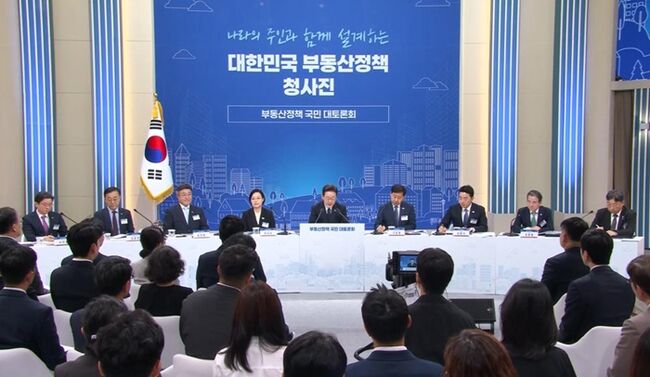 [Liberal Democratic Party Statement] Calling it a Grand Real Estate Debate… It Was Nothing More Than a Private Party Among Themselves
The 'National Grand Debate on Real Estate Policy' held on July 23rd and 27th. [Photo=Yonhap News]The 'National Grand Debate on Real Estate Policy,' hosted by the Lee Jae-myung administration under the
[Liberal Democratic Party Statement] Calling it a Grand Real Estate Debate… It Was Nothing More Than a Private Party Among Themselves
The 'National Grand Debate on Real Estate Policy' held on July 23rd and 27th. [Photo=Yonhap News]The 'National Grand Debate on Real Estate Policy,' hosted by the Lee Jae-myung administration under the
 [Photo] Evidence of Election Fraud Flooding U.S. Media… Trump Had 2.7 Million Votes Stolen
 [Video] U.S. Semiquincentennial Air Show... 'Art in the Sky' streaks across New York
 [Editorial Cartoon] A Draconian Law That Undermines Freedom of Expression

 List
List