Charles I
In her sentencing on the 19th, Judge Ji Gwi-yeon went to the lengths of summoning King Charles I of England from the Roman era to find evidence that a "president can be punished."
Placing a 21st-century president and a 17th-century monarch on the same pedestal? This is the first strategic error. Is the very act of comparing a president to a king not a pre-modern way of thinking?
Presidents are judged through elections
A king holds a lifelong position, but a president is judged by the people every five years. Since there is a definitive system of public judgment called an "election," how can the status of a president and a king be the same? A president governs, but does not reign.
On the other hand, a king reigns over his subjects, and the throne is hereditary. Once someone inherits it, they hold onto it until they die. Because it is incredibly difficult to force an incompetent leader from the throne, one often has to risk their life in a coup to replace them.
Without even going as far as Charles I, even in the Joseon Dynasty, there were examples like Gwanghaegun and Yeonsangun who were removed from power because they could not govern properly.
Of course, Judge Ji likely brought up the 17th-century English king to search for the crime of intimidating parliament. But was that even a proper parliament at the time?
Parliamentary democracy in the modern sense was born after the English Bill of Rights in 1689. Charles I (1600–1649) was a figure who wielded absolute power indiscriminately, claiming that the "divine right of kings" was heaven-sent, well before parliamentary democracy had taken root.
It was a different era. The people’s representatives sought to check the absolute superiority of the monarchy, while the king wanted to continue "acting like a king" as his ancestors had. In short, it was a period of power struggles.
Claiming that "the king is above the law," Charles I revived abolished taxes and engaged in abuses of power, such as providing various privileges to his close associates. Ultimately, a fight broke out between the Royalists and the Parliamentarians, and after Oliver Cromwell, the leader of the Parliamentarians, became the head of state, Charles I met his end on the guillotine in 1649.
Cromwell, who beheaded a king, was posthumously executed
After Charles I was executed, England was governed as a republic without a king, but it is not as if Cromwell governed well. He ignored the constitution, dissolved parliament, and reigned like a king, carrying out a strict military dictatorship for ten years. His title may have changed to "Lord Protector," but he was no different from a king.
Cromwell died of malaria in 1658, but as the monarchy was restored, his corpse was exhumed, beheaded, and his head was hung on a pole in a gruesome act of posthumous execution.
The British people, exhausted by Cromwell’s ruthless dictatorship, invited Charles II (the son of Charles I) back from exile, realizing the Restoration (Stuart Dynasty). He was followed by James II, who, being a Catholic, was deposed by his own daughter and her husband—both Protestants—and forced into exile in France.
After he left, Parliament adopted the Bill of Rights to limit royal power and laid the foundations for a parliamentary constitutional monarchy. This was to ensure that a king could never again wield power indiscriminately.
During the time of Charles I, before the Bill of Rights, parliament could not exercise proper power due to institutional inadequacies. Because the ousting of Charles I was achieved through a rebellion akin to treason, forcing it into the sentencing of President Yoon Suk Yeol is a stretch.
In the 17th century, when Charles I lived, only men who owned property (land) above a certain level could be voters. It is not an appropriate example for the 21st century, where all adult men and women exercise one vote each.
President Yoon Suk Yeol has already paid the price of impeachment for the failed martial law. Why go as far as to demand the death penalty, and what is this life sentence?
This life sentence is a pre-modern act of political retaliation that has deeply wounded the public. It has set a precedent that a deeper wound could one day be inflicted upon their own hearts. That is how history has unfolded.
Ji Gwi-yeon. It is a unique name. It was likely given with the hope that she would live a precious life, but her citation of Charles I and this ruling were shallow and hasty.
Reporter Lim Yo-hee

 [Statement by the Seo-beo-kka Korea Military Academy Save-the-Nation Comrades Association] ㉛ Recount the Votes Publicly, as the Previous Recount Concealed Election Fraud
Tongyeong Mayoral Election Recount [Photo=Yonhap News]South Korea's liberal democracy is dying. The National Election Commission (NEC) and the judiciary, which have plummeted into criminal syndicates
[Statement by the Seo-beo-kka Korea Military Academy Save-the-Nation Comrades Association] ㉛ Recount the Votes Publicly, as the Previous Recount Concealed Election Fraud
Tongyeong Mayoral Election Recount [Photo=Yonhap News]South Korea's liberal democracy is dying. The National Election Commission (NEC) and the judiciary, which have plummeted into criminal syndicates
 What is the significance of the "Trump 2028" red hats that keep making a comeback?
It is noteworthy that President Donald Trump is "intentionally" fueling controversy over whether he can actually run in the 2028 presidential election, even though it is "highly likely he is seriously
What is the significance of the "Trump 2028" red hats that keep making a comeback?
It is noteworthy that President Donald Trump is "intentionally" fueling controversy over whether he can actually run in the 2028 presidential election, even though it is "highly likely he is seriously
 Jin Cummings: "North Korea says it will increase the number of spies, so what is the government doing?"
U.S. political columnist Gene Cummings has publicly questioned the South Korean government, asking, "North Korea is announcing plans to increase its number of spies, yet what is the South Korean
Jin Cummings: "North Korea says it will increase the number of spies, so what is the government doing?"
U.S. political columnist Gene Cummings has publicly questioned the South Korean government, asking, "North Korea is announcing plans to increase its number of spies, yet what is the South Korean
 Attorney Do Tae-woo: “Discrepancies in Voter Count and Improper Sealing Confirmed in Tongyeong Mayoral Recount… Official Request for Further Verification Filed with Gyeongnam Election Commission”
A bundle of out-of-district early voting ballots photographed by attorney Do Tae-woo at the Tongyeong mayoral election recount site. A clear, solid line visible on the side of the ballots raises suspi
Attorney Do Tae-woo: “Discrepancies in Voter Count and Improper Sealing Confirmed in Tongyeong Mayoral Recount… Official Request for Further Verification Filed with Gyeongnam Election Commission”
A bundle of out-of-district early voting ballots photographed by attorney Do Tae-woo at the Tongyeong mayoral election recount site. A clear, solid line visible on the side of the ballots raises suspi
 Stock Market Crash 'Black Tuesday'… KOSPI down 10.8%, KOSDAQ down 7.7%
The KOSPI fell by more than 5% in early trading on the 28th, triggering a sell-side sidecar.On the 28th, the KOSPI plunged by more than 10%.Due to the sharp decline, a sell-side sidecar—a temporary
Stock Market Crash 'Black Tuesday'… KOSPI down 10.8%, KOSDAQ down 7.7%
The KOSPI fell by more than 5% in early trading on the 28th, triggering a sell-side sidecar.On the 28th, the KOSPI plunged by more than 10%.Due to the sharp decline, a sell-side sidecar—a temporary
 [World Heritage Committee] 25 New World Heritage Sites Inscribed in Busan… South Korea Successfully Expands 'Getbol' Listing
The Chairperson of the World Heritage Committee speaks at the plenary session of the 48th session of the World Heritage Committee, held at BEXCO in Busan on the 20th. [Photo: Yonhap News]A total of 25
[World Heritage Committee] 25 New World Heritage Sites Inscribed in Busan… South Korea Successfully Expands 'Getbol' Listing
The Chairperson of the World Heritage Committee speaks at the plenary session of the 48th session of the World Heritage Committee, held at BEXCO in Busan on the 20th. [Photo: Yonhap News]A total of 25
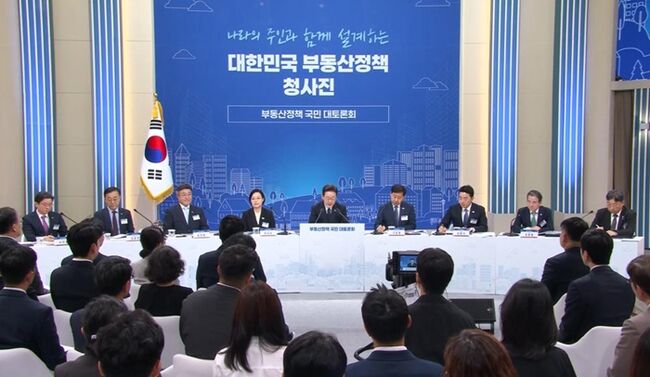 [Liberal Democratic Party Statement] Calling it a Grand Real Estate Debate… It Was Nothing More Than a Private Party Among Themselves
The 'National Grand Debate on Real Estate Policy' held on July 23rd and 27th. [Photo=Yonhap News]The 'National Grand Debate on Real Estate Policy,' hosted by the Lee Jae-myung administration under the
[Liberal Democratic Party Statement] Calling it a Grand Real Estate Debate… It Was Nothing More Than a Private Party Among Themselves
The 'National Grand Debate on Real Estate Policy' held on July 23rd and 27th. [Photo=Yonhap News]The 'National Grand Debate on Real Estate Policy,' hosted by the Lee Jae-myung administration under the
 [Photo] Evidence of Election Fraud Flooding U.S. Media… Trump Had 2.7 Million Votes Stolen
 [Video] U.S. Semiquincentennial Air Show... 'Art in the Sky' streaks across New York
 [Editorial Cartoon] A Draconian Law That Undermines Freedom of Expression

 List
List