U.S. President Donald Trump announcing reciprocal tariffs in April 2025 [Photo=Yonhap News]
As the U.S. Supreme Court has put the brakes on tariff measures based on the International Emergency Economic Powers Act (IEEPA), attention is shifting to Section 122 of the Trade Act, Section 232 of the Trade Expansion Act, and Section 301 of the Trade Act, which U.S. President Donald Trump has mentioned as alternatives.
All three provisions differ in legal structure from the emergency economic powers challenged in recent rulings, as they are based on legislation in which Congress has explicitly delegated tariff authority to the President.
Section 122 of the Trade Act is a provision of an emergency nature intended to address macroeconomic crises, such as a deterioration in the balance of payments or a flight of dollars.
Included in the Trade Act of 1974, this clause allows the President to impose tariffs for a certain period, with the tariff rate capped at 15% and the duration limited to 150 days.
While it can be invoked without congressional approval, it is characterized by being designed as a temporary response measure rather than a permanent system.
President Trump's mentioned executive order for a "10% additional tariff on all imports" is also a plan based on this provision.
Section 232 of the Trade Expansion Act is a provision that allows for the restriction of imports on the grounds of national security.
If the Department of Commerce investigates the impact of imports of a specific item on national security and recommends action to the President, the President can decide to impose tariffs or restrict imports without a separate legislative process.
This is the legal basis the Trump administration used when it imposed 25% and 10% tariffs on steel and aluminum, respectively.
It is distinguished from other trade laws in that the criteria for judgment are based on security elements such as the defense industry and supply chain stability, rather than economic emergencies.
Section 301 of the Trade Act is a regulation designed to respond to unfair trade practices by foreign governments.
Once the Office of the United States Trade Representative (USTR) confirms issues such as intellectual property rights infringement or restrictions on market access through an investigation process, the President can implement retaliatory tariffs or trade sanctions.
Large-scale additional tariffs on Chinese products during the U.S.-China trade dispute were also measures taken under Section 301. It differs in application from global tariffs, as it targets the policies of a specific country.
All three provisions grant the President relatively broad discretion, but they share the commonality of being powers explicitly delegated by Congress in advance.
This structure is also consistent with the "clear statement rule" emphasized by the Supreme Court in its recent move to curb the broad interpretation of emergency economic powers.
Legal experts explain that "these provisions have been used selectively depending on the situation, as Section 232 focuses on national security, Section 301 on responding to unfair trade, and Section 122 on short-term responses to balance-of-payments issues."
The tariff cards mentioned by the administration following the Supreme Court's ruling are drawing attention as they are being reviewed within this established framework of trade law.
There is also analysis suggesting a potential trend where tariff policies will be discussed centered on trade law provisions explicitly designed by Congress, rather than on emergency economic powers.

 [Statement by the Seo-beo-kka Korea Military Academy Save-the-Nation Comrades Association] ㉛ Recount the Votes Publicly, as the Previous Recount Concealed Election Fraud
Tongyeong Mayoral Election Recount [Photo=Yonhap News]South Korea's liberal democracy is dying. The National Election Commission (NEC) and the judiciary, which have plummeted into criminal syndicates
[Statement by the Seo-beo-kka Korea Military Academy Save-the-Nation Comrades Association] ㉛ Recount the Votes Publicly, as the Previous Recount Concealed Election Fraud
Tongyeong Mayoral Election Recount [Photo=Yonhap News]South Korea's liberal democracy is dying. The National Election Commission (NEC) and the judiciary, which have plummeted into criminal syndicates
 What is the significance of the "Trump 2028" red hats that keep making a comeback?
It is noteworthy that President Donald Trump is "intentionally" fueling controversy over whether he can actually run in the 2028 presidential election, even though it is "highly likely he is seriously
What is the significance of the "Trump 2028" red hats that keep making a comeback?
It is noteworthy that President Donald Trump is "intentionally" fueling controversy over whether he can actually run in the 2028 presidential election, even though it is "highly likely he is seriously
 Jin Cummings: "North Korea says it will increase the number of spies, so what is the government doing?"
U.S. political columnist Gene Cummings has publicly questioned the South Korean government, asking, "North Korea is announcing plans to increase its number of spies, yet what is the South Korean
Jin Cummings: "North Korea says it will increase the number of spies, so what is the government doing?"
U.S. political columnist Gene Cummings has publicly questioned the South Korean government, asking, "North Korea is announcing plans to increase its number of spies, yet what is the South Korean
 Attorney Do Tae-woo: “Discrepancies in Voter Count and Improper Sealing Confirmed in Tongyeong Mayoral Recount… Official Request for Further Verification Filed with Gyeongnam Election Commission”
A bundle of out-of-district early voting ballots photographed by attorney Do Tae-woo at the Tongyeong mayoral election recount site. A clear, solid line visible on the side of the ballots raises suspi
Attorney Do Tae-woo: “Discrepancies in Voter Count and Improper Sealing Confirmed in Tongyeong Mayoral Recount… Official Request for Further Verification Filed with Gyeongnam Election Commission”
A bundle of out-of-district early voting ballots photographed by attorney Do Tae-woo at the Tongyeong mayoral election recount site. A clear, solid line visible on the side of the ballots raises suspi
 Stock Market Crash 'Black Tuesday'… KOSPI down 10.8%, KOSDAQ down 7.7%
The KOSPI fell by more than 5% in early trading on the 28th, triggering a sell-side sidecar.On the 28th, the KOSPI plunged by more than 10%.Due to the sharp decline, a sell-side sidecar—a temporary
Stock Market Crash 'Black Tuesday'… KOSPI down 10.8%, KOSDAQ down 7.7%
The KOSPI fell by more than 5% in early trading on the 28th, triggering a sell-side sidecar.On the 28th, the KOSPI plunged by more than 10%.Due to the sharp decline, a sell-side sidecar—a temporary
 [World Heritage Committee] 25 New World Heritage Sites Inscribed in Busan… South Korea Successfully Expands 'Getbol' Listing
The Chairperson of the World Heritage Committee speaks at the plenary session of the 48th session of the World Heritage Committee, held at BEXCO in Busan on the 20th. [Photo: Yonhap News]A total of 25
[World Heritage Committee] 25 New World Heritage Sites Inscribed in Busan… South Korea Successfully Expands 'Getbol' Listing
The Chairperson of the World Heritage Committee speaks at the plenary session of the 48th session of the World Heritage Committee, held at BEXCO in Busan on the 20th. [Photo: Yonhap News]A total of 25
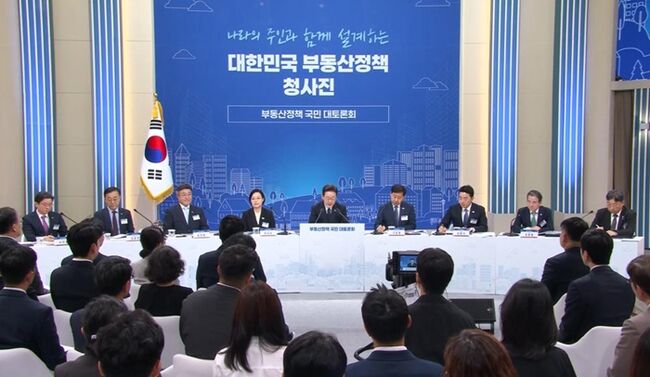 [Liberal Democratic Party Statement] Calling it a Grand Real Estate Debate… It Was Nothing More Than a Private Party Among Themselves
The 'National Grand Debate on Real Estate Policy' held on July 23rd and 27th. [Photo=Yonhap News]The 'National Grand Debate on Real Estate Policy,' hosted by the Lee Jae-myung administration under the
[Liberal Democratic Party Statement] Calling it a Grand Real Estate Debate… It Was Nothing More Than a Private Party Among Themselves
The 'National Grand Debate on Real Estate Policy' held on July 23rd and 27th. [Photo=Yonhap News]The 'National Grand Debate on Real Estate Policy,' hosted by the Lee Jae-myung administration under the
 [Photo] Evidence of Election Fraud Flooding U.S. Media… Trump Had 2.7 Million Votes Stolen
 [Video] U.S. Semiquincentennial Air Show... 'Art in the Sky' streaks across New York
 [Editorial Cartoon] A Draconian Law That Undermines Freedom of Expression

 List
List