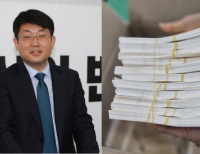
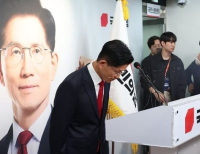
The status board at the Busan Metropolitan Election Commission in Yeonje-gu, Busan, shows D-103 days until the 6.3 nationwide simultaneous local elections, on February 20, when preliminary candidate registrations for metropolitan and local council members and heads of local governments began. 2026.2.20 [Photo=Yonhap News]
With the 9th nationwide simultaneous local elections approaching their 100-day mark on June 3rd, political circles have begun to stir in earnest.
This election is unfolding as a ‘life-impactful composite election,’ where political variables such as the debate over legislative dominance, the special prosecutor situation, and the former President Yoon's appellate trial are compounded by pressures from the Korea-US trade negotiations, exchange rates, and prices, as well as competition among candidates.
As it is the first nationwide election since the launch of the Lee Jae-myung administration, it effectively carries the nature of a midterm evaluation and is expected to serve as a testbed for gauging the direction of political dynamics leading up to the 2028 general elections and the 2030 presidential election.
The election schedule has also officially commenced.
Preliminary candidate registration for governor and superintendent of education elections began in early February, and the race for heads of local governments and local council members kicked off on February 20th.
The real battle in the political arena will begin when the lineup is finalized with the registration of main candidates on May 14-15. Subsequently, official election campaigns will commence on May 21st, followed by early voting on May 29-30, leading to the main vote on June 3rd, marking the activation of the ‘100-day election clock.’
There are quite a few political variables in this local election.
Amidst the opposition party's criticism of 'legislative dominance' over legislative initiatives concerning the parliamentary majority, the escalating conflicts surrounding consecutive special prosecutor pushes are heightening political tensions.
Furthermore, the progress of former President Yoon's appellate trial is likely to continue to have political repercussions throughout the election period, and discussions on administrative integration by region, such as in Daejeon/Chungnam and Gwangju/Jeonnam, are also being cited as variables that could sway regional voter sentiment.
Each camp is interpreting these issues as frameworks of 'political normalization' and 'abuse of power,' respectively, and reflecting them in their election strategies.
Economic variables are also difficult to ignore.
The Korea-US trade negotiations and tariff issues are directly linked to export industries and employment outlooks, and depending on the outcome of the negotiations, the evaluation of the government's economic policies could significantly change.
The trend of the won-dollar exchange rate and the pressure of rising living costs are elements directly connected to public sentiment.
There is also an analysis that if the rising exchange rate stimulates import prices and leads to increased household burdens such as dining out and energy costs, the election dynamics could shift from ideological competition to an evaluation of economic performance.
Livelihood variables are also a crucial pillar.
The trend of real estate prices in the metropolitan area, the perception of local economic conditions, and sales situations for small business owners are all intertwined with the daily lives of voters.
It is observed that this election could take on a stronger character of a ‘life-experience election,’ as the actual changes in living conditions may influence voting choices more than the messages conveyed by political circles.
Above all, it is widely assessed that individual candidates will play a significant role in this local election.
This is because it could serve as a test of leadership for the ruling and opposition party leaders and a stage to gauge the presence of potential future presidential contenders.
In hotly contested races in the metropolitan area, including the Seoul mayoral election, the participation of incumbent mayors and influential politicians is considered a key factor that will determine the outcome.
There is also speculation that by-elections for the National Assembly could expand to a scale comparable to a ‘mini general election,’ and there are projections that the return of influential politicians to the National Assembly could be linked to changes in the power structure after the elections.
While the current public opinion trend is considered somewhat favorable to the ruling party, there are ample variables remaining in the next 100 days.
Given that political issues, economic conditions, livelihood perceptions, and individual competitiveness will all be at play simultaneously, the political circles commonly analyze that the situation can be overturned at any time.
This local election is increasingly likely to become a complex stage that pre-emptively tests not only regional politics but also the political landscape, economic conditions, and the future power structure.

 [Statement by the Seo-beo-kka Korea Military Academy Save-the-Nation Comrades Association] ㉛ Recount the Votes Publicly, as the Previous Recount Concealed Election Fraud
Tongyeong Mayoral Election Recount [Photo=Yonhap News]South Korea's liberal democracy is dying. The National Election Commission (NEC) and the judiciary, which have plummeted into criminal syndicates
[Statement by the Seo-beo-kka Korea Military Academy Save-the-Nation Comrades Association] ㉛ Recount the Votes Publicly, as the Previous Recount Concealed Election Fraud
Tongyeong Mayoral Election Recount [Photo=Yonhap News]South Korea's liberal democracy is dying. The National Election Commission (NEC) and the judiciary, which have plummeted into criminal syndicates
 What is the significance of the "Trump 2028" red hats that keep making a comeback?
It is noteworthy that President Donald Trump is "intentionally" fueling controversy over whether he can actually run in the 2028 presidential election, even though it is "highly likely he is seriously
What is the significance of the "Trump 2028" red hats that keep making a comeback?
It is noteworthy that President Donald Trump is "intentionally" fueling controversy over whether he can actually run in the 2028 presidential election, even though it is "highly likely he is seriously
 Jin Cummings: "North Korea says it will increase the number of spies, so what is the government doing?"
U.S. political columnist Gene Cummings has publicly questioned the South Korean government, asking, "North Korea is announcing plans to increase its number of spies, yet what is the South Korean
Jin Cummings: "North Korea says it will increase the number of spies, so what is the government doing?"
U.S. political columnist Gene Cummings has publicly questioned the South Korean government, asking, "North Korea is announcing plans to increase its number of spies, yet what is the South Korean
 Attorney Do Tae-woo: “Discrepancies in Voter Count and Improper Sealing Confirmed in Tongyeong Mayoral Recount… Official Request for Further Verification Filed with Gyeongnam Election Commission”
A bundle of out-of-district early voting ballots photographed by attorney Do Tae-woo at the Tongyeong mayoral election recount site. A clear, solid line visible on the side of the ballots raises suspi
Attorney Do Tae-woo: “Discrepancies in Voter Count and Improper Sealing Confirmed in Tongyeong Mayoral Recount… Official Request for Further Verification Filed with Gyeongnam Election Commission”
A bundle of out-of-district early voting ballots photographed by attorney Do Tae-woo at the Tongyeong mayoral election recount site. A clear, solid line visible on the side of the ballots raises suspi
 Stock Market Crash 'Black Tuesday'… KOSPI down 10.8%, KOSDAQ down 7.7%
The KOSPI fell by more than 5% in early trading on the 28th, triggering a sell-side sidecar.On the 28th, the KOSPI plunged by more than 10%.Due to the sharp decline, a sell-side sidecar—a temporary
Stock Market Crash 'Black Tuesday'… KOSPI down 10.8%, KOSDAQ down 7.7%
The KOSPI fell by more than 5% in early trading on the 28th, triggering a sell-side sidecar.On the 28th, the KOSPI plunged by more than 10%.Due to the sharp decline, a sell-side sidecar—a temporary
 [World Heritage Committee] 25 New World Heritage Sites Inscribed in Busan… South Korea Successfully Expands 'Getbol' Listing
The Chairperson of the World Heritage Committee speaks at the plenary session of the 48th session of the World Heritage Committee, held at BEXCO in Busan on the 20th. [Photo: Yonhap News]A total of 25
[World Heritage Committee] 25 New World Heritage Sites Inscribed in Busan… South Korea Successfully Expands 'Getbol' Listing
The Chairperson of the World Heritage Committee speaks at the plenary session of the 48th session of the World Heritage Committee, held at BEXCO in Busan on the 20th. [Photo: Yonhap News]A total of 25
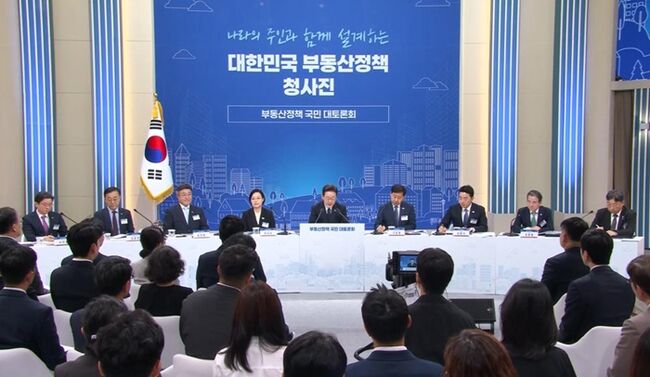 [Liberal Democratic Party Statement] Calling it a Grand Real Estate Debate… It Was Nothing More Than a Private Party Among Themselves
The 'National Grand Debate on Real Estate Policy' held on July 23rd and 27th. [Photo=Yonhap News]The 'National Grand Debate on Real Estate Policy,' hosted by the Lee Jae-myung administration under the
[Liberal Democratic Party Statement] Calling it a Grand Real Estate Debate… It Was Nothing More Than a Private Party Among Themselves
The 'National Grand Debate on Real Estate Policy' held on July 23rd and 27th. [Photo=Yonhap News]The 'National Grand Debate on Real Estate Policy,' hosted by the Lee Jae-myung administration under the
 [Photo] Evidence of Election Fraud Flooding U.S. Media… Trump Had 2.7 Million Votes Stolen
 [Video] U.S. Semiquincentennial Air Show... 'Art in the Sky' streaks across New York
 [Editorial Cartoon] A Draconian Law That Undermines Freedom of Expression

 List
List