Jamieson Greer, United States Trade Representative (USTR) [EPA Yonhap News]
U.S. Trade Representative (USTR) Jamieson Greer stated on the 22nd (local time) that the Supreme Court's ruling against President Donald Trump's reciprocal tariffs would not affect the upcoming U.S.-China summit scheduled for late March to early April.
In an interview with Fox News that day, when asked whether the Supreme Court's ruling would weaken U.S. negotiating power and deal a blow to America's position at the summit, Greer said, "The April summit will proceed as planned, and it will be very successful."
Greer emphasized, "We have been imposing tariffs on China since 2018, and the average tariff rate on China currently remains at approximately 40%," adding, "We have other tools at our disposal if needed."
He continued, "The point is not to try to pick a fight with China. It is about ensuring stability for our soybean farmers, those selling aircraft and medical devices (to China), and those seeking to import goods that cannot be obtained anywhere else but China," he added.
Regarding the goals of the U.S.-China summit, Greer said, "First, we want to confirm whether China is fulfilling its obligations under our agreements, such as continuing to purchase the goods they promised and continuing to supply us with rare earth elements."
He further stated, "This summit will focus on maintaining stability, monitoring the implementation of agreements, and building a relationship for the future."
In an interview with ABC News, Greer also noted that the measures newly introduced by President Trump following the reciprocal tariff ruling—such as a 15% "global tariff" under Section 122 of the Trade Act and the initiation of investigations under Section 301 of the same act—would have "no material impact" on the upcoming U.S.-China summit.
Regarding the Section 301 investigations, he said, "We have initiated investigations into Brazil and China," adding, "We also plan to launch investigations into overcapacity. This will address several countries in Asia that possess excess production capacity. They are producing more than they can consume, and without following basic economic principles, they are simply building factories and maintaining employment, thereby crashing prices globally."
Greer also revealed, "We are looking into foreign rice markets that are killing U.S. rice farmers through unfair trade practices and massive subsidies," noting that they are "reviewing the matter in a variety of ways at this time."
In a statement issued on the 20th following the Supreme Court ruling, Greer had previously mentioned regarding the Section 301 investigations to be initiated by the USTR, "We expect these investigations to cover most of our major trading partners." Consequently, it is expected that countries with which the U.S. records large trade deficits, such as South Korea, will be included in the scope of the investigations.
Furthermore, while Greer noted that new tariff imposition tools do not have the "same flexibility" as reciprocal tariffs, he said, "He (Trump) has given us very robust tools. Through these, we can conduct investigations and impose tariffs where necessary, which provides significant leverage and protection for American industries."
Referring specifically to Section 301 of the Trade Act and Section 232 of the Trade Expansion Act, he stated, "Through these other tariff authorities, we can reconstruct our side of the agreements."
Regarding the 15% global tariff under Section 122 of the Trade Act, which has a maximum duration of five months, Greer said, "When this tool expires, we will carry out the Section 301 investigations. The Department of Commerce maintains existing tariffs under Section 232. Many tariffs are still in place," adding, "The reality is that we want to maintain our (tariff) policy while ensuring as much continuity as possible."
Appearing on CBS, Greer addressed the new trade agreements the U.S. has concluded, stating, "We will honor these agreements, and we expect our partners to honor them as well. No one has said that the agreements have been broken yet."
He emphasized, "I spoke with my counterparts in the European Union (EU) and other countries this weekend. These agreements were not contingent on the success or failure of emergency tariff litigation. I have been in continuous dialogue with them, and I have told them for a year that I would impose tariffs regardless of whether we win or lose the litigation. That is why they signed them even while the litigation was ongoing."

 [Statement by the Seo-beo-kka Korea Military Academy Save-the-Nation Comrades Association] ㉛ Recount the Votes Publicly, as the Previous Recount Concealed Election Fraud
Tongyeong Mayoral Election Recount [Photo=Yonhap News]South Korea's liberal democracy is dying. The National Election Commission (NEC) and the judiciary, which have plummeted into criminal syndicates
[Statement by the Seo-beo-kka Korea Military Academy Save-the-Nation Comrades Association] ㉛ Recount the Votes Publicly, as the Previous Recount Concealed Election Fraud
Tongyeong Mayoral Election Recount [Photo=Yonhap News]South Korea's liberal democracy is dying. The National Election Commission (NEC) and the judiciary, which have plummeted into criminal syndicates
 What is the significance of the "Trump 2028" red hats that keep making a comeback?
It is noteworthy that President Donald Trump is "intentionally" fueling controversy over whether he can actually run in the 2028 presidential election, even though it is "highly likely he is seriously
What is the significance of the "Trump 2028" red hats that keep making a comeback?
It is noteworthy that President Donald Trump is "intentionally" fueling controversy over whether he can actually run in the 2028 presidential election, even though it is "highly likely he is seriously
 Jin Cummings: "North Korea says it will increase the number of spies, so what is the government doing?"
U.S. political columnist Gene Cummings has publicly questioned the South Korean government, asking, "North Korea is announcing plans to increase its number of spies, yet what is the South Korean
Jin Cummings: "North Korea says it will increase the number of spies, so what is the government doing?"
U.S. political columnist Gene Cummings has publicly questioned the South Korean government, asking, "North Korea is announcing plans to increase its number of spies, yet what is the South Korean
 Attorney Do Tae-woo: “Discrepancies in Voter Count and Improper Sealing Confirmed in Tongyeong Mayoral Recount… Official Request for Further Verification Filed with Gyeongnam Election Commission”
A bundle of out-of-district early voting ballots photographed by attorney Do Tae-woo at the Tongyeong mayoral election recount site. A clear, solid line visible on the side of the ballots raises suspi
Attorney Do Tae-woo: “Discrepancies in Voter Count and Improper Sealing Confirmed in Tongyeong Mayoral Recount… Official Request for Further Verification Filed with Gyeongnam Election Commission”
A bundle of out-of-district early voting ballots photographed by attorney Do Tae-woo at the Tongyeong mayoral election recount site. A clear, solid line visible on the side of the ballots raises suspi
 Stock Market Crash 'Black Tuesday'… KOSPI down 10.8%, KOSDAQ down 7.7%
The KOSPI fell by more than 5% in early trading on the 28th, triggering a sell-side sidecar.On the 28th, the KOSPI plunged by more than 10%.Due to the sharp decline, a sell-side sidecar—a temporary
Stock Market Crash 'Black Tuesday'… KOSPI down 10.8%, KOSDAQ down 7.7%
The KOSPI fell by more than 5% in early trading on the 28th, triggering a sell-side sidecar.On the 28th, the KOSPI plunged by more than 10%.Due to the sharp decline, a sell-side sidecar—a temporary
 [World Heritage Committee] 25 New World Heritage Sites Inscribed in Busan… South Korea Successfully Expands 'Getbol' Listing
The Chairperson of the World Heritage Committee speaks at the plenary session of the 48th session of the World Heritage Committee, held at BEXCO in Busan on the 20th. [Photo: Yonhap News]A total of 25
[World Heritage Committee] 25 New World Heritage Sites Inscribed in Busan… South Korea Successfully Expands 'Getbol' Listing
The Chairperson of the World Heritage Committee speaks at the plenary session of the 48th session of the World Heritage Committee, held at BEXCO in Busan on the 20th. [Photo: Yonhap News]A total of 25
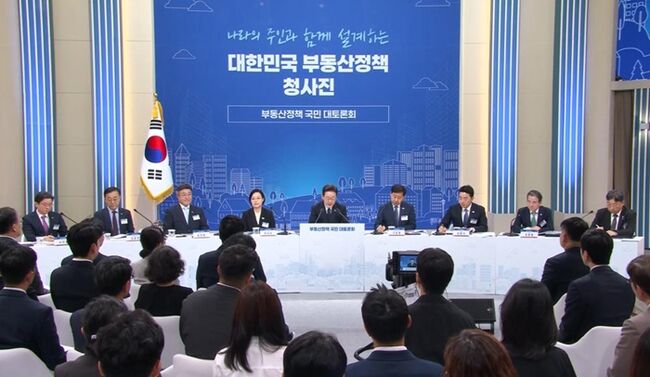 [Liberal Democratic Party Statement] Calling it a Grand Real Estate Debate… It Was Nothing More Than a Private Party Among Themselves
The 'National Grand Debate on Real Estate Policy' held on July 23rd and 27th. [Photo=Yonhap News]The 'National Grand Debate on Real Estate Policy,' hosted by the Lee Jae-myung administration under the
[Liberal Democratic Party Statement] Calling it a Grand Real Estate Debate… It Was Nothing More Than a Private Party Among Themselves
The 'National Grand Debate on Real Estate Policy' held on July 23rd and 27th. [Photo=Yonhap News]The 'National Grand Debate on Real Estate Policy,' hosted by the Lee Jae-myung administration under the
 [Photo] Evidence of Election Fraud Flooding U.S. Media… Trump Had 2.7 Million Votes Stolen
 [Video] U.S. Semiquincentennial Air Show... 'Art in the Sky' streaks across New York
 [Editorial Cartoon] A Draconian Law That Undermines Freedom of Expression

 List
List