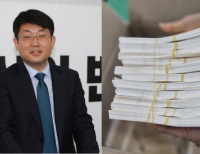
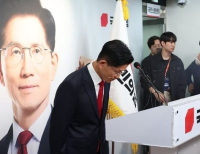
Harold Rogers, interim CEO of e-commerce giant Coupang, walks to attend a House committee hearing held at the U.S. Capitol in Washington, D.C., on February 23, 2026. [Photo = Yonhap News]
As the U.S. House Judiciary Committee summoned the interim head of Coupang’s Korean operations for a lengthy closed-door hearing, this investigation is emerging as a new variable in U.S.-Korea trade relations, extending beyond a simple corporate matter.
In Washington political circles, the interpretation is that this hearing is aimed more at the South Korean government’s platform and digital regulatory environment than at the data breach incident itself.
The hearing, held on the 23rd (local time), lasted approximately seven hours. It is reported that members of the House Judiciary Committee, led by Chairman Jim Jordan (Republican, Ohio), focused their questioning on whether the South Korean government has imposed discriminatory regulations on U.S. IT companies.
The hearing was led by the Subcommittee on Courts, Intellectual Property, and the Internet under the Judiciary Committee.
This scheduling draws further attention as it comes shortly after the U.S. Supreme Court put the brakes on President Donald Trump’s reciprocal tariff measures, and while the Trump administration has mentioned plans for global tariffs based on Section 122 of the Trade Act.
The fact that Congress has begun investigating Korea’s regulatory environment at a time when trade pressure cards are being discussed again is significant.
Focus on 'Korean Regulations' Rather than 'Coupang Case'
According to information released so far, lawmakers’ questions reportedly centered on the South Korean government's platform regulations and the investment environment for U.S. companies rather than the scale of the data breach itself.
The Judiciary Committee demanded the submission of communication logs between Coupang and the South Korean National Assembly, the Presidential Office, the Korea Fair Trade Commission, and the Ministry of Science and ICT, and it is reported that Coupang submitted thousands of documents in advance.
In Washington trade circles, this document request process is interpreted as a procedure to secure grounds for future policy responses.
In particular, as U.S. companies consider investments in AI data centers in Korea, concerns are being raised that if regulatory environment issues emerge as political disputes, the results of the congressional investigation could be directly reflected in trade negotiations.
Why the 'Judiciary Committee' — The Starting Point of Trade Issues
The U.S. House Judiciary Committee oversees a wide range of issues beyond simple judicial matters, including antitrust, freedom of speech, and platform regulation.
It is not uncommon for the Judiciary Committee to launch investigations before the Trade Committee when the regulatory issues of a specific country rise to the level of a political dispute.
When the Judiciary Committee makes 'discriminatory regulation' an agenda through hearings and data requests, it creates a structure that provides justification for the executive branch to review trade measures later.
Could This Lead to Section 301?… Interpreted as a "Record-Building Phase"
Some observers suggest that this hearing may be a 'record-building' phase to determine whether to apply Section 301 of the Trade Act in the future.
Section 301 is a provision that allows the U.S. government to take retaliatory tariffs or import restrictions if a foreign government is found to have discriminatory or unjust trade practices.
However, caution is advised as the Office of the United States Trade Representative (USTR) has not launched an official investigation, and raising issues at the congressional level does not immediately lead to the invocation of Section 301.
Indeed, this hearing was held as a closed-door investigation rather than public testimony, and no follow-up schedule has been announced.
Report and Legislation Will Be Key Variables
The turning point for future developments will be whether the Judiciary Committee releases an investigative report or pursues specific legislation.
If a congressional report formalizes the phrase 'discriminatory regulation,' it can be used as political justification for the executive branch to consider trade measures.
In Washington, there is also an assessment that this investigation could be a signal flare for the U.S. Congress to frame South Korea's digital regulatory policies within the scope of trade, going beyond a corporate-level incident.
Ultimately, the analysis suggests that the Coupang hearing could become a litmus test for a clash between U.S.-Korea platform policies and trade strategies.
<Reference Material>
From U.S. Congressional Investigation to Section 301 — Trade Pressure Flow at a Glance
① Congressional Investigation Stage
Making 'discriminatory regulation' an issue through House Judiciary Committee hearings and document requests
② Record Building
Securing communication data between companies and the government → Organizing grounds for trade pressure
③ Executive Branch Review Possibility
If a congressional report appears, USTR reviews whether to initiate a Section 301 investigation
④ Commencement of Section 301 Procedure
Parallel public hearings and negotiation pressure
⑤ Realization of Trade Pressure
Possible measures such as tariff hikes or import restrictions
※ Congressional investigation itself does not mean immediate invocation of Section 301

 [Statement by the Seo-beo-kka Korea Military Academy Save-the-Nation Comrades Association] ㉛ Recount the Votes Publicly, as the Previous Recount Concealed Election Fraud
Tongyeong Mayoral Election Recount [Photo=Yonhap News]South Korea's liberal democracy is dying. The National Election Commission (NEC) and the judiciary, which have plummeted into criminal syndicates
[Statement by the Seo-beo-kka Korea Military Academy Save-the-Nation Comrades Association] ㉛ Recount the Votes Publicly, as the Previous Recount Concealed Election Fraud
Tongyeong Mayoral Election Recount [Photo=Yonhap News]South Korea's liberal democracy is dying. The National Election Commission (NEC) and the judiciary, which have plummeted into criminal syndicates
 What is the significance of the "Trump 2028" red hats that keep making a comeback?
It is noteworthy that President Donald Trump is "intentionally" fueling controversy over whether he can actually run in the 2028 presidential election, even though it is "highly likely he is seriously
What is the significance of the "Trump 2028" red hats that keep making a comeback?
It is noteworthy that President Donald Trump is "intentionally" fueling controversy over whether he can actually run in the 2028 presidential election, even though it is "highly likely he is seriously
 Jin Cummings: "North Korea says it will increase the number of spies, so what is the government doing?"
U.S. political columnist Gene Cummings has publicly questioned the South Korean government, asking, "North Korea is announcing plans to increase its number of spies, yet what is the South Korean
Jin Cummings: "North Korea says it will increase the number of spies, so what is the government doing?"
U.S. political columnist Gene Cummings has publicly questioned the South Korean government, asking, "North Korea is announcing plans to increase its number of spies, yet what is the South Korean
 Attorney Do Tae-woo: “Discrepancies in Voter Count and Improper Sealing Confirmed in Tongyeong Mayoral Recount… Official Request for Further Verification Filed with Gyeongnam Election Commission”
A bundle of out-of-district early voting ballots photographed by attorney Do Tae-woo at the Tongyeong mayoral election recount site. A clear, solid line visible on the side of the ballots raises suspi
Attorney Do Tae-woo: “Discrepancies in Voter Count and Improper Sealing Confirmed in Tongyeong Mayoral Recount… Official Request for Further Verification Filed with Gyeongnam Election Commission”
A bundle of out-of-district early voting ballots photographed by attorney Do Tae-woo at the Tongyeong mayoral election recount site. A clear, solid line visible on the side of the ballots raises suspi
 Stock Market Crash 'Black Tuesday'… KOSPI down 10.8%, KOSDAQ down 7.7%
The KOSPI fell by more than 5% in early trading on the 28th, triggering a sell-side sidecar.On the 28th, the KOSPI plunged by more than 10%.Due to the sharp decline, a sell-side sidecar—a temporary
Stock Market Crash 'Black Tuesday'… KOSPI down 10.8%, KOSDAQ down 7.7%
The KOSPI fell by more than 5% in early trading on the 28th, triggering a sell-side sidecar.On the 28th, the KOSPI plunged by more than 10%.Due to the sharp decline, a sell-side sidecar—a temporary
 [World Heritage Committee] 25 New World Heritage Sites Inscribed in Busan… South Korea Successfully Expands 'Getbol' Listing
The Chairperson of the World Heritage Committee speaks at the plenary session of the 48th session of the World Heritage Committee, held at BEXCO in Busan on the 20th. [Photo: Yonhap News]A total of 25
[World Heritage Committee] 25 New World Heritage Sites Inscribed in Busan… South Korea Successfully Expands 'Getbol' Listing
The Chairperson of the World Heritage Committee speaks at the plenary session of the 48th session of the World Heritage Committee, held at BEXCO in Busan on the 20th. [Photo: Yonhap News]A total of 25
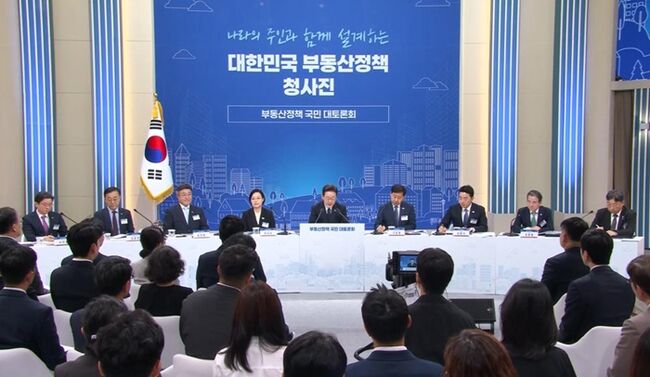 [Liberal Democratic Party Statement] Calling it a Grand Real Estate Debate… It Was Nothing More Than a Private Party Among Themselves
The 'National Grand Debate on Real Estate Policy' held on July 23rd and 27th. [Photo=Yonhap News]The 'National Grand Debate on Real Estate Policy,' hosted by the Lee Jae-myung administration under the
[Liberal Democratic Party Statement] Calling it a Grand Real Estate Debate… It Was Nothing More Than a Private Party Among Themselves
The 'National Grand Debate on Real Estate Policy' held on July 23rd and 27th. [Photo=Yonhap News]The 'National Grand Debate on Real Estate Policy,' hosted by the Lee Jae-myung administration under the
 [Photo] Evidence of Election Fraud Flooding U.S. Media… Trump Had 2.7 Million Votes Stolen
 [Video] U.S. Semiquincentennial Air Show... 'Art in the Sky' streaks across New York
 [Editorial Cartoon] A Draconian Law That Undermines Freedom of Expression

 List
List