Pedestrians walking through the financial district in Yeouido, Seoul [Photo=Yonhap News]
Although foreign investors have withdrawn approximately 5.2 trillion won from the market over six consecutive trading sessions, the KOSPI has risen by more than 10% during the same period, attempting to break through the 6,000-point mark.
While the index has climbed, the primary drivers of market supply and demand have shifted to institutional and retail investors. On the surface, this may look like a foreign exodus, but the prevailing view in the market is to interpret this not as a simple move toward liquidation, but as a signal of a “portfolio rotation.”
Looking at the actual trading data, foreign investors have been consistently taking profits in Samsung Electronics, which holds significant weight in the index. The net selling volume from the 13th to the 25th alone reached the multi-trillion won range.
On the other hand, they have concentrated their capital on exports, defense, shipbuilding, and select semiconductor stocks—such as SK Hynix, Hyundai Motor, Doosan Enerbility, Hanwha Ocean, and Hyundai Rotem—showing an effort to preemptively secure the next sector leaders.
This is being assessed as a classic trend of selling the index to buy into cycles.
There is also a clear divergence in perspective between domestic and foreign investors.
While retail and institutional investors have been buying up Samsung Electronics as it hits new highs, foreign investors appear focused on rebalancing their sectors in anticipation of the next phase following the index's rise.
Analysts suggest that as strategies diverge among market participants, short-term volatility is bound to increase.
In the brokerage industry, there are also suggestions that current stock prices may not fully reflect certain risks.
External variables such as U.S.-driven AI volatility, uncertainty over Trump’s tariffs, and geopolitical tensions remain ongoing. In particular, some expect that a valuation adjustment may occur once the lull in the March earnings announcement season begins.
Noh Dong-kil, a researcher at Shinhan Securities, explained to Yonhap News that “while this indicates the strength of earnings and liquidity, there is room for P/E adjustments during the lulls.”
However, it is difficult to interpret foreign capital flows in a purely negative light.
Passive capital flows are actually strengthening.
Cumulative inflows into MSCI Korea ETFs have exceeded $3.3 billion this year, and South Korea has ranked among the top destinations for capital inflows in the global ETF market.
This means that while active capital is repeatedly rotating between stocks, funds tracking the index are flowing in steadily.
Market experts point out that as capital flows become more concentrated toward specific entities, short-term fluctuations have tended to increase.
As the U.S. stock market repeats cycles of gains and losses amid tariff and AI issues, signs of volatility are also appearing in the domestic market, such as the intersection of weakness in the pre-market and strength during regular trading hours.
Han Ji-young, a researcher at Kiwoom Securities, told Yonhap News, “A strategy of maintaining existing positions in leading stocks while preparing for a period of supply and demand volatility is necessary.”
Ultimately, current foreign trading is interpreted not as an exit from the Korean market, but as a process of shifting leadership within a bull market.
In this phase of index growth, the taking of profits on past leaders and the movement to preemptively secure candidates for the next cycle are occurring simultaneously.
Rather than jumping to conclusions about the market's direction, analysts suggest it is necessary to focus on the fact that the market is increasingly taking on the characteristics of a “cyclical rally,” where the speed of growth varies significantly between individual stocks despite the rise in the index.

 [Statement by the Seo-beo-kka Korea Military Academy Save-the-Nation Comrades Association] ㉛ Recount the Votes Publicly, as the Previous Recount Concealed Election Fraud
Tongyeong Mayoral Election Recount [Photo=Yonhap News]South Korea's liberal democracy is dying. The National Election Commission (NEC) and the judiciary, which have plummeted into criminal syndicates
[Statement by the Seo-beo-kka Korea Military Academy Save-the-Nation Comrades Association] ㉛ Recount the Votes Publicly, as the Previous Recount Concealed Election Fraud
Tongyeong Mayoral Election Recount [Photo=Yonhap News]South Korea's liberal democracy is dying. The National Election Commission (NEC) and the judiciary, which have plummeted into criminal syndicates
 What is the significance of the "Trump 2028" red hats that keep making a comeback?
It is noteworthy that President Donald Trump is "intentionally" fueling controversy over whether he can actually run in the 2028 presidential election, even though it is "highly likely he is seriously
What is the significance of the "Trump 2028" red hats that keep making a comeback?
It is noteworthy that President Donald Trump is "intentionally" fueling controversy over whether he can actually run in the 2028 presidential election, even though it is "highly likely he is seriously
 Jin Cummings: "North Korea says it will increase the number of spies, so what is the government doing?"
U.S. political columnist Gene Cummings has publicly questioned the South Korean government, asking, "North Korea is announcing plans to increase its number of spies, yet what is the South Korean
Jin Cummings: "North Korea says it will increase the number of spies, so what is the government doing?"
U.S. political columnist Gene Cummings has publicly questioned the South Korean government, asking, "North Korea is announcing plans to increase its number of spies, yet what is the South Korean
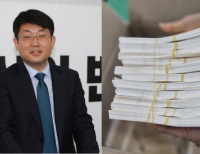
 Attorney Do Tae-woo: “Discrepancies in Voter Count and Improper Sealing Confirmed in Tongyeong Mayoral Recount… Official Request for Further Verification Filed with Gyeongnam Election Commission”
A bundle of out-of-district early voting ballots photographed by attorney Do Tae-woo at the Tongyeong mayoral election recount site. A clear, solid line visible on the side of the ballots raises suspi
Attorney Do Tae-woo: “Discrepancies in Voter Count and Improper Sealing Confirmed in Tongyeong Mayoral Recount… Official Request for Further Verification Filed with Gyeongnam Election Commission”
A bundle of out-of-district early voting ballots photographed by attorney Do Tae-woo at the Tongyeong mayoral election recount site. A clear, solid line visible on the side of the ballots raises suspi
 Stock Market Crash 'Black Tuesday'… KOSPI down 10.8%, KOSDAQ down 7.7%
The KOSPI fell by more than 5% in early trading on the 28th, triggering a sell-side sidecar.On the 28th, the KOSPI plunged by more than 10%.Due to the sharp decline, a sell-side sidecar—a temporary
Stock Market Crash 'Black Tuesday'… KOSPI down 10.8%, KOSDAQ down 7.7%
The KOSPI fell by more than 5% in early trading on the 28th, triggering a sell-side sidecar.On the 28th, the KOSPI plunged by more than 10%.Due to the sharp decline, a sell-side sidecar—a temporary
 [World Heritage Committee] 25 New World Heritage Sites Inscribed in Busan… South Korea Successfully Expands 'Getbol' Listing
The Chairperson of the World Heritage Committee speaks at the plenary session of the 48th session of the World Heritage Committee, held at BEXCO in Busan on the 20th. [Photo: Yonhap News]A total of 25
[World Heritage Committee] 25 New World Heritage Sites Inscribed in Busan… South Korea Successfully Expands 'Getbol' Listing
The Chairperson of the World Heritage Committee speaks at the plenary session of the 48th session of the World Heritage Committee, held at BEXCO in Busan on the 20th. [Photo: Yonhap News]A total of 25
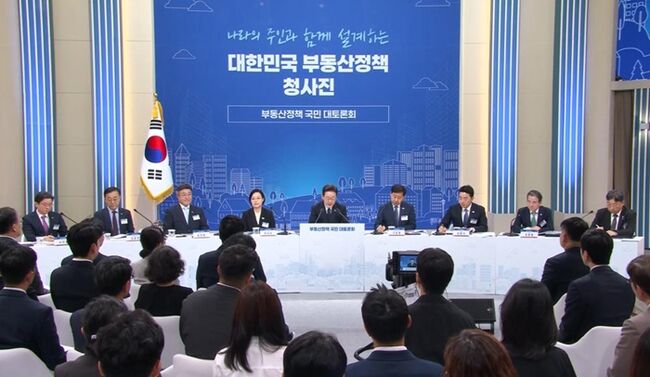 [Liberal Democratic Party Statement] Calling it a Grand Real Estate Debate… It Was Nothing More Than a Private Party Among Themselves
The 'National Grand Debate on Real Estate Policy' held on July 23rd and 27th. [Photo=Yonhap News]The 'National Grand Debate on Real Estate Policy,' hosted by the Lee Jae-myung administration under the
[Liberal Democratic Party Statement] Calling it a Grand Real Estate Debate… It Was Nothing More Than a Private Party Among Themselves
The 'National Grand Debate on Real Estate Policy' held on July 23rd and 27th. [Photo=Yonhap News]The 'National Grand Debate on Real Estate Policy,' hosted by the Lee Jae-myung administration under the
 [Photo] Evidence of Election Fraud Flooding U.S. Media… Trump Had 2.7 Million Votes Stolen
 [Video] U.S. Semiquincentennial Air Show... 'Art in the Sky' streaks across New York
 [Editorial Cartoon] A Draconian Law That Undermines Freedom of Expression

 List
List