On the first day of the ROK-US joint exercise 'Freedom Shield' (FS) on March 10, an RC-12X Guardrail reconnaissance aircraft takes off at Camp Humphreys in Pyeongtaek, Gyeonggi Province. 2025.3.10 [Photo=Yonhap News]
Late on the 24th, U.S. Forces Korea (USFK) issued an unusual statement.
This was in response to a perceived difference in understanding between the South Korean Ministry of National Defense and USFK regarding the issue of KADIZ (Korea Air Defense Identification Zone) access that arose during recent ROK-US and Japan joint exercises.
USFK stated, "We express our regret," but did not apologize, and regarding the protest, they said, "We understand," without admitting fault.
The very act of releasing a public document late at night, concerning an issue typically coordinated through diplomatic channels, was a scene that illustrated the tension within the alliance.
The origin of this controversy was a difference in airspace recognition.
While South Korea explained the exercise situation within the coordinated scope, USFK appeared to modify its wording through its statement.
Although the incident itself might seem like a technical issue, what was ultimately revealed was a strategic temperature difference within the alliance. This is why it has led to the interpretation of a potential crack in ROK-US cooperation, going beyond a simple clash of explanations.
The question we must ask now is simple.
Who benefits when the ROK-US alliance falters? North Korea is currently directing its recent messages not to Seoul, but to Washington.
Under the calculation that increasing tension enhances negotiating power, the strategy of 'talking to the US while ignoring South Korea' (통미봉남) is reappearing in reality. Gaps in the alliance are the most familiar opportunities for North Korea.
Looking broadly at the geopolitical landscape of Northeast Asia, China also secures strategic room within the cracks of cooperation.
As the ROK-US-Japan security axis loosens, South Korea might seem to have more options. However, in reality, it is more likely to lose its footing.
Cracks in the alliance provide space for external powers, but for South Korea, the party involved, it often translates into uncertainty.
The recent ROK-US and Japan-led military exercises are also to be understood in this context.
While it cannot be definitively stated that South Korea refused to participate, the impression left was that its presence appeared diminished.
It was a scene of subtle shifts in the weight of security cooperation. Even if the alliance is maintained, its center can shift at any time.
Furthermore, the discussion about restoring the inter-Korean Sept. 19 Military Agreement overlaps with this, making the temperature difference within the alliance even more apparent.
With North Korea having effectively nullified the agreement, any move to revert to past frameworks is bound to clash with the US's strategy.
The format of the statement, "regret without apology," symbolically exemplifies this gap.
The meaning of 'peace' as described by North Korea is also changing.
The recent messages revealed through the Korean Central News Agency are closer to conditional negotiations than proposals for de-escalation.
While stating that relations will be adjusted according to the US's attitude, Seoul is effectively excluded from negotiations.
It is a structure that demands a price for reduced tension after increased tension, rather than a method of declaring peace first.
The approach of simultaneously utilizing military tension and diplomatic messages to raise negotiation costs is no longer unfamiliar.
Ultimately, for North Korea, peace is not a goal but an option with a price tag, and the more its conditions are exploited on the basis of alliance cracks, the more South Korea's strategic space will inevitably shrink.
Alliances are maintained by strategy, not by emotion. The more we remain fixated on debates about wording, the narrower South Korea's position becomes.
When the ROK-US alliance is shaken, the first to smile are external forces, and Seoul is the first to lose its bearings. What is needed now is not strong words, but a clear direction.
Alliances do not collapse easily. However, their center can shift at any time.
We cannot help but ask again: who benefits from this conflict?
The moment we turn away from that answer, Seoul's marginalization will become not an exception, but a structural reality.

 [Statement by the Seo-beo-kka Korea Military Academy Save-the-Nation Comrades Association] ㉛ Recount the Votes Publicly, as the Previous Recount Concealed Election Fraud
Tongyeong Mayoral Election Recount [Photo=Yonhap News]South Korea's liberal democracy is dying. The National Election Commission (NEC) and the judiciary, which have plummeted into criminal syndicates
[Statement by the Seo-beo-kka Korea Military Academy Save-the-Nation Comrades Association] ㉛ Recount the Votes Publicly, as the Previous Recount Concealed Election Fraud
Tongyeong Mayoral Election Recount [Photo=Yonhap News]South Korea's liberal democracy is dying. The National Election Commission (NEC) and the judiciary, which have plummeted into criminal syndicates
 What is the significance of the "Trump 2028" red hats that keep making a comeback?
It is noteworthy that President Donald Trump is "intentionally" fueling controversy over whether he can actually run in the 2028 presidential election, even though it is "highly likely he is seriously
What is the significance of the "Trump 2028" red hats that keep making a comeback?
It is noteworthy that President Donald Trump is "intentionally" fueling controversy over whether he can actually run in the 2028 presidential election, even though it is "highly likely he is seriously
 Jin Cummings: "North Korea says it will increase the number of spies, so what is the government doing?"
U.S. political columnist Gene Cummings has publicly questioned the South Korean government, asking, "North Korea is announcing plans to increase its number of spies, yet what is the South Korean
Jin Cummings: "North Korea says it will increase the number of spies, so what is the government doing?"
U.S. political columnist Gene Cummings has publicly questioned the South Korean government, asking, "North Korea is announcing plans to increase its number of spies, yet what is the South Korean
 Attorney Do Tae-woo: “Discrepancies in Voter Count and Improper Sealing Confirmed in Tongyeong Mayoral Recount… Official Request for Further Verification Filed with Gyeongnam Election Commission”
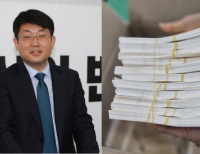
A bundle of out-of-district early voting ballots photographed by attorney Do Tae-woo at the Tongyeong mayoral election recount site. A clear, solid line visible on the side of the ballots raises suspi
Attorney Do Tae-woo: “Discrepancies in Voter Count and Improper Sealing Confirmed in Tongyeong Mayoral Recount… Official Request for Further Verification Filed with Gyeongnam Election Commission”
A bundle of out-of-district early voting ballots photographed by attorney Do Tae-woo at the Tongyeong mayoral election recount site. A clear, solid line visible on the side of the ballots raises suspi
 Stock Market Crash 'Black Tuesday'… KOSPI down 10.8%, KOSDAQ down 7.7%
The KOSPI fell by more than 5% in early trading on the 28th, triggering a sell-side sidecar.On the 28th, the KOSPI plunged by more than 10%.Due to the sharp decline, a sell-side sidecar—a temporary
Stock Market Crash 'Black Tuesday'… KOSPI down 10.8%, KOSDAQ down 7.7%
The KOSPI fell by more than 5% in early trading on the 28th, triggering a sell-side sidecar.On the 28th, the KOSPI plunged by more than 10%.Due to the sharp decline, a sell-side sidecar—a temporary
 [World Heritage Committee] 25 New World Heritage Sites Inscribed in Busan… South Korea Successfully Expands 'Getbol' Listing
The Chairperson of the World Heritage Committee speaks at the plenary session of the 48th session of the World Heritage Committee, held at BEXCO in Busan on the 20th. [Photo: Yonhap News]A total of 25
[World Heritage Committee] 25 New World Heritage Sites Inscribed in Busan… South Korea Successfully Expands 'Getbol' Listing
The Chairperson of the World Heritage Committee speaks at the plenary session of the 48th session of the World Heritage Committee, held at BEXCO in Busan on the 20th. [Photo: Yonhap News]A total of 25
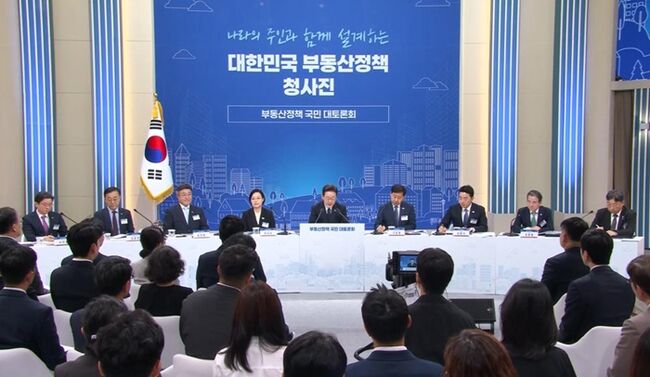 [Liberal Democratic Party Statement] Calling it a Grand Real Estate Debate… It Was Nothing More Than a Private Party Among Themselves
The 'National Grand Debate on Real Estate Policy' held on July 23rd and 27th. [Photo=Yonhap News]The 'National Grand Debate on Real Estate Policy,' hosted by the Lee Jae-myung administration under the
[Liberal Democratic Party Statement] Calling it a Grand Real Estate Debate… It Was Nothing More Than a Private Party Among Themselves
The 'National Grand Debate on Real Estate Policy' held on July 23rd and 27th. [Photo=Yonhap News]The 'National Grand Debate on Real Estate Policy,' hosted by the Lee Jae-myung administration under the
 [Photo] Evidence of Election Fraud Flooding U.S. Media… Trump Had 2.7 Million Votes Stolen
 [Video] U.S. Semiquincentennial Air Show... 'Art in the Sky' streaks across New York
 [Editorial Cartoon] A Draconian Law That Undermines Freedom of Expression

 List
List