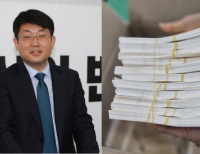
The 7-hour and 30-minute discussion did not reach a conclusion. However, one thing became clear: the core of the debate was not about reaching a conclusion of "was there fraud?" but rather a dispute over the standard of "what needs to be proven and to what extent."
One side presented a hypothesis based on statistical discrepancies and structural vulnerabilities, while the other side dismissed it as a conspiracy theory citing the lack of "conclusive evidence." The problem lies in the logical structure revealed during this categorization process.
Confusing Stages of the Burden of Proof
Statistics cannot prove a crime. However, statistics can reveal discrepancies in explanations. Discrepancies lead to hypotheses, and hypotheses demand verification. This is the basic structure of rational thought.
However, if proof at the level of criminal conviction is demanded as a prerequisite for questions at the hypothesis stage, the inquiry is blocked from the outset. The statement "there is no evidence" may be valid for concluding a crime. However, it does not serve as grounds to block the demand for verification.
Criminal judgment distinguishes between guilt and innocence. The demand for verification asks about explainability. These two standards are not the same. The moment the threshold for criminal conviction is applied to the stage of questioning, the discussion is structurally shut down.
The Fallacy of Relying on Authority
"The agency stated there were no issues" is one interpretation. An explanation is a starting point, not a declaration of conclusion. In a democracy, government agencies can be objects of trust. However, that trust is predicated on verifiability.
The moment an agency's announcement is fixed as "fact," the argument becomes reliant on authority. Trust is strengthened when explanations are repeatable and data is accessible. Trust that excludes verification is difficult to gain credibility.
Authority cannot replace evidence. Authority only has persuasive power based on evidence.
Labeling is Not Explanation
The word "conspiracy theory" is powerful. However, it is closer to a classification than an explanation. The moment this word appears, the debate shifts from content to attitude.
A refutation requires presenting what is problematic about the validity of the statistical model, where the premises of data interpretation went awry, and what the alternative explanations are. Demonstrating why something is wrong is argumentation. Labeling cannot substitute for argumentation.
To categorize a question as a conspiracy, that categorization itself must pass through argumentation.
The Structure Repeated in the Photo Controversy
This logical structure is also repeated in the so-called invalid ballot photo controversy. For various cases raised online and in the field, the response follows that "the source is unclear" or "it does not constitute legal evidence."
This is true from the perspective of criminal procedure. A few photos do not immediately prove a crime.
However, it is a different matter to conclude that photos cannot even be the subject of inquiry simply because they do not confirm a crime.
When there are seemingly strange cases, there can be various possible explanations. It could be manipulation, an error, or a simple misunderstanding.
The statement "it is not evidence" only denies the confirmation of a crime. It does not deny the necessity of verification. Providing an explanation, whether it be option 1, 2, or 3, through verification is argumentation.
Judgments and Institutional Verification Are Different Levels
Judicial judgment determines the legality of a specific case. That should be respected. However, a verdict does not permanently seal all structural doubts.
A verdict concludes a case. Institutional verification questions the structure of trust. The two domains do not conflict. Rather, transparent verification of institutions strengthens the authority of judicial judgments.
Respecting verdicts and demanding institutional verification are issues at different levels.
Will We Open or Close the Process?
Ultimately, the key is a difference in attitude. Observing an unusual case and saying "let's verify it" is not the same as accepting an agency's explanation at face value.
The former argues for opening the process, while the latter is closer to an attitude of closing the process.
Statistics are not judgments. Photos are not yet forensic evidence.
However, both can become questions.
What ends election disputes is not a declaration. It is structure.
Disclosure reduces doubts, verification creates explanations, and repeatability accumulates trust.
Trust is not generated by demand.
It is accumulated through explanation.

 [Statement by the Seo-beo-kka Korea Military Academy Save-the-Nation Comrades Association] ㉛ Recount the Votes Publicly, as the Previous Recount Concealed Election Fraud
Tongyeong Mayoral Election Recount [Photo=Yonhap News]South Korea's liberal democracy is dying. The National Election Commission (NEC) and the judiciary, which have plummeted into criminal syndicates
[Statement by the Seo-beo-kka Korea Military Academy Save-the-Nation Comrades Association] ㉛ Recount the Votes Publicly, as the Previous Recount Concealed Election Fraud
Tongyeong Mayoral Election Recount [Photo=Yonhap News]South Korea's liberal democracy is dying. The National Election Commission (NEC) and the judiciary, which have plummeted into criminal syndicates
 What is the significance of the "Trump 2028" red hats that keep making a comeback?
It is noteworthy that President Donald Trump is "intentionally" fueling controversy over whether he can actually run in the 2028 presidential election, even though it is "highly likely he is seriously
What is the significance of the "Trump 2028" red hats that keep making a comeback?
It is noteworthy that President Donald Trump is "intentionally" fueling controversy over whether he can actually run in the 2028 presidential election, even though it is "highly likely he is seriously
 Jin Cummings: "North Korea says it will increase the number of spies, so what is the government doing?"
U.S. political columnist Gene Cummings has publicly questioned the South Korean government, asking, "North Korea is announcing plans to increase its number of spies, yet what is the South Korean
Jin Cummings: "North Korea says it will increase the number of spies, so what is the government doing?"
U.S. political columnist Gene Cummings has publicly questioned the South Korean government, asking, "North Korea is announcing plans to increase its number of spies, yet what is the South Korean
 Attorney Do Tae-woo: “Discrepancies in Voter Count and Improper Sealing Confirmed in Tongyeong Mayoral Recount… Official Request for Further Verification Filed with Gyeongnam Election Commission”
A bundle of out-of-district early voting ballots photographed by attorney Do Tae-woo at the Tongyeong mayoral election recount site. A clear, solid line visible on the side of the ballots raises suspi
Attorney Do Tae-woo: “Discrepancies in Voter Count and Improper Sealing Confirmed in Tongyeong Mayoral Recount… Official Request for Further Verification Filed with Gyeongnam Election Commission”
A bundle of out-of-district early voting ballots photographed by attorney Do Tae-woo at the Tongyeong mayoral election recount site. A clear, solid line visible on the side of the ballots raises suspi
 Stock Market Crash 'Black Tuesday'… KOSPI down 10.8%, KOSDAQ down 7.7%
The KOSPI fell by more than 5% in early trading on the 28th, triggering a sell-side sidecar.On the 28th, the KOSPI plunged by more than 10%.Due to the sharp decline, a sell-side sidecar—a temporary
Stock Market Crash 'Black Tuesday'… KOSPI down 10.8%, KOSDAQ down 7.7%
The KOSPI fell by more than 5% in early trading on the 28th, triggering a sell-side sidecar.On the 28th, the KOSPI plunged by more than 10%.Due to the sharp decline, a sell-side sidecar—a temporary
 [World Heritage Committee] 25 New World Heritage Sites Inscribed in Busan… South Korea Successfully Expands 'Getbol' Listing
The Chairperson of the World Heritage Committee speaks at the plenary session of the 48th session of the World Heritage Committee, held at BEXCO in Busan on the 20th. [Photo: Yonhap News]A total of 25
[World Heritage Committee] 25 New World Heritage Sites Inscribed in Busan… South Korea Successfully Expands 'Getbol' Listing
The Chairperson of the World Heritage Committee speaks at the plenary session of the 48th session of the World Heritage Committee, held at BEXCO in Busan on the 20th. [Photo: Yonhap News]A total of 25
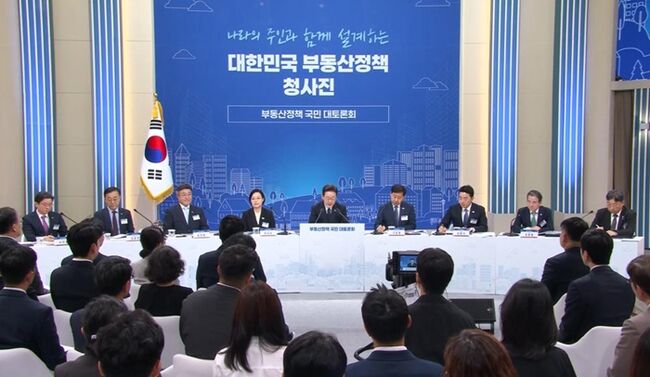 [Liberal Democratic Party Statement] Calling it a Grand Real Estate Debate… It Was Nothing More Than a Private Party Among Themselves
The 'National Grand Debate on Real Estate Policy' held on July 23rd and 27th. [Photo=Yonhap News]The 'National Grand Debate on Real Estate Policy,' hosted by the Lee Jae-myung administration under the
[Liberal Democratic Party Statement] Calling it a Grand Real Estate Debate… It Was Nothing More Than a Private Party Among Themselves
The 'National Grand Debate on Real Estate Policy' held on July 23rd and 27th. [Photo=Yonhap News]The 'National Grand Debate on Real Estate Policy,' hosted by the Lee Jae-myung administration under the
 [Photo] Evidence of Election Fraud Flooding U.S. Media… Trump Had 2.7 Million Votes Stolen
 [Video] U.S. Semiquincentennial Air Show... 'Art in the Sky' streaks across New York
 [Editorial Cartoon] A Draconian Law That Undermines Freedom of Expression

 List
List