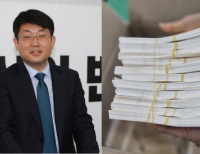
Song Mi-sun, CEO of Hana Tour, speaking her mind at the ‘11th Expanded National Tourism Strategy Meeting’. [YouTube Capture]
The ‘11th Expanded National Tourism Strategy Meeting’ was held at the Blue House on the 25th of last month, ahead of the era of 30 million foreign tourists.
At this meeting, which aims to devise a joint strategy across ministries under the slogan ‘K-Tourism, Embracing the World,’ Song Mi-sun, CEO of Hana Tour, Korea’s largest travel agency, explained a strategy for Korean travel agencies to directly enter overseas markets and attract local customers under the banner of ‘K-Travel Export.’
The Tourism Industry’s Development is Limited Without Improving Unequal Business Environments
To this end, CEO Song requested the government to improve inter-country entry barriers, particularly the unequal business environment in the Chinese market.
He stated, “China operates its business freely in Korea. However, the Chinese market is closed. Foreign companies cannot enter. The Korean government strictly regulates Korean companies. Conversely, foreign companies are not meticulously regulated, and even if there are regulations, there are no sanctions for their non-compliance.”
In her 11-minute speech, CEO Song highlighted the regulatory discrimination faced by domestic companies, explaining that while Korean travel agencies are subject to strict regulations such as the Fair Disclosure and Advertising Act (Fair Disclosure Act) and the Tourism Promotion Act, global platforms operate in regulatory blind spots.
The issue arose when, in response to the question, “The government is willing to invest budget and create organizations if necessary to promote the tourism industry. What exactly should be done?” CEO Song frankly told the President, “We have not considered any support from the Korean government for Korean travel agencies’ inbound business, that is, bringing foreigners to Korea. I apologize.”
This led to criticism from progressives who are now raising issues with CEO Song’s remarks. They seemingly expected her to gratefully accept any help offered by the President and plead for assistance.
CEO Song’s outspoken remarks that day truly revealed how domestic travel agencies have been treated by the government.
The Government Must Stop Discriminating Against Korean Travel Agencies
As of 2025, the Korean travel industry has attracted approximately 16 million people by October, an increase of over 15% compared to the previous year, driven by the K-content craze.
The travel industry has made every effort, navigating various regulations from the Korean government such as the Fair Disclosure Act and the Tourism Promotion Act, to revive the inbound sector, which was severely impacted by COVID-19.
In particular, the Fair Disclosure Act, under the jurisdiction of the Fair Trade Commission, is a law that ‘prohibits unfair disclosures and advertisements, such as false, exaggerated, deceptive, unfairly comparative, or defamatory statements about products and services.’ Violations can result in corrective orders, fines, imprisonment for up to two years, or fines of up to 150 million won, indicating severe penalties.
However, Chinese travel agencies continue their outbound and inbound business freely without such regulations.
CEO Song’s remarks should be interpreted as meaning that any government support is futile without a ‘fair playing field.’
This is not just an issue within the travel industry. The Korean government has been suspected of providing preferential treatment to foreigners residing in Korea (Chinese nationals) in various areas, including △medical insurance △unemployment benefits △unprecedented visa-free policies △eligibility for public service exams (special recruitment).
For example, foreigners residing in Korea for more than six months are eligible for health insurance and receive the same benefits as Korean nationals. Students (D-2 visa) receive a 50% discount on their insurance premiums. This was implemented after controversy arose regarding Chinese nationals taking advantage of Korea’s medical insurance system without paying their fair share, and the residency requirement for foreign dependents on health insurance was strengthened to more than six months starting in 2023.
Some argue that these preferential treatments apply to all foreigners, not just Chinese nationals.
78% of Foreign Unemployment Benefit Recipients are Korean-Chinese and Chinese Nationals
However, according to the Ministry of Justice, as of May 2025, there are 2.73 million foreigners residing in Korea, with Chinese nationals accounting for the largest portion at 972,176, or 35.6% of the total. This means one out of every three foreigners is Chinese.
Yet, regarding unemployment benefits, 78% of foreign unemployment benefit recipients in 2025 were Korean-Chinese and Chinese nationals, meaning approximately 8 out of every 10 recipients were of Korean descent or Chinese nationals.
What does this indicate? If there are 1 million Chinese nationals among the 3 million foreigners residing in Korea, then their proportion of unemployment benefit recipients should be around 30%. However, it is peculiar that the proportion of Chinese nationals receiving unemployment benefits is close to 80% of all foreigners. This is evidence that Chinese nationals are receiving more benefits than any other foreigners, funded by the taxes paid by Korean citizens.
Most foreigners residing in Korea from Vietnam (12.4%), Thailand (6.3%), and Uzbekistan (3.6%) are marriage immigrants who have settled in Korea with their Korean husbands, have children with Korean nationality, and are living in Korea. Therefore, they cannot strictly be considered foreigners.
However, the majority of Chinese residents in Korea are staying for employment and study purposes. They are people who will eventually return to China.
The government needs to distinguish between marriage immigrants who will live in Korea for a long time and Chinese nationals who will eventually return to their home country. Because these groups are not distinguished and are provided with the same benefits such as medical insurance, unemployment benefits, voting rights, and special recruitment for public service, rumors of preferential treatment for Chinese nationals arise.
If Hana Tour, Korea’s largest travel agency, is voicing complaints about discrimination in the field, how much more must ordinary citizens, who faithfully pay taxes for Chinese nationals who will eventually leave for their own country, be feeling?
By Reporter Lim Yo-hee

 [Statement by the Seo-beo-kka Korea Military Academy Save-the-Nation Comrades Association] ㉛ Recount the Votes Publicly, as the Previous Recount Concealed Election Fraud
Tongyeong Mayoral Election Recount [Photo=Yonhap News]South Korea's liberal democracy is dying. The National Election Commission (NEC) and the judiciary, which have plummeted into criminal syndicates
[Statement by the Seo-beo-kka Korea Military Academy Save-the-Nation Comrades Association] ㉛ Recount the Votes Publicly, as the Previous Recount Concealed Election Fraud
Tongyeong Mayoral Election Recount [Photo=Yonhap News]South Korea's liberal democracy is dying. The National Election Commission (NEC) and the judiciary, which have plummeted into criminal syndicates
 What is the significance of the "Trump 2028" red hats that keep making a comeback?
It is noteworthy that President Donald Trump is "intentionally" fueling controversy over whether he can actually run in the 2028 presidential election, even though it is "highly likely he is seriously
What is the significance of the "Trump 2028" red hats that keep making a comeback?
It is noteworthy that President Donald Trump is "intentionally" fueling controversy over whether he can actually run in the 2028 presidential election, even though it is "highly likely he is seriously
 Jin Cummings: "North Korea says it will increase the number of spies, so what is the government doing?"
U.S. political columnist Gene Cummings has publicly questioned the South Korean government, asking, "North Korea is announcing plans to increase its number of spies, yet what is the South Korean
Jin Cummings: "North Korea says it will increase the number of spies, so what is the government doing?"
U.S. political columnist Gene Cummings has publicly questioned the South Korean government, asking, "North Korea is announcing plans to increase its number of spies, yet what is the South Korean
 Attorney Do Tae-woo: “Discrepancies in Voter Count and Improper Sealing Confirmed in Tongyeong Mayoral Recount… Official Request for Further Verification Filed with Gyeongnam Election Commission”
A bundle of out-of-district early voting ballots photographed by attorney Do Tae-woo at the Tongyeong mayoral election recount site. A clear, solid line visible on the side of the ballots raises suspi
Attorney Do Tae-woo: “Discrepancies in Voter Count and Improper Sealing Confirmed in Tongyeong Mayoral Recount… Official Request for Further Verification Filed with Gyeongnam Election Commission”
A bundle of out-of-district early voting ballots photographed by attorney Do Tae-woo at the Tongyeong mayoral election recount site. A clear, solid line visible on the side of the ballots raises suspi
 Stock Market Crash 'Black Tuesday'… KOSPI down 10.8%, KOSDAQ down 7.7%
The KOSPI fell by more than 5% in early trading on the 28th, triggering a sell-side sidecar.On the 28th, the KOSPI plunged by more than 10%.Due to the sharp decline, a sell-side sidecar—a temporary
Stock Market Crash 'Black Tuesday'… KOSPI down 10.8%, KOSDAQ down 7.7%
The KOSPI fell by more than 5% in early trading on the 28th, triggering a sell-side sidecar.On the 28th, the KOSPI plunged by more than 10%.Due to the sharp decline, a sell-side sidecar—a temporary
 [World Heritage Committee] 25 New World Heritage Sites Inscribed in Busan… South Korea Successfully Expands 'Getbol' Listing
The Chairperson of the World Heritage Committee speaks at the plenary session of the 48th session of the World Heritage Committee, held at BEXCO in Busan on the 20th. [Photo: Yonhap News]A total of 25
[World Heritage Committee] 25 New World Heritage Sites Inscribed in Busan… South Korea Successfully Expands 'Getbol' Listing
The Chairperson of the World Heritage Committee speaks at the plenary session of the 48th session of the World Heritage Committee, held at BEXCO in Busan on the 20th. [Photo: Yonhap News]A total of 25
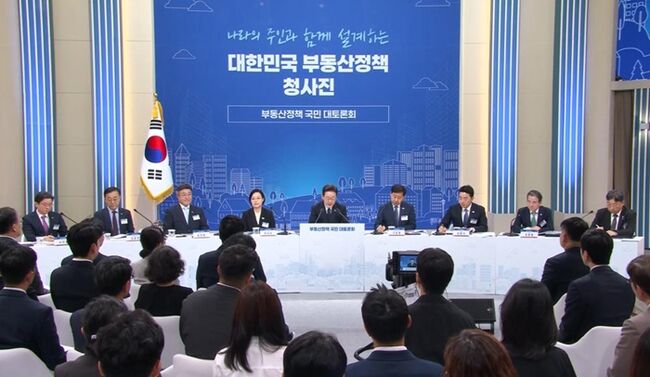 [Liberal Democratic Party Statement] Calling it a Grand Real Estate Debate… It Was Nothing More Than a Private Party Among Themselves
The 'National Grand Debate on Real Estate Policy' held on July 23rd and 27th. [Photo=Yonhap News]The 'National Grand Debate on Real Estate Policy,' hosted by the Lee Jae-myung administration under the
[Liberal Democratic Party Statement] Calling it a Grand Real Estate Debate… It Was Nothing More Than a Private Party Among Themselves
The 'National Grand Debate on Real Estate Policy' held on July 23rd and 27th. [Photo=Yonhap News]The 'National Grand Debate on Real Estate Policy,' hosted by the Lee Jae-myung administration under the
 [Photo] Evidence of Election Fraud Flooding U.S. Media… Trump Had 2.7 Million Votes Stolen
 [Video] U.S. Semiquincentennial Air Show... 'Art in the Sky' streaks across New York
 [Editorial Cartoon] A Draconian Law That Undermines Freedom of Expression

 List
List