Following massive airstrikes by the United States and Israel against Iran and the dramatic arrest of Venezuelan leader Nicolas Maduro, close associates of President Donald Trump have revealed that the administration is preparing to target Cuba as its next major foreign policy objective.
Senator Lindsey Graham (R-S.C.) declared last weekend that "Cuba is next," asserting that the communist government in Cuba is on the verge of collapse.
"The communist dictatorships in Cuba? Their days are numbered," he stated, praising President Trump's foreign policy as exceeding that of former President Ronald Reagan.
Within the administration, the situation is being framed as a historic opportunity not achieved by any of the 12 preceding presidents—the termination of a 67-year-old communist regime established by former Cuban leader Fidel Castro.
Trump himself has fanned the flames of speculation.
Speaking at the White House last week, President Trump stated that Secretary of State Marco Rubio is engaged in high-level talks with Cuban leadership and hinted at the possibility of a "friendly takeover" of Cuba.
"The Cuban government is talking to us," Trump said, "They have no money, they have nothing right now."
"But they're talking to us, and perhaps we can have a friendly takeover," he added.
Administration officials are describing a dual strategy: simultaneously intensifying economic pressure while opening the door to negotiations that could allow U.S. businesses to enter the Cuban market, contingent on political reforms.
Rubio has been engaged in discreet discussions with members of the Castro family, according to reports cited by Axios and an Atlantic column.
Instead of directly negotiating with Cuban President Miguel Díaz-Canel, Secretary Rubio is reportedly reaching out to associates of Raul Castro, particularly his grandson, Raul Guillermo Rodriguez Castro.
For Rubio, who was born to Cuban immigrant parents and rose to prominence in Florida politics by spearheading the anti-Castro movement, these negotiations carry significant personal weight.
One State Department official told Newsmax that Secretary Rubio is looking for figures like "Dexi Rodriguez," who is serving as the interim president of Venezuela and is cooperating with the United States to ensure the transition to democratic elections.
For now, the administration's strategy heavily relies on Cuba's dire economic situation.
Since the United States took control of Venezuela's oil industry in January, subsidized Venezuelan crude oil shipments to Cuba, long a lifeline for the island, have ceased.
Subsequent executive orders threatened tariffs on nations supplying oil to Havana, pressuring alternative sources.
The result has been a cascade of blackouts, factory closures, food shortages, and disruptions to hospital operations.
Canadian and Russian airlines have reportedly suspended flights due to a lack of jet fuel, further crippling Cuba's tourism industry, one of its few sources of foreign currency.
Trump recently characterized Cuba as an "unusual and extraordinary threat," though he offered no detailed explanation for the assertion.
Critics point out that Russia, China, and Iran are not currently deploying missiles in Havana, and Cuba's military equipment is largely Soviet-era.
However, administration officials maintain that economic collapse could trigger internal reforms or a negotiated transition of power.
When asked about the imminence of military action, President Trump stated, "I think it's going to collapse. I think it's going to completely collapse."
Uncertainty is mounting on the island.
Following U.S. airstrikes in Venezuela and against Iran, Cuban counterintelligence agents have reportedly visited areas near military facilities in Havana, collecting lists of residents and preparing evacuation plans.
In Havana, fears have intensified that the United States might pursue a regime change in the style of assassinating leaders, amplified by the recent killing of Iran's supreme leader.
Over the past five years, more than 2 million Cubans have left the island.
Those remaining face daily blackouts, gasoline shortages, and soaring food prices. "For the people there, hunger is all that's left," one Havana resident said of a nearby military installation.
However, public opinion appears divided.
Some religious and civic leaders are calling for a negotiated settlement to prevent civilian casualties, while others openly argue that U.S. intervention may be the only path to ending decades of repression.
With Venezuela destabilized and Iran reeling, the administration believes the geopolitical landscape has fundamentally shifted.
Cuban officials have expressed a willingness to engage in dialogue, but only "without pressure or preconditions."
Cuba, long a symbol of Cold War rivalries, has re-emerged at the center of Washington's ambitions, and the Trump administration appears determined to be at the forefront, Newsmax reports.
By United States NNP=Hong Seong-gu Chief Reporter / Special Correspondent NNP info@newsandpost.com

 [Statement by the Seo-beo-kka Korea Military Academy Save-the-Nation Comrades Association] ㉛ Recount the Votes Publicly, as the Previous Recount Concealed Election Fraud
Tongyeong Mayoral Election Recount [Photo=Yonhap News]South Korea's liberal democracy is dying. The National Election Commission (NEC) and the judiciary, which have plummeted into criminal syndicates
[Statement by the Seo-beo-kka Korea Military Academy Save-the-Nation Comrades Association] ㉛ Recount the Votes Publicly, as the Previous Recount Concealed Election Fraud
Tongyeong Mayoral Election Recount [Photo=Yonhap News]South Korea's liberal democracy is dying. The National Election Commission (NEC) and the judiciary, which have plummeted into criminal syndicates
 What is the significance of the "Trump 2028" red hats that keep making a comeback?
It is noteworthy that President Donald Trump is "intentionally" fueling controversy over whether he can actually run in the 2028 presidential election, even though it is "highly likely he is seriously
What is the significance of the "Trump 2028" red hats that keep making a comeback?
It is noteworthy that President Donald Trump is "intentionally" fueling controversy over whether he can actually run in the 2028 presidential election, even though it is "highly likely he is seriously
 Jin Cummings: "North Korea says it will increase the number of spies, so what is the government doing?"
U.S. political columnist Gene Cummings has publicly questioned the South Korean government, asking, "North Korea is announcing plans to increase its number of spies, yet what is the South Korean
Jin Cummings: "North Korea says it will increase the number of spies, so what is the government doing?"
U.S. political columnist Gene Cummings has publicly questioned the South Korean government, asking, "North Korea is announcing plans to increase its number of spies, yet what is the South Korean
 Attorney Do Tae-woo: “Discrepancies in Voter Count and Improper Sealing Confirmed in Tongyeong Mayoral Recount… Official Request for Further Verification Filed with Gyeongnam Election Commission”
A bundle of out-of-district early voting ballots photographed by attorney Do Tae-woo at the Tongyeong mayoral election recount site. A clear, solid line visible on the side of the ballots raises suspi
Attorney Do Tae-woo: “Discrepancies in Voter Count and Improper Sealing Confirmed in Tongyeong Mayoral Recount… Official Request for Further Verification Filed with Gyeongnam Election Commission”
A bundle of out-of-district early voting ballots photographed by attorney Do Tae-woo at the Tongyeong mayoral election recount site. A clear, solid line visible on the side of the ballots raises suspi
 Stock Market Crash 'Black Tuesday'… KOSPI down 10.8%, KOSDAQ down 7.7%
The KOSPI fell by more than 5% in early trading on the 28th, triggering a sell-side sidecar.On the 28th, the KOSPI plunged by more than 10%.Due to the sharp decline, a sell-side sidecar—a temporary
Stock Market Crash 'Black Tuesday'… KOSPI down 10.8%, KOSDAQ down 7.7%
The KOSPI fell by more than 5% in early trading on the 28th, triggering a sell-side sidecar.On the 28th, the KOSPI plunged by more than 10%.Due to the sharp decline, a sell-side sidecar—a temporary
 [World Heritage Committee] 25 New World Heritage Sites Inscribed in Busan… South Korea Successfully Expands 'Getbol' Listing
The Chairperson of the World Heritage Committee speaks at the plenary session of the 48th session of the World Heritage Committee, held at BEXCO in Busan on the 20th. [Photo: Yonhap News]A total of 25
[World Heritage Committee] 25 New World Heritage Sites Inscribed in Busan… South Korea Successfully Expands 'Getbol' Listing
The Chairperson of the World Heritage Committee speaks at the plenary session of the 48th session of the World Heritage Committee, held at BEXCO in Busan on the 20th. [Photo: Yonhap News]A total of 25
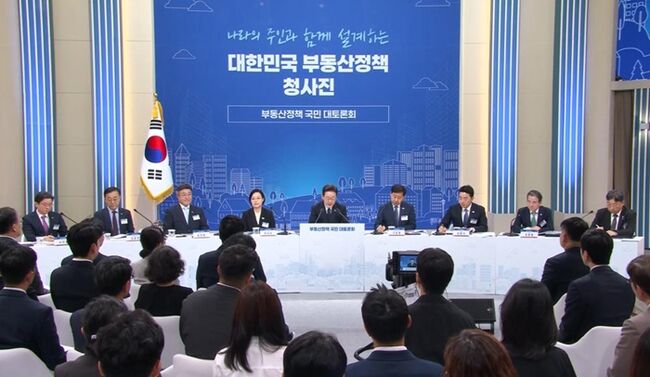 [Liberal Democratic Party Statement] Calling it a Grand Real Estate Debate… It Was Nothing More Than a Private Party Among Themselves
The 'National Grand Debate on Real Estate Policy' held on July 23rd and 27th. [Photo=Yonhap News]The 'National Grand Debate on Real Estate Policy,' hosted by the Lee Jae-myung administration under the
[Liberal Democratic Party Statement] Calling it a Grand Real Estate Debate… It Was Nothing More Than a Private Party Among Themselves
The 'National Grand Debate on Real Estate Policy' held on July 23rd and 27th. [Photo=Yonhap News]The 'National Grand Debate on Real Estate Policy,' hosted by the Lee Jae-myung administration under the
 [Photo] Evidence of Election Fraud Flooding U.S. Media… Trump Had 2.7 Million Votes Stolen
 [Video] U.S. Semiquincentennial Air Show... 'Art in the Sky' streaks across New York
 [Editorial Cartoon] A Draconian Law That Undermines Freedom of Expression

 List
List