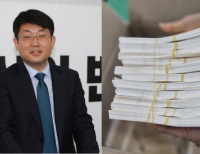
On the 9th, during early trading after the market opened, a program sell order triggered a temporary suspension of trading (sidecar) due to volatility in the KOSPI 200 futures index. This was the first sell-sidecar on the KOSPI market in three trading days since the 4th, and the third this month. [Photo=Yonhap News]
Financial market volatility is rapidly expanding due to soaring international oil prices and continued won depreciation.
Amidst geopolitical instability in the Middle East and global capital movements, the Korean stock market has also been significantly shaken. The market's unease is growing rapidly with continuous selling by foreign investors and a surge in the exchange rate.
The Korean stock market is structurally volatile.
Although individual investors account for a high proportion of trading, the index's direction is heavily influenced by the supply and demand of foreign and institutional investors. When global capital flows change, the Korean market is one of the first to be impacted.
There is another characteristic added to this. It is a market with a high volume of margin trading.
With outstanding margin loans exceeding 30 trillion won, a significant market downturn can erode the collateral ratios of leveraged investment accounts, increasing the pressure for forced selling (reverse trading).
In a market with increased volatility, a flood of forced liquidation orders can create a structure where the decline is further amplified. This is a mechanism that has been repeatedly observed in financial markets for a long time.
What individual investors often refer to as a "shakeout" also occurs during this process. At moments of market turmoil, leveraged investors are the first to be pushed out of the market, and as the decline widens, individual investors repeatedly suffer larger losses.
The problem lies in statements made by the President, who should be aware of such market structures.
The fact that the President conveyed a message to the public to "sell your house and invest in Exchange Traded Funds (ETFs)" was shocking to many.
This is because the President's words are interpreted not as personal opinions but as policy signals.
ETFs are passive investment products that track an index, rather than products that involve analyzing and investing in specific companies.
When individual funds flow into ETFs, they ultimately head to large-cap stocks included in the index, and their prices are determined by the supply and demand of foreign and institutional investors. Individual investors become participants integrated into a market structure driven by foreign and institutional players, rather than being its architects.
The essence of the problem is not ETFs. It is the very fact that the President has begun to dictate investment direction in the stock market to the public.
Fundamentally, the stock market is not a market that the government can design or control.
It is a market driven by a multitude of immense variables, including global capital flows, politics, exchange rates, energy prices, international conflicts, and financial policies.
Within this structure, the language of power cannot help but be interpreted as market signals rather than mere opinions.
It is not that past governments were less competent than the current one in stimulating the stock market.
This is because the stock market is not a market that moves with the President's will. A bull market is created when global capital flows, macroeconomic variables, and the international political environment align, and the market reacts coolly when they do not.
Hankyoreh, in its stock market analysis, has consistently pointed to the so-called 'Trump variable'.
From the geopolitical situation in the Middle East and Iran issues to tariff policies and trade pressures, and global capital movements, the policy direction of U.S. President Trump remains a variable that directly impacts international financial markets.
Ultimately, the stock market moves within the flow of global politics and capital.
Ignoring these variables and solely encouraging domestic investment sentiment will inevitably lead to risks being borne by individual investors.
The stock market is not a market that the government can control. In that market, individual investors are always in the weakest position. This is precisely why the President's remarks must be more cautious.
The moment the President speaks as if they can sway the stock market, their words become not investment advice but a market signal. And individual investors ultimately bear the risks of that signal.
The current state of the KOSPI is a reality created by the President's reckless confidence.

 [Statement by the Seo-beo-kka Korea Military Academy Save-the-Nation Comrades Association] ㉛ Recount the Votes Publicly, as the Previous Recount Concealed Election Fraud
Tongyeong Mayoral Election Recount [Photo=Yonhap News]South Korea's liberal democracy is dying. The National Election Commission (NEC) and the judiciary, which have plummeted into criminal syndicates
[Statement by the Seo-beo-kka Korea Military Academy Save-the-Nation Comrades Association] ㉛ Recount the Votes Publicly, as the Previous Recount Concealed Election Fraud
Tongyeong Mayoral Election Recount [Photo=Yonhap News]South Korea's liberal democracy is dying. The National Election Commission (NEC) and the judiciary, which have plummeted into criminal syndicates
 What is the significance of the "Trump 2028" red hats that keep making a comeback?
It is noteworthy that President Donald Trump is "intentionally" fueling controversy over whether he can actually run in the 2028 presidential election, even though it is "highly likely he is seriously
What is the significance of the "Trump 2028" red hats that keep making a comeback?
It is noteworthy that President Donald Trump is "intentionally" fueling controversy over whether he can actually run in the 2028 presidential election, even though it is "highly likely he is seriously
 Jin Cummings: "North Korea says it will increase the number of spies, so what is the government doing?"
U.S. political columnist Gene Cummings has publicly questioned the South Korean government, asking, "North Korea is announcing plans to increase its number of spies, yet what is the South Korean
Jin Cummings: "North Korea says it will increase the number of spies, so what is the government doing?"
U.S. political columnist Gene Cummings has publicly questioned the South Korean government, asking, "North Korea is announcing plans to increase its number of spies, yet what is the South Korean
 Attorney Do Tae-woo: “Discrepancies in Voter Count and Improper Sealing Confirmed in Tongyeong Mayoral Recount… Official Request for Further Verification Filed with Gyeongnam Election Commission”
A bundle of out-of-district early voting ballots photographed by attorney Do Tae-woo at the Tongyeong mayoral election recount site. A clear, solid line visible on the side of the ballots raises suspi
Attorney Do Tae-woo: “Discrepancies in Voter Count and Improper Sealing Confirmed in Tongyeong Mayoral Recount… Official Request for Further Verification Filed with Gyeongnam Election Commission”
A bundle of out-of-district early voting ballots photographed by attorney Do Tae-woo at the Tongyeong mayoral election recount site. A clear, solid line visible on the side of the ballots raises suspi
 Stock Market Crash 'Black Tuesday'… KOSPI down 10.8%, KOSDAQ down 7.7%
The KOSPI fell by more than 5% in early trading on the 28th, triggering a sell-side sidecar.On the 28th, the KOSPI plunged by more than 10%.Due to the sharp decline, a sell-side sidecar—a temporary
Stock Market Crash 'Black Tuesday'… KOSPI down 10.8%, KOSDAQ down 7.7%
The KOSPI fell by more than 5% in early trading on the 28th, triggering a sell-side sidecar.On the 28th, the KOSPI plunged by more than 10%.Due to the sharp decline, a sell-side sidecar—a temporary
 [World Heritage Committee] 25 New World Heritage Sites Inscribed in Busan… South Korea Successfully Expands 'Getbol' Listing
The Chairperson of the World Heritage Committee speaks at the plenary session of the 48th session of the World Heritage Committee, held at BEXCO in Busan on the 20th. [Photo: Yonhap News]A total of 25
[World Heritage Committee] 25 New World Heritage Sites Inscribed in Busan… South Korea Successfully Expands 'Getbol' Listing
The Chairperson of the World Heritage Committee speaks at the plenary session of the 48th session of the World Heritage Committee, held at BEXCO in Busan on the 20th. [Photo: Yonhap News]A total of 25
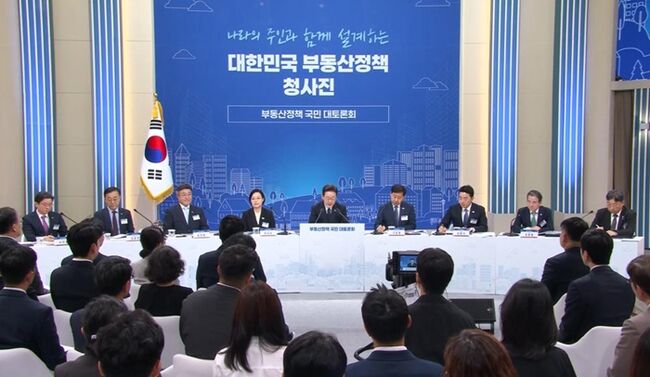 [Liberal Democratic Party Statement] Calling it a Grand Real Estate Debate… It Was Nothing More Than a Private Party Among Themselves
The 'National Grand Debate on Real Estate Policy' held on July 23rd and 27th. [Photo=Yonhap News]The 'National Grand Debate on Real Estate Policy,' hosted by the Lee Jae-myung administration under the
[Liberal Democratic Party Statement] Calling it a Grand Real Estate Debate… It Was Nothing More Than a Private Party Among Themselves
The 'National Grand Debate on Real Estate Policy' held on July 23rd and 27th. [Photo=Yonhap News]The 'National Grand Debate on Real Estate Policy,' hosted by the Lee Jae-myung administration under the
 [Photo] Evidence of Election Fraud Flooding U.S. Media… Trump Had 2.7 Million Votes Stolen
 [Video] U.S. Semiquincentennial Air Show... 'Art in the Sky' streaks across New York
 [Editorial Cartoon] A Draconian Law That Undermines Freedom of Expression

 List
List