President Trump and President Xi (right) [Reuters Yonhap News]
With just over two weeks remaining until the US-China summit, the Trump administration has launched an investigation under Section 301 of the Trade Act to counter tariffs, drawing attention to the implications of this move for US-China relations.
There is an analysis suggesting that the administration is intentionally wielding the Section 301 card, which ignited the US-China trade war in 2018, just before meeting with Chinese President Xi Jinping to bolster its negotiation power at the summit.
On the 11th (local time), the Trump administration announced that it would investigate "overcapacity and production capacity" based on Section 301 of the Trade Act, targeting 15 countries including South Korea, China, and Japan, as well as the European Union (EU).
It also stated that it would conduct separate Section 301 investigations into approximately 60 countries that produce and sell goods through forced labor. The specific countries targeted were not disclosed.
There is an analysis that China is the primary target of this investigation, with overcapacity and forced labor cited as the pretexts.
China is a major surplus country in trade with the US. Although it has been trending towards reducing its reliance on the US due to high tariffs from the Trump administration, it demonstrated its presence last year by recording its largest-ever trade surplus through trade diversification. In this context, Trump administration officials such as Treasury Secretary Scott Bessant have consistently raised the issue of China's overcapacity whenever the opportunity arose.
Forced labor is also an issue that the US administration has repeatedly raised with the Chinese government. The US has accused Chinese authorities of operating forced labor camps while oppressing Muslim minorities, including the Uyghurs, an accusation that China has denied.
Dan Wang, China director at political consulting firm Eurasia Group, told CNBC, a US business media outlet, that while the US is investigating several trade partners, the issues of overcapacity and forced labor clearly indicate that China is the intended target.
In particular, the Trump administration has been perceived as less involved in human rights issues in other countries compared to previous US administrations, including the Biden administration. The fact that the Trump administration is directly addressing the issue of "forced labor" lends credence to the analysis that, in addition to the immediate goal of imposing tariffs, another objective of securing leverage over China may be implied.
The launch of the Section 301 investigation shortly before the US-China summit, targeting the issue of forced labor, may reflect President Trump's intention to use this issue as leverage in negotiations with China.
President Trump's visit to China is scheduled from the 31st to the 2nd of the following month. Currently, the prevailing view is that a "big deal" in economics and security is less likely to occur at the US-China summit during this visit, and a simple agreement to extend the trade truce is more probable.
However, President Trump appears to have an urgent need to achieve results during his visit to China ahead of the November midterm elections, which will determine the congressional landscape for the remaining two years of his term. In addition to extending the trade truce with China, he needs to secure achievements such as increasing China's imports of US soybeans and aircraft, and controlling China's rare earth export restrictions.
The Trump administration had already declared its intention to fill the gap in reciprocal tariffs, which the Supreme Court had ruled illegal, through Section 301 investigations and subsequent additional tariffs. Therefore, while the announcement of this investigation was a foregone conclusion, its timing in conjunction with the US-China summit has effectively provided President Trump with additional bargaining chips.
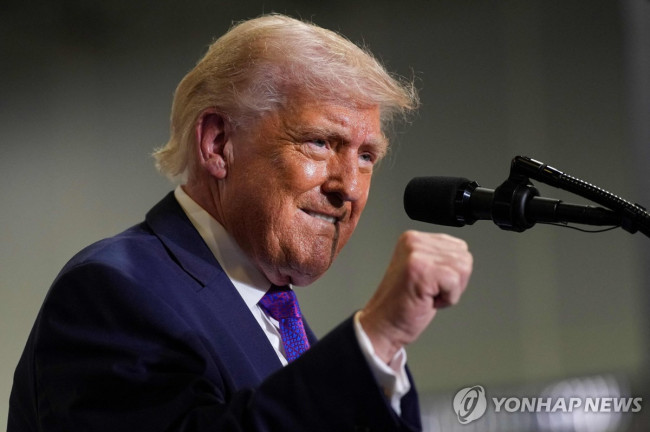 President Trump [AFP Yonhap News]
During his first term, in August 2017, President Trump had already ordered an investigation into China's trade practices under Section 301 of the Trade Act, and in March of the following year, he imposed broad tariffs on Chinese imports, igniting the US-China trade war.
Although a Phase One trade agreement was reached between the US and China afterward, in October of last year, the US again invoked Section 301 of the Trade Act, stating it would investigate the implementation of the agreement. At that time, as President Trump and President Xi were about to meet in Busan during the Asia-Pacific Economic Cooperation (APEC) summit, the analysis was that it was intended to be used as a negotiation leverage.
For now, Chinese authorities, while opposing the Trump administration's launch of this Section 301 investigation, are showing a relatively measured response.
Chinese Foreign Ministry spokesperson Geng Shuang stated at a regular press briefing on the 12th, "We oppose unilateral tariff measures of all forms," adding, "So-called 'overcapacity' is a false proposition, and China opposes its political manipulation."
While clearly stating its opposition, the restrained use of stronger language is interpreted as an attempt to avoid conflict on the eve of the US-China summit. However, it seems likely that China will also prepare its own response logic and counter-measures for the remaining period until the US-China summit.
Section 301 of the Trade Act grants the US administration the authority to respond to trade practices that the US deems unfair and discriminatory with measures such as imposing tariffs. On the 20th of last month, after the federal court ruled the collection of reciprocal tariffs illegal, President Trump announced that he would first impose a 10% tariff globally under Section 122 of the Trade Act and begin investigations under Section 301 of the Trade Act.

 [Statement by the Seo-beo-kka Korea Military Academy Save-the-Nation Comrades Association] ㉛ Recount the Votes Publicly, as the Previous Recount Concealed Election Fraud
Tongyeong Mayoral Election Recount [Photo=Yonhap News]South Korea's liberal democracy is dying. The National Election Commission (NEC) and the judiciary, which have plummeted into criminal syndicates
[Statement by the Seo-beo-kka Korea Military Academy Save-the-Nation Comrades Association] ㉛ Recount the Votes Publicly, as the Previous Recount Concealed Election Fraud
Tongyeong Mayoral Election Recount [Photo=Yonhap News]South Korea's liberal democracy is dying. The National Election Commission (NEC) and the judiciary, which have plummeted into criminal syndicates
 What is the significance of the "Trump 2028" red hats that keep making a comeback?
It is noteworthy that President Donald Trump is "intentionally" fueling controversy over whether he can actually run in the 2028 presidential election, even though it is "highly likely he is seriously
What is the significance of the "Trump 2028" red hats that keep making a comeback?
It is noteworthy that President Donald Trump is "intentionally" fueling controversy over whether he can actually run in the 2028 presidential election, even though it is "highly likely he is seriously
 Jin Cummings: "North Korea says it will increase the number of spies, so what is the government doing?"
U.S. political columnist Gene Cummings has publicly questioned the South Korean government, asking, "North Korea is announcing plans to increase its number of spies, yet what is the South Korean
Jin Cummings: "North Korea says it will increase the number of spies, so what is the government doing?"
U.S. political columnist Gene Cummings has publicly questioned the South Korean government, asking, "North Korea is announcing plans to increase its number of spies, yet what is the South Korean
 Attorney Do Tae-woo: “Discrepancies in Voter Count and Improper Sealing Confirmed in Tongyeong Mayoral Recount… Official Request for Additional Verification Submitted to Gyeongnam Election Commission”
A bundle of mail-in early voting ballots captured by lawyer Do Tae-woo at the Tongyeong mayoral election recount site. A clear solid line, raising suspicions of election fraud, is visible on the side
Attorney Do Tae-woo: “Discrepancies in Voter Count and Improper Sealing Confirmed in Tongyeong Mayoral Recount… Official Request for Additional Verification Submitted to Gyeongnam Election Commission”
A bundle of mail-in early voting ballots captured by lawyer Do Tae-woo at the Tongyeong mayoral election recount site. A clear solid line, raising suspicions of election fraud, is visible on the side
 Stock Market Crash 'Black Tuesday'… KOSPI down 10.8%, KOSDAQ down 7.7%
The KOSPI fell by more than 5% in early trading on the 28th, triggering a sell-side sidecar.On the 28th, the KOSPI plunged by more than 10%.Due to the sharp decline, a sell-side sidecar—a temporary
Stock Market Crash 'Black Tuesday'… KOSPI down 10.8%, KOSDAQ down 7.7%
The KOSPI fell by more than 5% in early trading on the 28th, triggering a sell-side sidecar.On the 28th, the KOSPI plunged by more than 10%.Due to the sharp decline, a sell-side sidecar—a temporary
 [World Heritage Committee] 25 New World Heritage Sites Inscribed in Busan… South Korea Successfully Expands 'Getbol' Listing
The Chairperson of the World Heritage Committee speaks at the plenary session of the 48th session of the World Heritage Committee, held at BEXCO in Busan on the 20th. [Photo: Yonhap News]A total of 25
[World Heritage Committee] 25 New World Heritage Sites Inscribed in Busan… South Korea Successfully Expands 'Getbol' Listing
The Chairperson of the World Heritage Committee speaks at the plenary session of the 48th session of the World Heritage Committee, held at BEXCO in Busan on the 20th. [Photo: Yonhap News]A total of 25
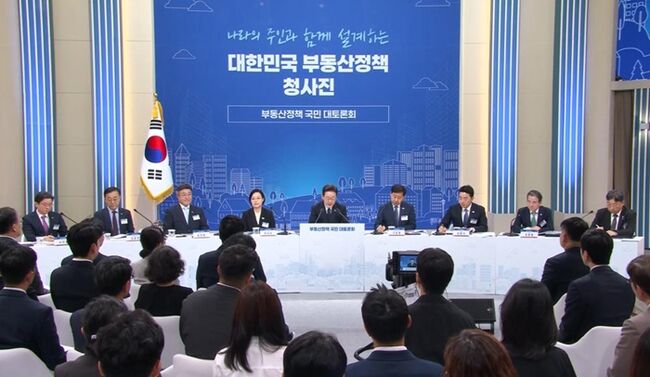 [Liberal Democratic Party Statement] Calling it a Grand Real Estate Debate… It Was Nothing More Than a Private Party Among Themselves
The 'National Grand Debate on Real Estate Policy' held on July 23rd and 27th. [Photo=Yonhap News]The 'National Grand Debate on Real Estate Policy,' hosted by the Lee Jae-myung administration under the
[Liberal Democratic Party Statement] Calling it a Grand Real Estate Debate… It Was Nothing More Than a Private Party Among Themselves
The 'National Grand Debate on Real Estate Policy' held on July 23rd and 27th. [Photo=Yonhap News]The 'National Grand Debate on Real Estate Policy,' hosted by the Lee Jae-myung administration under the
 [Photo] Evidence of Election Fraud Flooding U.S. Media… Trump Had 2.7 Million Votes Stolen
 [Video] U.S. Semiquincentennial Air Show... 'Art in the Sky' streaks across New York
 [Editorial Cartoon] A Draconian Law That Undermines Freedom of Expression

 List
List