The red circle in the map is Jask Port. [Photo=tankertrackers.com]
Following the airstrikes on Kharg Island, the international energy market is naturally posing the next question.
“What is the next vulnerable point in Iran's crude oil export structure?”
A day before the Kharg airstrikes, on the 13th, Yonhap News reported on the possibility of airstrikes on Kharg. Military analysts have long identified this island as a strategic vulnerability for the Iranian economy.
In military strategy, bottlenecks where logistics or energy flows are concentrated are called choke points. These are logistics hubs in peacetime but naturally become targets of attack once war begins.
Following the Kharg airstrikes, analysts are focusing on Jask Port and the Goreh–Jask pipeline.
Jask Port is an oil export terminal located in the Gulf of Oman in southeastern Iran. Unlike Kharg in the northern Persian Gulf, this port is located outside the Strait of Hormuz.
The significance of this location is clear. Tankers departing from Jask can head directly to the Indian Ocean without passing through the Strait of Hormuz.
Iran has built the approximately 1,000 km long Goreh–Jask pipeline to alleviate its reliance on Kharg. This pipeline is designed to transport crude oil produced in the southwestern oil fields directly to Jask Port.
Once this system is fully operational, Iran will have secured an alternative route to maintain its crude oil exports without passing through the Strait of Hormuz. For this reason, Jask is often referred to as the core hub of the 'De-Hormuz Strategy'.
However, Jask is currently considered to not yet possess export infrastructure at a level that can fully replace Kharg.
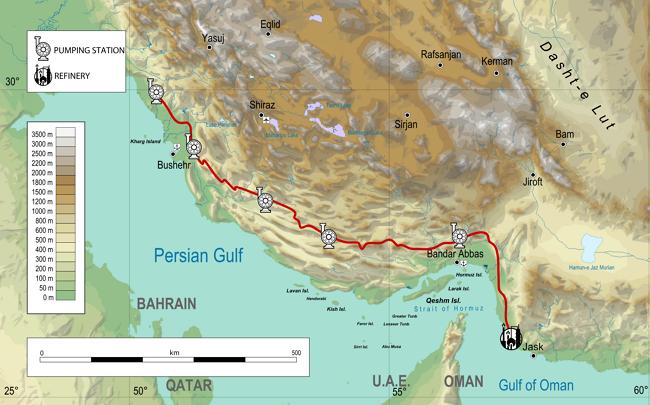 The red line in the photo is the Goreh-Jask pipeline. [Photo=Wikimedia Commons]
Firstly, the scale of storage facilities is limited.
Jask's crude oil storage capacity is known to be around 4 to 5 million barrels. In contrast, Kharg is a large export terminal with storage capacity in the tens of millions of barrels.
The loading infrastructure is also not yet complete.
Jask Port has only partially installed Single Point Mooring (SPM) facilities for loading crude oil onto Very Large Crude Carriers (VLCCs), and the planned full facilities have not yet been established.
Another bottleneck is the transportation capacity of the pipeline itself.
The design capacity of the Goreh–Jask pipeline is around 1 million barrels per day, but its actual operational capacity is estimated to be lower.
Moreover, the fact that most of the approximately 1,000 km pipeline passes through desert areas is also pointed out as a structural vulnerability.
Long-distance pipelines are difficult to defend militarily and are infrastructure that can be easily damaged by relatively small attacks in wartime.
For this reason, some military analysts view Jask Port and the pipeline as a single energy export system and discuss them together as potential attack targets.
Currently, Iran has been exporting around 1.5 to 1.7 million barrels of crude oil per day. A significant portion of this still goes to the global market via Kharg.
If Kharg is Iran's current oil export route, then Jask and the Goreh–Jask pipeline represent the future export structure.
And the logic of war always leads to the same question.
What is the next point of attack?

 [Statement by the Seo-beo-kka Korea Military Academy Save-the-Nation Comrades Association] ㉛ Recount the Votes Publicly, as the Previous Recount Concealed Election Fraud
Tongyeong Mayoral Election Recount [Photo=Yonhap News]South Korea's liberal democracy is dying. The National Election Commission (NEC) and the judiciary, which have plummeted into criminal syndicates
[Statement by the Seo-beo-kka Korea Military Academy Save-the-Nation Comrades Association] ㉛ Recount the Votes Publicly, as the Previous Recount Concealed Election Fraud
Tongyeong Mayoral Election Recount [Photo=Yonhap News]South Korea's liberal democracy is dying. The National Election Commission (NEC) and the judiciary, which have plummeted into criminal syndicates
 What is the significance of the "Trump 2028" red hats that keep making a comeback?
It is noteworthy that President Donald Trump is "intentionally" fueling controversy over whether he can actually run in the 2028 presidential election, even though it is "highly likely he is seriously
What is the significance of the "Trump 2028" red hats that keep making a comeback?
It is noteworthy that President Donald Trump is "intentionally" fueling controversy over whether he can actually run in the 2028 presidential election, even though it is "highly likely he is seriously
 Jin Cummings: "North Korea says it will increase the number of spies, so what is the government doing?"
U.S. political columnist Gene Cummings has publicly questioned the South Korean government, asking, "North Korea is announcing plans to increase its number of spies, yet what is the South Korean
Jin Cummings: "North Korea says it will increase the number of spies, so what is the government doing?"
U.S. political columnist Gene Cummings has publicly questioned the South Korean government, asking, "North Korea is announcing plans to increase its number of spies, yet what is the South Korean
 Attorney Do Tae-woo: “Discrepancies in Voter Count and Improper Sealing Confirmed in Tongyeong Mayoral Recount… Official Request for Additional Verification Submitted to Gyeongnam Election Commission”
A bundle of mail-in early voting ballots captured by lawyer Do Tae-woo at the Tongyeong mayoral election recount site. A clear solid line, raising suspicions of election fraud, is visible on the side
Attorney Do Tae-woo: “Discrepancies in Voter Count and Improper Sealing Confirmed in Tongyeong Mayoral Recount… Official Request for Additional Verification Submitted to Gyeongnam Election Commission”
A bundle of mail-in early voting ballots captured by lawyer Do Tae-woo at the Tongyeong mayoral election recount site. A clear solid line, raising suspicions of election fraud, is visible on the side
 Stock Market Crash 'Black Tuesday'… KOSPI down 10.8%, KOSDAQ down 7.7%
The KOSPI fell by more than 5% in early trading on the 28th, triggering a sell-side sidecar.On the 28th, the KOSPI plunged by more than 10%.Due to the sharp decline, a sell-side sidecar—a temporary
Stock Market Crash 'Black Tuesday'… KOSPI down 10.8%, KOSDAQ down 7.7%
The KOSPI fell by more than 5% in early trading on the 28th, triggering a sell-side sidecar.On the 28th, the KOSPI plunged by more than 10%.Due to the sharp decline, a sell-side sidecar—a temporary
 [World Heritage Committee] 25 New World Heritage Sites Inscribed in Busan… South Korea Successfully Expands 'Getbol' Listing
The Chairperson of the World Heritage Committee speaks at the plenary session of the 48th session of the World Heritage Committee, held at BEXCO in Busan on the 20th. [Photo: Yonhap News]A total of 25
[World Heritage Committee] 25 New World Heritage Sites Inscribed in Busan… South Korea Successfully Expands 'Getbol' Listing
The Chairperson of the World Heritage Committee speaks at the plenary session of the 48th session of the World Heritage Committee, held at BEXCO in Busan on the 20th. [Photo: Yonhap News]A total of 25
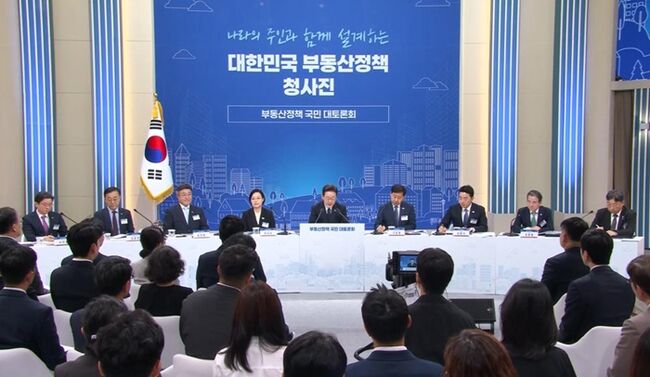 [Liberal Democratic Party Statement] Calling it a Grand Real Estate Debate… It Was Nothing More Than a Private Party Among Themselves
The 'National Grand Debate on Real Estate Policy' held on July 23rd and 27th. [Photo=Yonhap News]The 'National Grand Debate on Real Estate Policy,' hosted by the Lee Jae-myung administration under the
[Liberal Democratic Party Statement] Calling it a Grand Real Estate Debate… It Was Nothing More Than a Private Party Among Themselves
The 'National Grand Debate on Real Estate Policy' held on July 23rd and 27th. [Photo=Yonhap News]The 'National Grand Debate on Real Estate Policy,' hosted by the Lee Jae-myung administration under the
 [Photo] Evidence of Election Fraud Flooding U.S. Media… Trump Had 2.7 Million Votes Stolen
 [Video] U.S. Semiquincentennial Air Show... 'Art in the Sky' streaks across New York
 [Editorial Cartoon] A Draconian Law That Undermines Freedom of Expression

 List
List