U.S. President Donald Trump [EPA Yonhap News]
The New York Times (NYT) reported on the 17th (local time) that U.S. President Donald Trump appears to be considering options to seize or destroy Iran's nuclear weapons materials.
If an operation were successful, it could serve as a justification for President Trump's declaration of victory. However, it is being evaluated as the most dangerous of modern military operations for the U.S. military.
According to the NYT, President Trump has been making statements in recent days that suggest he is weighing options for directly handling highly enriched uranium, which Iran could process into nuclear material feedstock.
President Trump has repeatedly asserted the justification for the ongoing military attack.
In this context, the logic presented by President Trump was that Iran was on the verge of acquiring nuclear weapons and had a high probability of using them against Israel and the United States in the future.
When meeting with reporters on the 16th, President Trump stated, "If Iran has nuclear weapons, they will use them within an hour, within a day, so a bad situation will occur."
According to the International Atomic Energy Agency (IAEA) and reports from prominent media outlets, Iran is estimated to possess 440 kg of enriched uranium with 60% purity.
This is a level that could reach the 90% purity required to build a nuclear bomb within weeks, and it is also observed that the current amount could be used to manufacture 9 to 10 nuclear warheads.
The whereabouts of this weapons-grade highly enriched uranium possessed by Iran are uncertain.
Various theories abound, ranging from speculation that it is among the debris of Iran's Isfahan nuclear facility, which the U.S. bombed last June, to claims that Iran secretly removed it before the bombing.
U.S. Secretary of State Marco Rubio recently stated in Congress that an operation to seize highly enriched uranium would require direct intervention by special forces.
President Trump, meeting with reporters, opened the possibility of deploying special forces, stating, "I am not afraid of ground operations at all."
Regardless of where the nuclear material is located, the mission to seize or destroy it is generally considered to be of unprecedented difficulty in modern warfare.
The NYT pointed out that it would be far more complex and dangerous than the operation to kill Osama bin Laden in 2011 or the operation to capture Venezuelan President Nicolas Maduro in January.
This is because it is difficult to pinpoint the exact location of the hidden uranium, and if the storage containers are damaged, highly toxic radioactive gas could leak.
There are also concerns that a chain reaction could occur if the containers are closely packed.
The possibility that Iran may have prepared tactics for hiding and deceiving regarding nuclear materials is also being raised.
It is speculated that hundreds of decoy containers could be placed within facilities to disrupt U.S. special forces operations.
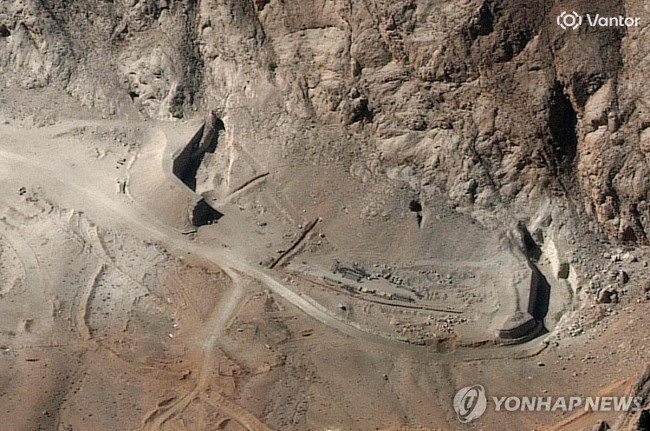 Entrance to a tunnel at Iran's central Isfahan missile base destroyed by U.S. and Israeli attacks. March 8, 2026. [AFP Yonhap News]
There are also many observations that the whereabouts of Iran's weapons-grade enriched uranium are directly linked to President Trump's justification for victory.
The current war, which began on the 28th of last month with surprise air strikes by the U.S. and Israel, is dragging on contrary to the initial expectations of both countries.
Experts point out that if President Trump were to conclude the war under the current circumstances due to costs and deteriorating public opinion, repercussions could follow.
The worst-case scenario is Iran actually embarking on the development of nuclear weapons.
Matthew Bunn, a nuclear expert at Harvard University, expressed concern, stating, "If the U.S. stops its attacks right now, the Iranian regime, harboring resentment from this war, will unprecedentedly pursue the manufacture of nuclear weapons."
There are conflicting assessments regarding how quickly Iran can convert its 60% enriched uranium into weapons.
President Trump claims that before bombing Iran's nuclear facilities last June, Iran could have produced nuclear weapons within a month.
Experts analyze that while Iran could have raised the purity of that enriched uranium to bomb-grade within a month, it would have taken more than several months, possibly up to a year, to build even a crude nuclear weapon.
Joe Kent, Director of the U.S. National Counterterrorism Center (NCTC), also resigned that day, arguing that Iran did not pose an imminent threat to the U.S.
Weapons-grade enriched uranium is drawing attention as a crucial leverage in a situation where conventional missile capabilities have been significantly weakened by the intense bombardment from the U.S. and Israel.
Given the extreme difficulty of a seizure operation, there are also predictions that diplomatic compromises, which were abandoned just before the war's outbreak, could re-emerge at some point.
Iranian Foreign Minister Abbas Araghchi proposed last month to dilute nuclear materials to a level suitable for power generation under IAEA inspection but to store them within Iran.
However, the U.S. rejected this, stating it could not tolerate Iran possessing nuclear materials, leading to the collapse of negotiations and ultimately the outbreak of war.
The NYT reported that while the U.S. approach to removing or diluting weapons-grade enriched uranium could become part of an agreement in future ceasefire negotiations, there are no signs that a solution will emerge through negotiations.

 [Statement by the Seo-beo-kka Korea Military Academy Save-the-Nation Comrades Association] ㉛ Recount the Votes Publicly, as the Previous Recount Concealed Election Fraud
Tongyeong Mayoral Election Recount [Photo=Yonhap News]South Korea's liberal democracy is dying. The National Election Commission (NEC) and the judiciary, which have plummeted into criminal syndicates
[Statement by the Seo-beo-kka Korea Military Academy Save-the-Nation Comrades Association] ㉛ Recount the Votes Publicly, as the Previous Recount Concealed Election Fraud
Tongyeong Mayoral Election Recount [Photo=Yonhap News]South Korea's liberal democracy is dying. The National Election Commission (NEC) and the judiciary, which have plummeted into criminal syndicates
 What is the significance of the "Trump 2028" red hats that keep making a comeback?
It is noteworthy that President Donald Trump is "intentionally" fueling controversy over whether he can actually run in the 2028 presidential election, even though it is "highly likely he is seriously
What is the significance of the "Trump 2028" red hats that keep making a comeback?
It is noteworthy that President Donald Trump is "intentionally" fueling controversy over whether he can actually run in the 2028 presidential election, even though it is "highly likely he is seriously
 Jin Cummings: "North Korea says it will increase the number of spies, so what is the government doing?"
U.S. political columnist Gene Cummings has publicly questioned the South Korean government, asking, "North Korea is announcing plans to increase its number of spies, yet what is the South Korean
Jin Cummings: "North Korea says it will increase the number of spies, so what is the government doing?"
U.S. political columnist Gene Cummings has publicly questioned the South Korean government, asking, "North Korea is announcing plans to increase its number of spies, yet what is the South Korean
 Attorney Do Tae-woo: “Discrepancies in Voter Count and Improper Sealing Confirmed in Tongyeong Mayoral Recount… Official Request for Additional Verification Submitted to Gyeongnam Election Commission”
A bundle of mail-in early voting ballots captured by lawyer Do Tae-woo at the Tongyeong mayoral election recount site. A clear solid line, raising suspicions of election fraud, is visible on the side
Attorney Do Tae-woo: “Discrepancies in Voter Count and Improper Sealing Confirmed in Tongyeong Mayoral Recount… Official Request for Additional Verification Submitted to Gyeongnam Election Commission”
A bundle of mail-in early voting ballots captured by lawyer Do Tae-woo at the Tongyeong mayoral election recount site. A clear solid line, raising suspicions of election fraud, is visible on the side
 Stock Market Crash 'Black Tuesday'… KOSPI down 10.8%, KOSDAQ down 7.7%
The KOSPI fell by more than 5% in early trading on the 28th, triggering a sell-side sidecar.On the 28th, the KOSPI plunged by more than 10%.Due to the sharp decline, a sell-side sidecar—a temporary
Stock Market Crash 'Black Tuesday'… KOSPI down 10.8%, KOSDAQ down 7.7%
The KOSPI fell by more than 5% in early trading on the 28th, triggering a sell-side sidecar.On the 28th, the KOSPI plunged by more than 10%.Due to the sharp decline, a sell-side sidecar—a temporary
 [World Heritage Committee] 25 New World Heritage Sites Inscribed in Busan… South Korea Successfully Expands 'Getbol' Listing
The Chairperson of the World Heritage Committee speaks at the plenary session of the 48th session of the World Heritage Committee, held at BEXCO in Busan on the 20th. [Photo: Yonhap News]A total of 25
[World Heritage Committee] 25 New World Heritage Sites Inscribed in Busan… South Korea Successfully Expands 'Getbol' Listing
The Chairperson of the World Heritage Committee speaks at the plenary session of the 48th session of the World Heritage Committee, held at BEXCO in Busan on the 20th. [Photo: Yonhap News]A total of 25
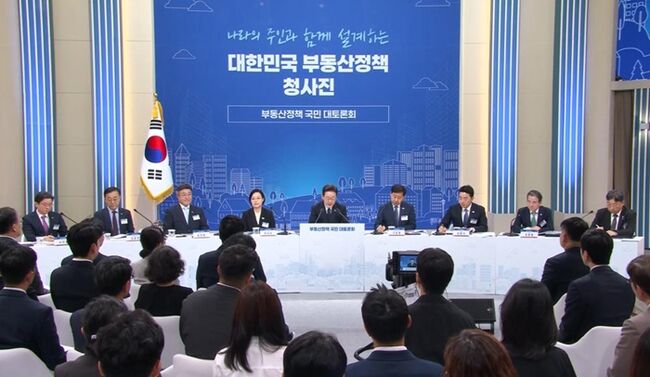 [Liberal Democratic Party Statement] Calling it a Grand Real Estate Debate… It Was Nothing More Than a Private Party Among Themselves
The 'National Grand Debate on Real Estate Policy' held on July 23rd and 27th. [Photo=Yonhap News]The 'National Grand Debate on Real Estate Policy,' hosted by the Lee Jae-myung administration under the
[Liberal Democratic Party Statement] Calling it a Grand Real Estate Debate… It Was Nothing More Than a Private Party Among Themselves
The 'National Grand Debate on Real Estate Policy' held on July 23rd and 27th. [Photo=Yonhap News]The 'National Grand Debate on Real Estate Policy,' hosted by the Lee Jae-myung administration under the
 [Photo] Evidence of Election Fraud Flooding U.S. Media… Trump Had 2.7 Million Votes Stolen
 [Video] U.S. Semiquincentennial Air Show... 'Art in the Sky' streaks across New York
 [Editorial Cartoon] A Draconian Law That Undermines Freedom of Expression

 List
List