New York Stock Exchange, USA [EPA=Yonhap News]
Investor funds that were heading towards global markets are now flowing back into the United States in the aftermath of the war in Iran, according to a report by the U.S. daily Wall Street Journal (WSJ) on the 21st (local time).
Following the outbreak of the war at the end of February, overseas stock markets all saw declines. The U.S. was no exception, but the drop was relatively limited.
The MSCI World ex USA Index fell by about 10%, while the U.S. index only dropped by 5.4%. Germany's DAX index and Japan's Nikkei average stock price also declined by 11% and 9.3%, respectively.
The Korean stock market showed a similar trend. According to the Korea Exchange, the KOSPI fell by 7.41%.
The surge in oil prices was a major factor behind this trend.
The United States is the world's largest producer of oil and natural gas. It has a structure that can relatively absorb the shock of rising energy prices. Combined with solid corporate earnings, U.S. assets are re-emerging as a 'safe haven' in an increasingly uncertain market.
In contrast, energy importers, including South Korea, face increased cost burdens and a structure where investment attractiveness is relatively weakened.
The situation was different before the war. Europe and Asia attracted investors' interest based on expanded fiscal spending and relatively low valuations, and were also seen as alternative investment destinations to avoid concerns about overheating in AI-related stocks.
As a result, the global MSCI index surged by 29% last year, significantly outpacing the rise in U.S. stock prices (16%). This was the largest difference since 2009.
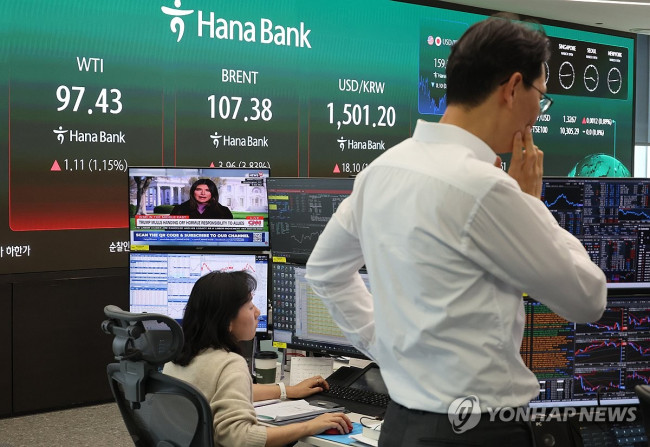 Rising oil prices and a strong dollar due to the Middle East war As the Iran war intensifies, oil prices and the dollar continue to strengthen. On the 19th, the status board at the dealing room of Hana Bank in Jung-gu, Seoul, displays the won/dollar exchange rate, which has soared to its highest level since the financial crisis, and the benchmark international oil prices, Brent crude and West Texas Intermediate (WTI). [Yonhap News]
In particular, according to the Korea Exchange, the KOSPI's growth rate last year was 75.6%, ranking first among G20 and OECD member countries.
Michael Rosen, Chief Investment Officer at Angeles Investments, told the WSJ that he had increased his investment in European and emerging markets at the beginning of the year, but changed his investment direction in less than two months.
"We are currently taking a very neutral stance and are closely watching how this situation will unfold," he added.
Michael Green, senior market strategist at Simplify Asset Management, cited South Korea as an example, arguing that there were not enough fundamentals to justify the previous strength of overseas stock markets.
Green pointed to South Korea's heavy reliance on natural gas imports and its proximity to North Korea.
"I don't think this movement is sustainable," he said.
However, it is unclear how long the current trend of U.S. outperformance will last.
The rise in energy prices is lowering expectations for interest rate cuts by the Federal Reserve (Fed), which was a major supporting factor for U.S. stocks. Some even suggest the possibility of interest rate hikes rather than cuts.
If the global economy slows down, it will be difficult for U.S. companies to avoid the impact, and concerns about defaults in the private credit loan market are also being raised due to lingering anxieties related to AI.

 [Statement by the Seo-beo-kka Korea Military Academy Save-the-Nation Comrades Association] ㉛ Recount the Votes Publicly, as the Previous Recount Concealed Election Fraud
Tongyeong Mayoral Election Recount [Photo=Yonhap News]South Korea's liberal democracy is dying. The National Election Commission (NEC) and the judiciary, which have plummeted into criminal syndicates
[Statement by the Seo-beo-kka Korea Military Academy Save-the-Nation Comrades Association] ㉛ Recount the Votes Publicly, as the Previous Recount Concealed Election Fraud
Tongyeong Mayoral Election Recount [Photo=Yonhap News]South Korea's liberal democracy is dying. The National Election Commission (NEC) and the judiciary, which have plummeted into criminal syndicates
 What is the significance of the "Trump 2028" red hats that keep making a comeback?
It is noteworthy that President Donald Trump is "intentionally" fueling controversy over whether he can actually run in the 2028 presidential election, even though it is "highly likely he is seriously
What is the significance of the "Trump 2028" red hats that keep making a comeback?
It is noteworthy that President Donald Trump is "intentionally" fueling controversy over whether he can actually run in the 2028 presidential election, even though it is "highly likely he is seriously
 Jin Cummings: "North Korea says it will increase the number of spies, so what is the government doing?"
U.S. political columnist Gene Cummings has publicly questioned the South Korean government, asking, "North Korea is announcing plans to increase its number of spies, yet what is the South Korean
Jin Cummings: "North Korea says it will increase the number of spies, so what is the government doing?"
U.S. political columnist Gene Cummings has publicly questioned the South Korean government, asking, "North Korea is announcing plans to increase its number of spies, yet what is the South Korean
 Attorney Do Tae-woo: “Discrepancies in Voter Count and Improper Sealing Confirmed in Tongyeong Mayoral Recount… Official Request for Additional Verification Submitted to Gyeongnam Election Commission”
A bundle of mail-in early voting ballots captured by lawyer Do Tae-woo at the Tongyeong mayoral election recount site. A clear solid line, raising suspicions of election fraud, is visible on the side
Attorney Do Tae-woo: “Discrepancies in Voter Count and Improper Sealing Confirmed in Tongyeong Mayoral Recount… Official Request for Additional Verification Submitted to Gyeongnam Election Commission”
A bundle of mail-in early voting ballots captured by lawyer Do Tae-woo at the Tongyeong mayoral election recount site. A clear solid line, raising suspicions of election fraud, is visible on the side
 Stock Market Crash 'Black Tuesday'… KOSPI down 10.8%, KOSDAQ down 7.7%
The KOSPI fell by more than 5% in early trading on the 28th, triggering a sell-side sidecar.On the 28th, the KOSPI plunged by more than 10%.Due to the sharp decline, a sell-side sidecar—a temporary
Stock Market Crash 'Black Tuesday'… KOSPI down 10.8%, KOSDAQ down 7.7%
The KOSPI fell by more than 5% in early trading on the 28th, triggering a sell-side sidecar.On the 28th, the KOSPI plunged by more than 10%.Due to the sharp decline, a sell-side sidecar—a temporary
 [World Heritage Committee] 25 New World Heritage Sites Inscribed in Busan… South Korea Successfully Expands 'Getbol' Listing
The Chairperson of the World Heritage Committee speaks at the plenary session of the 48th session of the World Heritage Committee, held at BEXCO in Busan on the 20th. [Photo: Yonhap News]A total of 25
[World Heritage Committee] 25 New World Heritage Sites Inscribed in Busan… South Korea Successfully Expands 'Getbol' Listing
The Chairperson of the World Heritage Committee speaks at the plenary session of the 48th session of the World Heritage Committee, held at BEXCO in Busan on the 20th. [Photo: Yonhap News]A total of 25
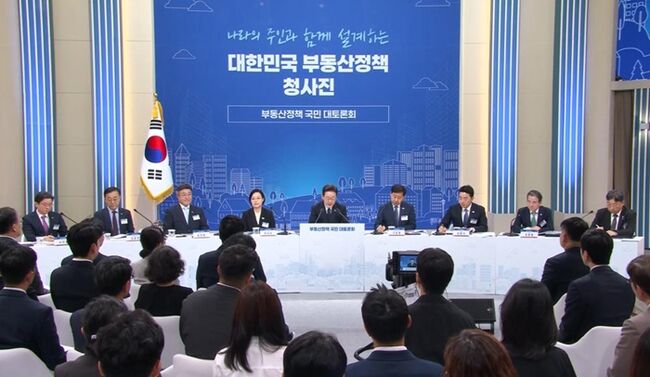 [Liberal Democratic Party Statement] Calling it a Grand Real Estate Debate… It Was Nothing More Than a Private Party Among Themselves
The 'National Grand Debate on Real Estate Policy' held on July 23rd and 27th. [Photo=Yonhap News]The 'National Grand Debate on Real Estate Policy,' hosted by the Lee Jae-myung administration under the
[Liberal Democratic Party Statement] Calling it a Grand Real Estate Debate… It Was Nothing More Than a Private Party Among Themselves
The 'National Grand Debate on Real Estate Policy' held on July 23rd and 27th. [Photo=Yonhap News]The 'National Grand Debate on Real Estate Policy,' hosted by the Lee Jae-myung administration under the
 [Photo] Evidence of Election Fraud Flooding U.S. Media… Trump Had 2.7 Million Votes Stolen
 [Video] U.S. Semiquincentennial Air Show... 'Art in the Sky' streaks across New York
 [Editorial Cartoon] A Draconian Law That Undermines Freedom of Expression

 List
List