Gunpo City Hall inspecting the implementation of the 5-day driving restriction. On the 25th, the first day of strengthened implementation of the public sector's 5-day driving restriction as an energy conservation measure due to the Middle East situation, public institutions nationwide generally carried out the system in a calm atmosphere. [Photo=Yonhap News]
As energy supply and demand instability becomes a reality due to rising tensions in the Strait of Hormuz, the government has stepped in to curb demand by introducing a '5-day driving ban for passenger cars'.
However, criticism of "yet another belated response" is emerging from the market. This is because the approach of reducing consumption without securing supply is being repeated.
The starting point of this controversy is '900,000 barrels of crude oil'.
Despite the government having the priority purchase right for the jointly managed international reserves stored in Ulsan, it failed to exercise this right in a timely manner, resulting in the oil being exported. Consequently, strategic reserves that could have been used in a crisis have effectively disappeared.
The problem is that this incident revealed not just an administrative error but a structural limitation. The government has consistently emphasized "sufficient reserves." However, if these reserves did not function in an actual crisis, it is a systemic issue, not just a matter of numbers. It means that while the reserves existed, they were unusable.
In this situation, the government's move is the '5-day driving ban for passenger cars.' This measure aims to reduce fuel consumption by restricting vehicle operation. This approach, which also appeared during past oil crises, is a typical administrative tool for crisis response. However, the market is raising concerns that this measure might be an attempt to "cover up supply failures with demand control."
Indeed, the current response pattern shows a consistent trend.
Failure to secure supply → Price increase → Demand suppression policy → Burden shifted to citizens.
The direction of policy is shifting from market response to control. In particular, the fact that post-crisis measures were implemented before proactive responses, despite anticipated instability in crude oil supply and demand, raises questions about the government's crisis management capabilities.
The bigger problem is trust.
The government has repeatedly stated that "energy reserves are sufficient." However, this incident revealed how detached those words are from reality. It has been confirmed that the crucial factor is not the scale of reserves but whether they can actually be used.
The most important factor in energy policy is 'time'.
Secured quantities at the onset of a crisis represent not just volume but also room for response. The 900,000 barrels lost this time are not merely a few hours' worth of consumption, but a loss of time for initial response.
As a result, the government has resorted to the easiest option once again: consumption control.
However, the market already knows this. It knows that control policies, in a state where supply has been missed, are not a fundamental solution.
This situation is not simply an energy supply and demand issue.
It poses the question: "Is the crisis response system actually functioning?"
And the answer, based on the flow so far, is far from positive.

 [Statement by the Seo-beo-kka Korea Military Academy Save-the-Nation Comrades Association] ㉛ Recount the Votes Publicly, as the Previous Recount Concealed Election Fraud
Tongyeong Mayoral Election Recount [Photo=Yonhap News]South Korea's liberal democracy is dying. The National Election Commission (NEC) and the judiciary, which have plummeted into criminal syndicates
[Statement by the Seo-beo-kka Korea Military Academy Save-the-Nation Comrades Association] ㉛ Recount the Votes Publicly, as the Previous Recount Concealed Election Fraud
Tongyeong Mayoral Election Recount [Photo=Yonhap News]South Korea's liberal democracy is dying. The National Election Commission (NEC) and the judiciary, which have plummeted into criminal syndicates
 What is the significance of the "Trump 2028" red hats that keep making a comeback?
It is noteworthy that President Donald Trump is "intentionally" fueling controversy over whether he can actually run in the 2028 presidential election, even though it is "highly likely he is seriously
What is the significance of the "Trump 2028" red hats that keep making a comeback?
It is noteworthy that President Donald Trump is "intentionally" fueling controversy over whether he can actually run in the 2028 presidential election, even though it is "highly likely he is seriously
 Jin Cummings: “North Korea says it will increase the number of spies, so what is the government doing?”
U.S. political columnist Gene Cummings has publicly questioned the South Korean government, asking, "North Korea is declaring that it will increase its number of spies, so what is the South Kore
Jin Cummings: “North Korea says it will increase the number of spies, so what is the government doing?”
U.S. political columnist Gene Cummings has publicly questioned the South Korean government, asking, "North Korea is declaring that it will increase its number of spies, so what is the South Kore
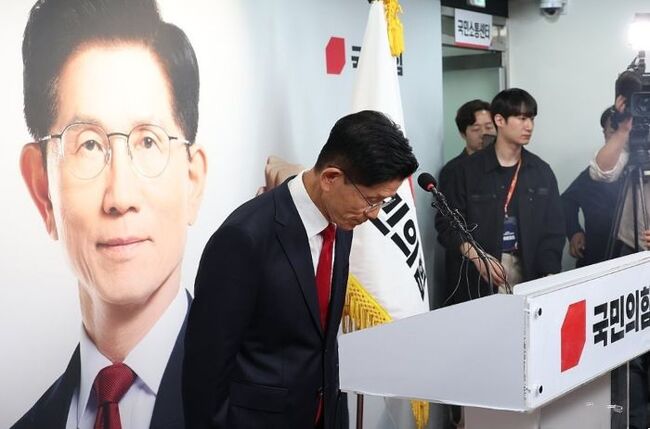 “Too little, too late?…” Kim Moon-soo, who previously conceded his presidential election defeat, now demands a special counsel investigation into ‘allegations of election fraud in the 2025 presidential election’
People Power Party presidential candidate Kim Moon-soo concedes defeat during a press conference at the party headquarters in Yeouido, Seoul, on June 4, 2025. [Joint Press Corps]As allegations emerge
“Too little, too late?…” Kim Moon-soo, who previously conceded his presidential election defeat, now demands a special counsel investigation into ‘allegations of election fraud in the 2025 presidential election’
People Power Party presidential candidate Kim Moon-soo concedes defeat during a press conference at the party headquarters in Yeouido, Seoul, on June 4, 2025. [Joint Press Corps]As allegations emerge
 Stock Market Crash 'Black Tuesday'… KOSPI down 10.8%, KOSDAQ down 7.7%
The KOSPI fell by more than 5% in early trading on the 28th, triggering a sell-side sidecar.On the 28th, the KOSPI plunged by more than 10%.Due to the sharp decline, a sell-side sidecar—a temporary
Stock Market Crash 'Black Tuesday'… KOSPI down 10.8%, KOSDAQ down 7.7%
The KOSPI fell by more than 5% in early trading on the 28th, triggering a sell-side sidecar.On the 28th, the KOSPI plunged by more than 10%.Due to the sharp decline, a sell-side sidecar—a temporary
 [World Heritage Committee] 25 New World Heritage Sites Inscribed in Busan… South Korea Successfully Expands 'Getbol' Listing
The Chairperson of the World Heritage Committee speaks at the plenary session of the 48th session of the World Heritage Committee, held at BEXCO in Busan on the 20th. [Photo: Yonhap News]A total of 25
[World Heritage Committee] 25 New World Heritage Sites Inscribed in Busan… South Korea Successfully Expands 'Getbol' Listing
The Chairperson of the World Heritage Committee speaks at the plenary session of the 48th session of the World Heritage Committee, held at BEXCO in Busan on the 20th. [Photo: Yonhap News]A total of 25
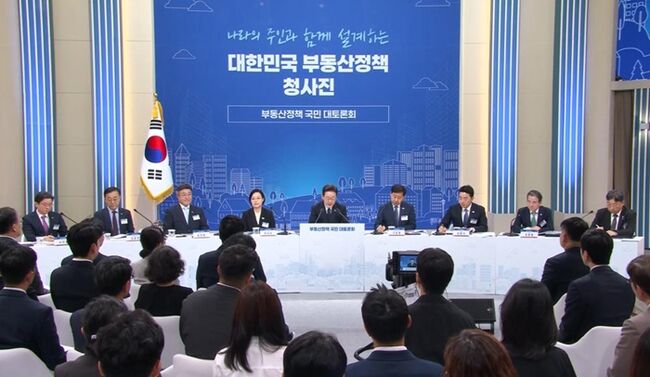 [Liberal Democratic Party Statement] Calling it a Grand Real Estate Debate… It Was Nothing More Than a Private Party Among Themselves
The 'National Grand Debate on Real Estate Policy' held on July 23rd and 27th. [Photo=Yonhap News]The 'National Grand Debate on Real Estate Policy,' hosted by the Lee Jae-myung administration under the
[Liberal Democratic Party Statement] Calling it a Grand Real Estate Debate… It Was Nothing More Than a Private Party Among Themselves
The 'National Grand Debate on Real Estate Policy' held on July 23rd and 27th. [Photo=Yonhap News]The 'National Grand Debate on Real Estate Policy,' hosted by the Lee Jae-myung administration under the
 [Photo] Evidence of Election Fraud Flooding U.S. Media… Trump Had 2.7 Million Votes Stolen
 [Video] U.S. Semiquincentennial Air Show... 'Art in the Sky' streaks across New York
 [Editorial Cartoon] A Draconian Law That Undermines Freedom of Expression

 List
List