"If the state appeals to its citizens, asking seniors to refrain from using public transportation during rush hour, how many people would actually leave early for their morning commute."
President Lee Jae-myung reportedly instructed a cabinet meeting to consider limiting free subway rides for seniors as a measure to alleviate traffic congestion during commute hours.
As someone who benefits from the free ride program, I feel a bit apologetic writing this, but I cannot help but express my frustration with Lee Jae-myung's approach to national governance, which seems to solely focus on financial solutions for every problem.
Does this mean carrying two separate tickets: one for free rides and one for paid rides?
Traffic congestion during commute hours is a concern for governments not only in Korea but worldwide. This problem is particularly pronounced in capitalist countries due to population concentration in urban areas.
Consequently, other countries attempt to stagger work hours and increase transportation options, but these measures provide only temporary relief. South Korea is no exception. While I understand the Lee Jae-myung administration's efforts to solve this transportation dilemma, the proposed solution is deeply problematic.
It is true that with a drastically low birth rate and increasing life expectancy, the elderly population is growing, leading to a rise in the number of seniors using the subway.
However, explicitly blaming seniors for commute hour traffic congestion and attempting to solve the problem by restricting their free rides is utterly pathetic and frustrating. It even makes one wonder if Lee Jae-myung harbors some personal grudge against the elderly.
To be blunt, I believe this approach will only provoke criticism from the elderly population and yield little significant effect.
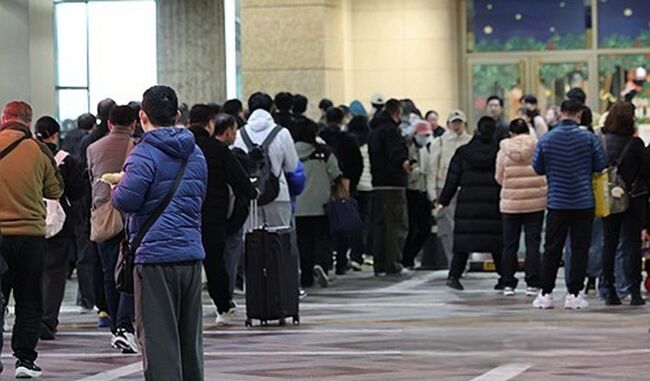 Chinese tourists occupying streets and roads from the morning. [Photo = Yonhap News]
Firstly, it's impractical to expect seniors to switch their current free ride passes to regular fare tickets solely during commute hours. This would necessitate seniors carrying two separate tickets: one for free rides and one for paid rides.
I fail to understand why the Lee Jae-myung administration insists on addressing every issue solely through financial means. Even in a highly individualistic capitalist society like South Korea, the elderly are not inherently selfish or ignorant individuals.
If the state appeals to its citizens, asking seniors to refrain from using public transportation during rush hour, how many people would actually leave early for their morning commute.
Frankly, very few people take the subway during morning rush hour purely for leisure. To portray this situation as a traffic paralysis caused by seniors reflects poorly on Lee Jae-myung's judgment.
If various clubs and senior organizations were guided to schedule their events outside of commute hours, and the government recommended this, there would likely be no public opposition from citizens or organizations.
Why Blame Korean Seniors When Chinese are Also Present?
In North Korea, where transportation is significantly less developed than in South Korea, one can only imagine how crowded the Pyongyang subway and buses are during peak hours.
Therefore, North Korea also educates (informs) seniors to largely refrain from using the subway during commute hours. Of course, in North Korea, there are no places for seniors to go for leisure like in South Korea, nor are there any events organized for them, so they generally have no particular reason to go out in the morning. Nevertheless, seniors are cautioned against taking the subway during commute hours.
I believe Korean seniors are no different. Of course, for the few individuals who are genuinely in a hurry, what can be done? It's impossible to prevent everyone.
If traffic congestion during commute hours is truly believed to be caused by seniors, then it would be more logical to either abolish the senior free ride system entirely or adjust the eligibility age to 80 and above. Of course, even then, the traffic congestion would likely not change significantly.
Furthermore, when I occasionally ride the subway during commute hours, I observe more Chinese and ethnic Korean seniors (over 65) than Korean seniors. It's astonishing how many Chinese individuals are on the subway even during daylight hours. If we are to assign blame, it lies with the Moon Jae-in and Lee Jae-myung administrations for attracting millions of Chinese visitors, contributing to the congestion in the Seoul metropolitan area.
It is truly embarrassing that the Lee Jae-myung administration refuses to reflect on its own policy failures and instead shifts the blame onto its own elderly citizens.
If the government genuinely wishes to resolve the issue of commute hour traffic congestion, it should first relocate the Blue House and the National Assembly to Sejong City.
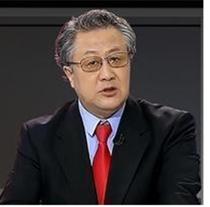
◆ Advisor Kim Tae-san
Advisor to The Hankyoreh, former representative of a North Korean trading company stationed in the Czech Republic. In South Korea, he has served as Vice President of the North Korea Social Science Research Institute, providing insightful analysis and experience on inter-Korean relations and North Korean affairs.

 [Statement by the Seo-beo-kka Korea Military Academy Save-the-Nation Comrades Association] ㉛ Recount the Votes Publicly, as the Previous Recount Concealed Election Fraud
Tongyeong Mayoral Election Recount [Photo=Yonhap News]South Korea's liberal democracy is dying. The National Election Commission (NEC) and the judiciary, which have plummeted into criminal syndicates
[Statement by the Seo-beo-kka Korea Military Academy Save-the-Nation Comrades Association] ㉛ Recount the Votes Publicly, as the Previous Recount Concealed Election Fraud
Tongyeong Mayoral Election Recount [Photo=Yonhap News]South Korea's liberal democracy is dying. The National Election Commission (NEC) and the judiciary, which have plummeted into criminal syndicates
 What is the significance of the "Trump 2028" red hats that keep making a comeback?
It is noteworthy that President Donald Trump is "intentionally" fueling controversy over whether he can actually run in the 2028 presidential election, even though it is "highly likely he is seriously
What is the significance of the "Trump 2028" red hats that keep making a comeback?
It is noteworthy that President Donald Trump is "intentionally" fueling controversy over whether he can actually run in the 2028 presidential election, even though it is "highly likely he is seriously
 Jin Cummings: “North Korea says it will increase the number of spies, so what is the government doing?”
U.S. political columnist Gene Cummings has publicly questioned the South Korean government, asking, "North Korea is declaring that it will increase its number of spies, so what is the South Kore
Jin Cummings: “North Korea says it will increase the number of spies, so what is the government doing?”
U.S. political columnist Gene Cummings has publicly questioned the South Korean government, asking, "North Korea is declaring that it will increase its number of spies, so what is the South Kore
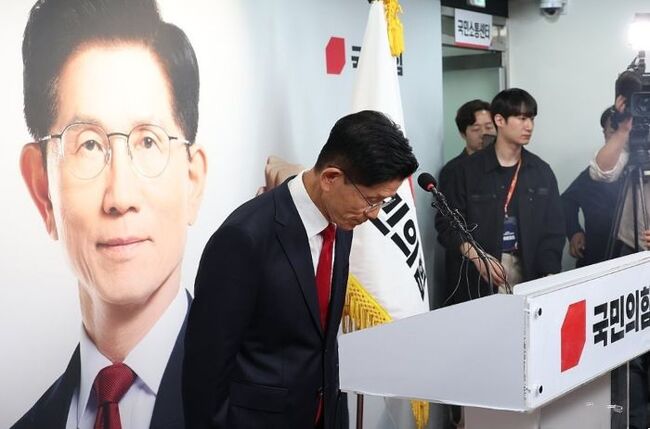 “Too little, too late?…” Kim Moon-soo, who previously conceded his presidential election defeat, now demands a special counsel investigation into ‘allegations of election fraud in the 2025 presidential election’
People Power Party presidential candidate Kim Moon-soo concedes defeat during a press conference at the party headquarters in Yeouido, Seoul, on June 4, 2025. [Joint Press Corps]As allegations emerge
“Too little, too late?…” Kim Moon-soo, who previously conceded his presidential election defeat, now demands a special counsel investigation into ‘allegations of election fraud in the 2025 presidential election’
People Power Party presidential candidate Kim Moon-soo concedes defeat during a press conference at the party headquarters in Yeouido, Seoul, on June 4, 2025. [Joint Press Corps]As allegations emerge
 Stock Market Crash 'Black Tuesday'… KOSPI down 10.8%, KOSDAQ down 7.7%
The KOSPI fell by more than 5% in early trading on the 28th, triggering a sell-side sidecar.On the 28th, the KOSPI plunged by more than 10%.Due to the sharp decline, a sell-side sidecar—a temporary
Stock Market Crash 'Black Tuesday'… KOSPI down 10.8%, KOSDAQ down 7.7%
The KOSPI fell by more than 5% in early trading on the 28th, triggering a sell-side sidecar.On the 28th, the KOSPI plunged by more than 10%.Due to the sharp decline, a sell-side sidecar—a temporary
 [World Heritage Committee] 25 New World Heritage Sites Inscribed in Busan… South Korea Successfully Expands 'Getbol' Listing
The Chairperson of the World Heritage Committee speaks at the plenary session of the 48th session of the World Heritage Committee, held at BEXCO in Busan on the 20th. [Photo: Yonhap News]A total of 25
[World Heritage Committee] 25 New World Heritage Sites Inscribed in Busan… South Korea Successfully Expands 'Getbol' Listing
The Chairperson of the World Heritage Committee speaks at the plenary session of the 48th session of the World Heritage Committee, held at BEXCO in Busan on the 20th. [Photo: Yonhap News]A total of 25
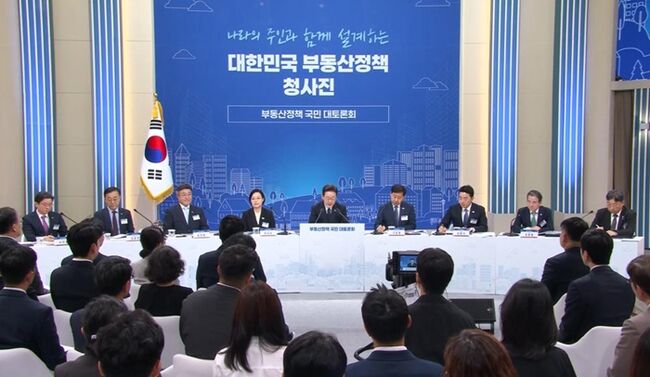 [Liberal Democratic Party Statement] Calling it a Grand Real Estate Debate… It Was Nothing More Than a Private Party Among Themselves
The 'National Grand Debate on Real Estate Policy' held on July 23rd and 27th. [Photo=Yonhap News]The 'National Grand Debate on Real Estate Policy,' hosted by the Lee Jae-myung administration under the
[Liberal Democratic Party Statement] Calling it a Grand Real Estate Debate… It Was Nothing More Than a Private Party Among Themselves
The 'National Grand Debate on Real Estate Policy' held on July 23rd and 27th. [Photo=Yonhap News]The 'National Grand Debate on Real Estate Policy,' hosted by the Lee Jae-myung administration under the
 [Photo] Evidence of Election Fraud Flooding U.S. Media… Trump Had 2.7 Million Votes Stolen
 [Video] U.S. Semiquincentennial Air Show... 'Art in the Sky' streaks across New York
 [Editorial Cartoon] A Draconian Law That Undermines Freedom of Expression

 List
List