Korea University (left) and Yonsei University (right) [Photo=Yonhap]
Yonsei University and Korea University are facing allegations that they inflated their university evaluation performance by largely recruiting prolific international researchers as non-tenured faculty, such as visiting or special professors, and then listing their affiliations with the universities on papers without requiring them to stay in Korea long-term or lecture.
Yonhap News reported on this, calling it the so-called "academic mercenary" controversy. While universities may explain this as a legitimate strategy for international cooperation, if the reports are true, this is not just an issue of internationalization policy but one that shakes the very foundation of a university's existence.
A university is not a corporation. Corporations sell performance, but universities teach trust. Students pay tuition expecting lectures, research labs, mentorship, discussions, and an academic community.
However, if researchers who are not in the lecture halls, do not provide student guidance, and have minimal actual collaboration are attached to a university's name, and their papers are counted as university achievements under that name, it is not education but superficial management.
QS reflects research performance and internationality indicators in university evaluations, and under this structure, it is undeniable that co-affiliation with university names can become a motivation for ranking competition.
Of course, we cannot conclude at this moment that all facts have been definitively confirmed. The non-tenured faculty system itself is not immediately illegal. Even looking at the Ministry of Education's data, the operation of non-tenured faculty, such as invited or adjunct professors, exists within the system.
The problem is not the existence of the system but the purpose for which it is used. We must determine whether the positions are for educational and research collaboration or if they have been perverted into a mechanism for inflating university evaluation metrics. The core of this controversy lies not in the format of employment but in the substance of the employment.
This is precisely why the National Assembly's Education Committee must intervene.
It must inquire about the appointment criteria for foreign non-tenured faculty, whether there were actual lectures and student guidance, the extent of joint research achievements in Korea, what incentives were provided for co-affiliation on papers, and how the results impacted university evaluations and financial support structures.
The Ministry of Education is the governing body responsible for managing and inspecting university faculty status and system operations. If this method of operation has continued for years, the Ministry of Education must clarify what it knew and what it inspected. University autonomy is not a license for negligence. Autonomy is predicated on trust, but the moment trust is shaken, the responsibility for oversight becomes heavier.
This controversy is not an issue that can end with the reputation of just two specific universities. Yonhap News already mentioned the case in 2023 where major Saudi Arabian universities faced international controversy after paying renowned scholars large sums to list their affiliations with their institutions.
The damage is significant even if Korean academia is merely suspected of similar practices. This is not a problem for Yonsei and Korea University alone but an issue of credibility for higher education in Korea as a whole.
There are two things to be most wary of in this matter.
First is the universities glossing over superficial co-affiliation under the guise of "internationalization."
Second is the Ministry of Education evading responsibility by hiding behind the familiar phrase of "university autonomy."
The integrity of educational institutions is far more important than university ranking tables.
If the practice of listing faculty who are not in lecture halls only on paper performance metrics is true, it is not a matter of ranking competition but a problem that degrades the dignity of academia.
The National Assembly's Education Committee must step in. It must investigate, disclose, and establish correct standards.
Glossary: QS refers to a British university ranking organization and the world university rankings it publishes. Its full name is Quacquarelli Symonds, commonly known as QS World University Rankings. It is one of the leading rankings that compare universities worldwide. When evaluating universities, it reflects various indicators such as research performance, reputation, internationality, and employability. Therefore, QS often appears as a background explanation for why universities react sensitively to indicators like paper affiliation, international faculty, and international cooperation. QS discloses its ranking methodology in its official statements and is operating the 2026 edition of its World University Rankings. |

 [Statement by the Seo-beo-kka Korea Military Academy Save-the-Nation Comrades Association] ㉛ Recount the Votes Publicly, as the Previous Recount Concealed Election Fraud
Tongyeong Mayoral Election Recount [Photo=Yonhap News]South Korea's liberal democracy is dying. The National Election Commission (NEC) and the judiciary, which have plummeted into criminal syndicates
[Statement by the Seo-beo-kka Korea Military Academy Save-the-Nation Comrades Association] ㉛ Recount the Votes Publicly, as the Previous Recount Concealed Election Fraud
Tongyeong Mayoral Election Recount [Photo=Yonhap News]South Korea's liberal democracy is dying. The National Election Commission (NEC) and the judiciary, which have plummeted into criminal syndicates
 What is the significance of the "Trump 2028" red hats that keep making a comeback?
It is noteworthy that President Donald Trump is "intentionally" fueling controversy over whether he can actually run in the 2028 presidential election, even though it is "highly likely he is seriously
What is the significance of the "Trump 2028" red hats that keep making a comeback?
It is noteworthy that President Donald Trump is "intentionally" fueling controversy over whether he can actually run in the 2028 presidential election, even though it is "highly likely he is seriously
 Jin Cummings: “North Korea says it will increase the number of spies, so what is the government doing?”
U.S. political columnist Gene Cummings has publicly questioned the South Korean government, asking, "North Korea is declaring that it will increase its number of spies, so what is the South Kore
Jin Cummings: “North Korea says it will increase the number of spies, so what is the government doing?”
U.S. political columnist Gene Cummings has publicly questioned the South Korean government, asking, "North Korea is declaring that it will increase its number of spies, so what is the South Kore
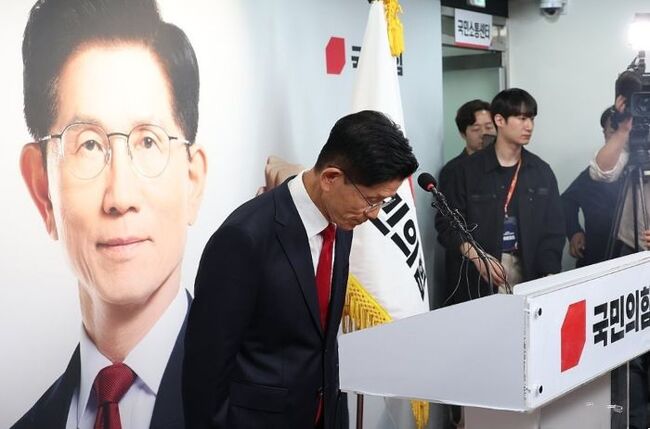 “Too little, too late?…” Kim Moon-soo, who previously conceded his presidential election defeat, now demands a special counsel investigation into ‘allegations of election fraud in the 2025 presidential election’
People Power Party presidential candidate Kim Moon-soo concedes defeat during a press conference at the party headquarters in Yeouido, Seoul, on June 4, 2025. [Joint Press Corps]As allegations emerge
“Too little, too late?…” Kim Moon-soo, who previously conceded his presidential election defeat, now demands a special counsel investigation into ‘allegations of election fraud in the 2025 presidential election’
People Power Party presidential candidate Kim Moon-soo concedes defeat during a press conference at the party headquarters in Yeouido, Seoul, on June 4, 2025. [Joint Press Corps]As allegations emerge
 Stock Market Crash 'Black Tuesday'… KOSPI down 10.8%, KOSDAQ down 7.7%
The KOSPI fell by more than 5% in early trading on the 28th, triggering a sell-side sidecar.On the 28th, the KOSPI plunged by more than 10%.Due to the sharp decline, a sell-side sidecar—a temporary
Stock Market Crash 'Black Tuesday'… KOSPI down 10.8%, KOSDAQ down 7.7%
The KOSPI fell by more than 5% in early trading on the 28th, triggering a sell-side sidecar.On the 28th, the KOSPI plunged by more than 10%.Due to the sharp decline, a sell-side sidecar—a temporary
 [World Heritage Committee] 25 New World Heritage Sites Inscribed in Busan… South Korea Successfully Expands 'Getbol' Listing
The Chairperson of the World Heritage Committee speaks at the plenary session of the 48th session of the World Heritage Committee, held at BEXCO in Busan on the 20th. [Photo: Yonhap News]A total of 25
[World Heritage Committee] 25 New World Heritage Sites Inscribed in Busan… South Korea Successfully Expands 'Getbol' Listing
The Chairperson of the World Heritage Committee speaks at the plenary session of the 48th session of the World Heritage Committee, held at BEXCO in Busan on the 20th. [Photo: Yonhap News]A total of 25
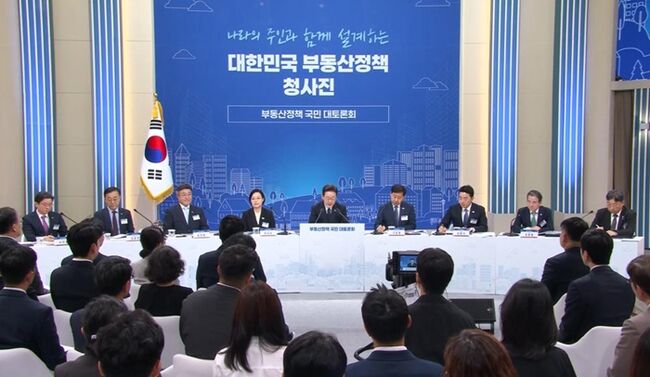 [Liberal Democratic Party Statement] Calling it a Grand Real Estate Debate… It Was Nothing More Than a Private Party Among Themselves
The 'National Grand Debate on Real Estate Policy' held on July 23rd and 27th. [Photo=Yonhap News]The 'National Grand Debate on Real Estate Policy,' hosted by the Lee Jae-myung administration under the
[Liberal Democratic Party Statement] Calling it a Grand Real Estate Debate… It Was Nothing More Than a Private Party Among Themselves
The 'National Grand Debate on Real Estate Policy' held on July 23rd and 27th. [Photo=Yonhap News]The 'National Grand Debate on Real Estate Policy,' hosted by the Lee Jae-myung administration under the
 [Photo] Evidence of Election Fraud Flooding U.S. Media… Trump Had 2.7 Million Votes Stolen
 [Video] U.S. Semiquincentennial Air Show... 'Art in the Sky' streaks across New York
 [Editorial Cartoon] A Draconian Law That Undermines Freedom of Expression

 List
List