The fire safety industry is at a major turning point. Large-scale fires and complex disasters occurring worldwide repeatedly prove that existing detection technologies are no longer sufficient.
Buildings have become more complex, systems are more interconnected, and risks have become more unpredictable. Amidst these changes, fire detection technology is evolving beyond simple alarm devices into intelligent safety platforms.
The North American market, in particular, is experiencing the fastest pace of change. The revision of 'UL 268', a key standard in the North American fire detection field, is a prime example. Previously, detectors judged based solely on smoke concentration, but now, intelligent detection capabilities are required to precisely distinguish between actual fire signals and everyday environmental factors.
Next-Generation Fire Detection Technology Unlocks Safety Infrastructure
False alarms are the most persistent problem facing the global fire industry, and without addressing this, the reliability of the entire fire system is inevitably undermined.
Detectors are no longer just "sensitive sensors." They must become AI-based intelligent devices capable of integrating and analyzing smoke, heat, and environmental data, making independent judgments based on the situation, and sounding alarms accurately only when necessary. This is the core of next-generation detection technology and is becoming the new standard for fire safety.
Standards are also keeping pace with technological evolution. While technology used to follow standards, now standards are evolving to accommodate technology and guide the industry's direction.
AI-based detectors, intelligent control panels, and integrated platforms are no longer future technologies but realities already being applied in the field. Control panels are transforming from simple signal receivers into active brains that interpret data and determine priorities.
The expansion of connectivity is also a significant change. Fire systems are organically connecting with building management systems, IP networks, and cloud-based monitoring platforms, dramatically increasing maintenance efficiency and response speed. However, as connectivity grows, so does the importance of cybersecurity.
The damage from an attack on a life safety system is difficult to imagine. Future detection systems must simultaneously meet performance, connectivity, and security requirements.
Changes are also evident at the device level. Detectors are evolving to be smaller, smarter, and equipped with more complex functions. 'Multi-criteria detectors' that simultaneously assess multiple conditions, rather than relying on a single sensor, are becoming the standard. This helps reduce installation numbers, lower maintenance burdens, and address labor shortages.
Reducing Societal Costs Through Technological Innovation
The development of 'IP-based communication', a digital detection communication structure compliant with international standards, and advancements in wireless technology are rapidly replacing traditional phone line-centric system structures. This enables more flexible, scalable systems applicable to a wider range of environments.
This aligns precisely with the 'Industry 4.0' trend of 4th Industrial Revolution-style smart safety infrastructure. Fire detection systems are ultimately being integrated into data-driven intelligent infrastructure.
Sustainability is no longer a secondary concern. Reducing false alarms, efficient design, energy saving, and minimizing unnecessary dispatches are all core elements of a sustainable safety system. Technological innovation must move beyond simple performance improvements to reduce societal costs and enhance the quality of safety.
The AI fire safety sector stands at the forefront of these changes. It is securing AI-based false alarm reduction technologies and realizing integration with building systems through intelligent detectors and panels. Wireless IoT-based detection technology expands safety coverage to environments where traditional installation was difficult.
In particular, the world's first complex detector based on acoustic sensors presents a new paradigm that can protect more households without requiring system installation.
The future of fire safety is not just a race of technology. Only systems that possess accuracy, connectivity, intelligence, and sustainability can respond to future risks. AI fire safety technology will contribute to protecting lives, expanding safety, and creating a better world. And at the center of this transformation lies next-generation detection technology.

◆ Cho Young-jin, CEO
Rose AI

 [Statement by the Seo-beo-kka Korea Military Academy Save-the-Nation Comrades Association] ㉛ Recount the Votes Publicly, as the Previous Recount Concealed Election Fraud
Tongyeong Mayoral Election Recount [Photo=Yonhap News]South Korea's liberal democracy is dying. The National Election Commission (NEC) and the judiciary, which have plummeted into criminal syndicates
[Statement by the Seo-beo-kka Korea Military Academy Save-the-Nation Comrades Association] ㉛ Recount the Votes Publicly, as the Previous Recount Concealed Election Fraud
Tongyeong Mayoral Election Recount [Photo=Yonhap News]South Korea's liberal democracy is dying. The National Election Commission (NEC) and the judiciary, which have plummeted into criminal syndicates
 What is the significance of the "Trump 2028" red hats that keep making a comeback?
It is noteworthy that President Donald Trump is "intentionally" fueling controversy over whether he can actually run in the 2028 presidential election, even though it is "highly likely he is seriously
What is the significance of the "Trump 2028" red hats that keep making a comeback?
It is noteworthy that President Donald Trump is "intentionally" fueling controversy over whether he can actually run in the 2028 presidential election, even though it is "highly likely he is seriously
 Jin Cummings: “North Korea says it will increase the number of spies, so what is the government doing?”
U.S. political columnist Gene Cummings has publicly questioned the South Korean government, asking, "North Korea is declaring that it will increase its number of spies, so what is the South Kore
Jin Cummings: “North Korea says it will increase the number of spies, so what is the government doing?”
U.S. political columnist Gene Cummings has publicly questioned the South Korean government, asking, "North Korea is declaring that it will increase its number of spies, so what is the South Kore
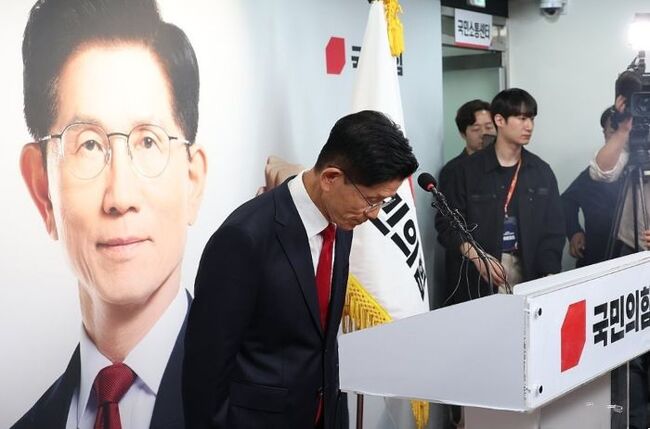 “Too little, too late?…” Kim Moon-soo, who previously conceded his presidential election defeat, now demands a special counsel investigation into ‘allegations of election fraud in the 2025 presidential election’
People Power Party presidential candidate Kim Moon-soo concedes defeat during a press conference at the party headquarters in Yeouido, Seoul, on June 4, 2025. [Joint Press Corps]As allegations emerge
“Too little, too late?…” Kim Moon-soo, who previously conceded his presidential election defeat, now demands a special counsel investigation into ‘allegations of election fraud in the 2025 presidential election’
People Power Party presidential candidate Kim Moon-soo concedes defeat during a press conference at the party headquarters in Yeouido, Seoul, on June 4, 2025. [Joint Press Corps]As allegations emerge
 Stock Market Crash 'Black Tuesday'… KOSPI down 10.8%, KOSDAQ down 7.7%
The KOSPI fell by more than 5% in early trading on the 28th, triggering a sell-side sidecar.On the 28th, the KOSPI plunged by more than 10%.Due to the sharp decline, a sell-side sidecar—a temporary
Stock Market Crash 'Black Tuesday'… KOSPI down 10.8%, KOSDAQ down 7.7%
The KOSPI fell by more than 5% in early trading on the 28th, triggering a sell-side sidecar.On the 28th, the KOSPI plunged by more than 10%.Due to the sharp decline, a sell-side sidecar—a temporary
 [World Heritage Committee] 25 New World Heritage Sites Inscribed in Busan… South Korea Successfully Expands 'Getbol' Listing
The Chairperson of the World Heritage Committee speaks at the plenary session of the 48th session of the World Heritage Committee, held at BEXCO in Busan on the 20th. [Photo: Yonhap News]A total of 25
[World Heritage Committee] 25 New World Heritage Sites Inscribed in Busan… South Korea Successfully Expands 'Getbol' Listing
The Chairperson of the World Heritage Committee speaks at the plenary session of the 48th session of the World Heritage Committee, held at BEXCO in Busan on the 20th. [Photo: Yonhap News]A total of 25
 [Liberal Democratic Party Statement] Calling it a Grand Real Estate Debate… It Was Nothing More Than a Private Party Among Themselves
The 'National Grand Debate on Real Estate Policy' held on July 23rd and 27th. [Photo=Yonhap News]The 'National Grand Debate on Real Estate Policy,' hosted by the Lee Jae-myung administration under the
[Liberal Democratic Party Statement] Calling it a Grand Real Estate Debate… It Was Nothing More Than a Private Party Among Themselves
The 'National Grand Debate on Real Estate Policy' held on July 23rd and 27th. [Photo=Yonhap News]The 'National Grand Debate on Real Estate Policy,' hosted by the Lee Jae-myung administration under the
 [Photo] Evidence of Election Fraud Flooding U.S. Media… Trump Had 2.7 Million Votes Stolen
 [Video] U.S. Semiquincentennial Air Show... 'Art in the Sky' streaks across New York
 [Editorial Cartoon] A Draconian Law That Undermines Freedom of Expression

 List
List