French President Emmanuel Macron. [Photo = Yonhap News}
The Presidential Office explained that French President Emmanuel Macron's visit to Korea marks the first state visit by a European leader since the current government's inauguration and the first visit by a French president in 11 years.
The two leaders were scheduled to hold an official welcoming ceremony, summit, treaty and memorandum of understanding signing ceremony, and a state luncheon on April 3rd, and were expected to discuss cooperation in advanced industries such as AI, quantum, space, and nuclear energy, as well as regional and global issues. Judging by the announcement alone, it seems substantial.
However, diplomacy is often revealed more by the itinerary than by press releases. It's not the number of days spent in the country that matters, but the formality of a state visit and the density of the actual time allocated.
According to the schedule released by the Elysée Palace, President Macron's itinerary included a visit to Japan on April 1st, morning activities in Japan on April 2nd, travel to Korea on the afternoon of the same day, and his visit to Korea on April 3rd.
The official public schedule in Korea was essentially concentrated on the welcoming ceremony, summit, signing ceremony, and luncheon on the 3rd. While formally a two-day schedule, the actual public movements show a structure where major events are handled and concluded the day after arrival.
Compared to the statement "a state visit in 11 years," the timetable that the public can see is excessively light.
What is even more stark is the contrast with Japan.
The Japanese Ministry of Foreign Affairs announced that following the summit between President Macron and the Japanese Prime Minister on April 1st, there was a signing ceremony for a joint statement, a joint press conference, and a working dinner.
When comparing the official Japanese documents with the French itinerary, Japan's schedule included a summit, press conference, dinner, and morning activities the following day, while Korea's key events were from the afternoon of the 2nd until the luncheon on the 3rd.
The issue is not whether Korea or Japan came first, but the noticeable difference in the depth of time allocated.
France is by no means a country to be treated lightly in international diplomacy. France is a permanent member of the UN Security Council. The Presidential Office explicitly stated France's status as a permanent member of the Security Council during its briefing on this visit.
When the leader of such a nation visits for the first time in 11 years, and the public schedule in Korea is effectively compressed into a welcoming ceremony, summit, and luncheon, it is natural for evaluations like "an itinerary embarrassing to call a state visit" to emerge.
Compared to recent state visits by leaders of major countries, this schedule is thin.
Furthermore, during the state visit of Vietnamese Party General Secretary To Lam, there was a summit, an exchange of cooperation documents, a joint press conference, a state banquet, and a friendly gathering at Sangchunjae the following day. The Presidential Office stated that the two leaders discussed matters for a total of six hours.
During Brazilian President Lula's state visit, a state banquet was also separately publicized.
Even though Prabowo's state visit as Indonesian President, on the surface of the public schedule, was centered around a luncheon, there was a separate friendly gathering at Nokjiwon in the afternoon of the same day.
There is no rule that a state visit must end with a dinner. However, considering that recent cases have shown at least a certain depth of engagement after the luncheon, the Macron visit, within its currently disclosed scope, does not exhibit that depth.
Of course, counterarguments are possible. One could say that diplomacy is about content rather than time. Even if the visit lasts only a day, discussing AI, nuclear energy, space, and advanced industries can be considered highly meaningful. This is true.
However, if such important agendas are to be discussed, the question arises: why is the public schedule so brief? If the elevation of relations to a strategic level is proclaimed, yet the temporal design that demonstrates that strategy is absent, the rhetoric becomes hollow.
Ultimately, there are two uncomfortable interpretations.
One interpretation is that France allocated only that much time to Korea.
The other interpretation is that Korea was satisfied with receiving the title of "state guest" but failed to secure the density of the itinerary and courtesies befitting that title.
Based solely on the currently disclosed information, it is impossible to definitively conclude either interpretation. However, the outcome is clear. Japan had a working dinner and activities the following day, while Korea's engagement effectively concluded with a luncheon. This is the timetable that the public can visually confirm.
Diplomacy is proven not by words but by time. However, this Macron visit's timetable lacks the weight of a state visit. Although the significance of a visit after 11 years was emphasized, the public is likely to see a compressed itinerary ending with a luncheon.
Considering the standing of France, the visit seems meager, and considering the government's explanation of the "state guest" designation, it is even more embarrassing.
There was the title of a state guest, but not the time of a state guest.

 [Statement by the Seo-beo-kka Korea Military Academy Save-the-Nation Comrades Association] ㉛ Recount the Votes Publicly, as the Previous Recount Concealed Election Fraud
Tongyeong Mayoral Election Recount [Photo=Yonhap News]South Korea's liberal democracy is dying. The National Election Commission (NEC) and the judiciary, which have plummeted into criminal syndicates
[Statement by the Seo-beo-kka Korea Military Academy Save-the-Nation Comrades Association] ㉛ Recount the Votes Publicly, as the Previous Recount Concealed Election Fraud
Tongyeong Mayoral Election Recount [Photo=Yonhap News]South Korea's liberal democracy is dying. The National Election Commission (NEC) and the judiciary, which have plummeted into criminal syndicates
 What is the significance of the "Trump 2028" red hats that keep making a comeback?
It is noteworthy that President Donald Trump is "intentionally" fueling controversy over whether he can actually run in the 2028 presidential election, even though it is "highly likely he is seriously
What is the significance of the "Trump 2028" red hats that keep making a comeback?
It is noteworthy that President Donald Trump is "intentionally" fueling controversy over whether he can actually run in the 2028 presidential election, even though it is "highly likely he is seriously
 Jin Cummings: “North Korea says it will increase the number of spies, so what is the government doing?”
U.S. political columnist Gene Cummings has publicly questioned the South Korean government, asking, "North Korea is declaring that it will increase its number of spies, so what is the South Kore
Jin Cummings: “North Korea says it will increase the number of spies, so what is the government doing?”
U.S. political columnist Gene Cummings has publicly questioned the South Korean government, asking, "North Korea is declaring that it will increase its number of spies, so what is the South Kore
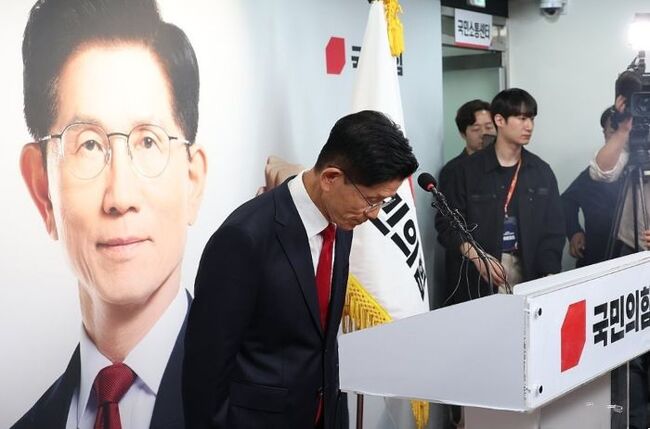 “Too little, too late?…” Kim Moon-soo, who previously conceded his presidential election defeat, now demands a special counsel investigation into ‘allegations of election fraud in the 2025 presidential election’
People Power Party presidential candidate Kim Moon-soo concedes defeat during a press conference at the party headquarters in Yeouido, Seoul, on June 4, 2025. [Joint Press Corps]As allegations emerge
“Too little, too late?…” Kim Moon-soo, who previously conceded his presidential election defeat, now demands a special counsel investigation into ‘allegations of election fraud in the 2025 presidential election’
People Power Party presidential candidate Kim Moon-soo concedes defeat during a press conference at the party headquarters in Yeouido, Seoul, on June 4, 2025. [Joint Press Corps]As allegations emerge
 Stock Market Crash 'Black Tuesday'… KOSPI down 10.8%, KOSDAQ down 7.7%
The KOSPI fell by more than 5% in early trading on the 28th, triggering a sell-side sidecar.On the 28th, the KOSPI plunged by more than 10%.Due to the sharp decline, a sell-side sidecar—a temporary
Stock Market Crash 'Black Tuesday'… KOSPI down 10.8%, KOSDAQ down 7.7%
The KOSPI fell by more than 5% in early trading on the 28th, triggering a sell-side sidecar.On the 28th, the KOSPI plunged by more than 10%.Due to the sharp decline, a sell-side sidecar—a temporary
 [World Heritage Committee] 25 New World Heritage Sites Inscribed in Busan… South Korea Successfully Expands 'Getbol' Listing
The Chairperson of the World Heritage Committee speaks at the plenary session of the 48th session of the World Heritage Committee, held at BEXCO in Busan on the 20th. [Photo: Yonhap News]A total of 25
[World Heritage Committee] 25 New World Heritage Sites Inscribed in Busan… South Korea Successfully Expands 'Getbol' Listing
The Chairperson of the World Heritage Committee speaks at the plenary session of the 48th session of the World Heritage Committee, held at BEXCO in Busan on the 20th. [Photo: Yonhap News]A total of 25
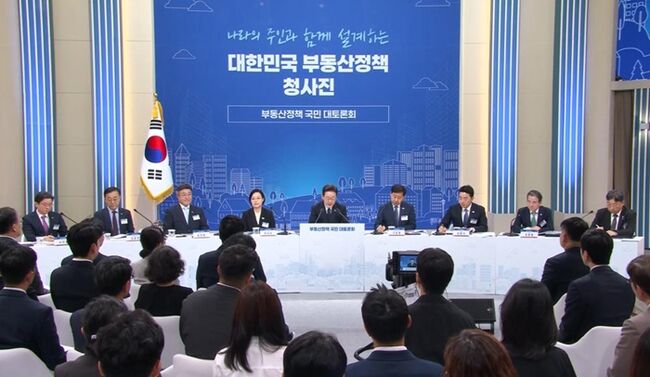 [Liberal Democratic Party Statement] Calling it a Grand Real Estate Debate… It Was Nothing More Than a Private Party Among Themselves
The 'National Grand Debate on Real Estate Policy' held on July 23rd and 27th. [Photo=Yonhap News]The 'National Grand Debate on Real Estate Policy,' hosted by the Lee Jae-myung administration under the
[Liberal Democratic Party Statement] Calling it a Grand Real Estate Debate… It Was Nothing More Than a Private Party Among Themselves
The 'National Grand Debate on Real Estate Policy' held on July 23rd and 27th. [Photo=Yonhap News]The 'National Grand Debate on Real Estate Policy,' hosted by the Lee Jae-myung administration under the
 [Photo] Evidence of Election Fraud Flooding U.S. Media… Trump Had 2.7 Million Votes Stolen
 [Video] U.S. Semiquincentennial Air Show... 'Art in the Sky' streaks across New York
 [Editorial Cartoon] A Draconian Law That Undermines Freedom of Expression

 List
List