U.S. President Donald Trump [Photo=Yonhap News]
U.S. President Donald Trump's national address on the first of the month (local time) sounded like a victory declaration signaling the end of the war at first glance.
He claimed that Iran's navy was virtually finished, its air force had collapsed, and its missile and drone capabilities were significantly weakened. He added that the United States' core strategic objectives were nearing completion.
However, he also stated that operations would continue until the objectives were fully achieved and made it clear that Iran would be hit even harder over the next two to three weeks.
This demonstrates that the essence of the address was not a declaration of the end of hostilities, but rather an explanation to the American people for extending military action while showcasing achievements.
The White House intentionally highlighted this point.
Along with the address, the White House released a separate document (background material) emphasizing that President Trump's objectives against Iran were clear from the outset and remain unchanged.
This document organizes statements made by U.S. President Trump, Vice President J.D. Vance, Secretary of State Marco Rubio, Secretary of Defense Pete Hegses, Chairman of the Joint Chiefs of Staff Dan Caine, and Admiral Brad Cooper throughout the month of March in chronological order.
The message emphasized by the White House is simple: the objectives of this operation were clear from the beginning and have not changed. This address was not an impromptu speech, but rather a moment where the President personally tied up the messages accumulated over the month.
The 'unchanging objectives' can be summarized into four pillars.
First, the elimination of Iran's ballistic missile and launch capabilities.
Second, the destruction of Iran's naval power.
Third, the dismantling of its defense industry base and production capacity.
Fourth, the permanent prevention of Iran's acquisition of nuclear weapons.
In the background material provided by the White House, Vice President Vance, Secretary of State Rubio, Secretary of Defense Hegses, and military leadership repeatedly echoed these four pillars. This indicates that the war was not merely an incident of striking a few nuclear facilities, but an operation designed to structurally dismantle Iran's threat capabilities as a nation.
In reality, the key sentence of this address is not "almost finished." It is the sentence that follows.
While U.S. President Trump stated that American military objectives would be achieved "very shortly," he immediately followed up with, "we will continue until our objectives are fully achieved." He then announced that Iran would be hit "extremely hard" over the next two to three weeks.
This is a dual message: politically declaring victory and militarily extending pressure. The language of victory is necessary to soothe war fatigue and anxiety over energy prices within the United States, but it also signals that the actual strategy is not yet at a stage to halt.
This structure becomes even clearer when examining the background material distributed by the White House. According to the document, the U.S. administration has consistently repeated "destruction of Iran's navy," "elimination of missile launch capabilities," "dismantling of the defense industry base," and "prevention of nuclear weapons acquisition" in the same order since mid-March.
Notably, Secretary of State Rubio and Secretary of Defense Hegses repeatedly stated that the objective of the operation was not short-term retaliation but to also disrupt future reconstruction capabilities. This confirms that the address did not introduce a new policy, but rather reaffirmed publicly announced war objectives by the President.
Statements regarding the Strait of Hormuz are in the same vein.
U.S. President Trump attributed rising energy prices to Iran's aggressive actions and suggested that other countries should go to the strait and protect and use it themselves.
This is not simply a mention of oil prices. It is pressure on allies and friends to share the costs and responsibilities, as the United States has already borne the greatest military burden.
This implies that the address serves not only as an explanation to U.S. domestic public opinion but also as a demand for burden-sharing from allies.
Ultimately, U.S. President Trump's national address is a speech where the language of incapacitation is stronger than the language of peace.
Through the background material, the White House reiterated that the goals of this war have not changed since the beginning, and in the address, the phrases "core objectives are almost complete" and "we will hit even harder for the next 2-3 weeks" were juxtaposed.
This is not a method of announcing the end of the war. Rather, it is closer to a method of politically preempting the war's achievements and then justifying the remaining military actions.
The true message U.S. President Trump delivered to the American people is clear.
He said the war has been won, but it is not over yet.
Therefore, interpreting this address as a declaration of the end of hostilities would be a misinterpretation. A more accurate interpretation is as follows:
Victory was declared. But cessation was not.
This is why the White House meticulously attached the background material on 'unchanging objectives'.
This speech is not one that announces an end, but rather one that states the end is near while also indicating a push to press further.
White House Press Release
|

 [Statement by the Seo-beo-kka Korea Military Academy Save-the-Nation Comrades Association] ㉛ Recount the Votes Publicly, as the Previous Recount Concealed Election Fraud
Tongyeong Mayoral Election Recount [Photo=Yonhap News]South Korea's liberal democracy is dying. The National Election Commission (NEC) and the judiciary, which have plummeted into criminal syndicates
[Statement by the Seo-beo-kka Korea Military Academy Save-the-Nation Comrades Association] ㉛ Recount the Votes Publicly, as the Previous Recount Concealed Election Fraud
Tongyeong Mayoral Election Recount [Photo=Yonhap News]South Korea's liberal democracy is dying. The National Election Commission (NEC) and the judiciary, which have plummeted into criminal syndicates
 What is the significance of the "Trump 2028" red hats that keep making a comeback?
It is noteworthy that President Donald Trump is "intentionally" fueling controversy over whether he can actually run in the 2028 presidential election, even though it is "highly likely he is seriously
What is the significance of the "Trump 2028" red hats that keep making a comeback?
It is noteworthy that President Donald Trump is "intentionally" fueling controversy over whether he can actually run in the 2028 presidential election, even though it is "highly likely he is seriously
 Jin Cummings: “North Korea says it will increase the number of spies, so what is the government doing?”
U.S. political columnist Gene Cummings has publicly questioned the South Korean government, asking, "North Korea is declaring that it will increase its number of spies, so what is the South Kore
Jin Cummings: “North Korea says it will increase the number of spies, so what is the government doing?”
U.S. political columnist Gene Cummings has publicly questioned the South Korean government, asking, "North Korea is declaring that it will increase its number of spies, so what is the South Kore
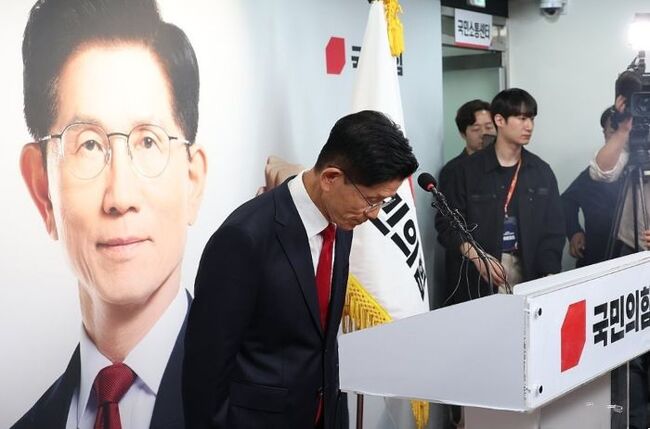 “Too little, too late?…” Kim Moon-soo, who previously conceded his presidential election defeat, now demands a special counsel investigation into ‘allegations of election fraud in the 2025 presidential election’
People Power Party presidential candidate Kim Moon-soo concedes defeat during a press conference at the party headquarters in Yeouido, Seoul, on June 4, 2025. [Joint Press Corps]As allegations emerge
“Too little, too late?…” Kim Moon-soo, who previously conceded his presidential election defeat, now demands a special counsel investigation into ‘allegations of election fraud in the 2025 presidential election’
People Power Party presidential candidate Kim Moon-soo concedes defeat during a press conference at the party headquarters in Yeouido, Seoul, on June 4, 2025. [Joint Press Corps]As allegations emerge
 Stock Market Crash 'Black Tuesday'… KOSPI down 10.8%, KOSDAQ down 7.7%
The KOSPI fell by more than 5% in early trading on the 28th, triggering a sell-side sidecar.On the 28th, the KOSPI plunged by more than 10%.Due to the sharp decline, a sell-side sidecar—a temporary
Stock Market Crash 'Black Tuesday'… KOSPI down 10.8%, KOSDAQ down 7.7%
The KOSPI fell by more than 5% in early trading on the 28th, triggering a sell-side sidecar.On the 28th, the KOSPI plunged by more than 10%.Due to the sharp decline, a sell-side sidecar—a temporary
 [World Heritage Committee] 25 New World Heritage Sites Inscribed in Busan… South Korea Successfully Expands 'Getbol' Listing
The Chairperson of the World Heritage Committee speaks at the plenary session of the 48th session of the World Heritage Committee, held at BEXCO in Busan on the 20th. [Photo: Yonhap News]A total of 25
[World Heritage Committee] 25 New World Heritage Sites Inscribed in Busan… South Korea Successfully Expands 'Getbol' Listing
The Chairperson of the World Heritage Committee speaks at the plenary session of the 48th session of the World Heritage Committee, held at BEXCO in Busan on the 20th. [Photo: Yonhap News]A total of 25
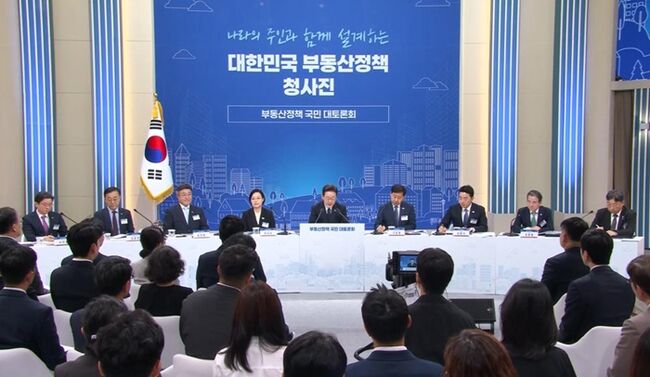 [Liberal Democratic Party Statement] Calling it a Grand Real Estate Debate… It Was Nothing More Than a Private Party Among Themselves
The 'National Grand Debate on Real Estate Policy' held on July 23rd and 27th. [Photo=Yonhap News]The 'National Grand Debate on Real Estate Policy,' hosted by the Lee Jae-myung administration under the
[Liberal Democratic Party Statement] Calling it a Grand Real Estate Debate… It Was Nothing More Than a Private Party Among Themselves
The 'National Grand Debate on Real Estate Policy' held on July 23rd and 27th. [Photo=Yonhap News]The 'National Grand Debate on Real Estate Policy,' hosted by the Lee Jae-myung administration under the
 [Photo] Evidence of Election Fraud Flooding U.S. Media… Trump Had 2.7 Million Votes Stolen
 [Video] U.S. Semiquincentennial Air Show... 'Art in the Sky' streaks across New York
 [Editorial Cartoon] A Draconian Law That Undermines Freedom of Expression

 List
List