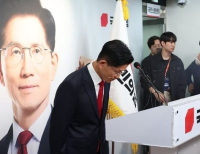
What the media needs now is not grand declarations, but the basics: reporting events, clarifying issues, and leaving judgment to the readers. On April 2nd, after the trial of writer Kim Kyu-na concluded, his supporters gathered in front of the Bucheon Branch of the Incheon District Court to issue a statement. ⒸHanmi Ilbo
The stance of the right-wing media surrounding the trial of writer Kim Kyu-na is not merely a matter of whether to report it. This case is a test of how the principles advocated by a certain camp actually function in real-world situations. The outcome is simple: the gap between words and actions has been revealed.
Right-wing media outlets have long championed freedom of expression as a core value. They have criticized realities where certain statements are sanctioned or punished simply because they are considered uncomfortable.
They have been wary of state power intervening in the realm of thought and have maintained the position that individuals' speech should be protected as broadly as possible. These arguments are not mere political slogans but align with the fundamental principles of modern liberalism.
However, principles are not maintained by declarations alone. How they are applied in actual cases is more important. The Kim Kyu-na trial highlights precisely this issue of application.
This is a situation where an individual's speech leads to criminal proceedings and is debated in court. In such cases, the media's role is clear: to report on the course of events, clarify the issues, and enable social discussion.
Despite this, a significant number of right-wing media outlets have effectively ignored this case. Some treated it with brief mentions, while many did not report on it at all. This silence is not accidental. It is the result of a judgment, whether conscious or unconscious. And that judgment inevitably leads to questions of standards.
At this point, a question arises: Why was this case not covered sufficiently? The reasons can be summarized as follows.
First, internal burden. Reporting on matters involving individuals within the same camp can escalate internal conflicts. Second, political calculation. If a particular case is deemed unhelpful to the overall strategy, it is deprioritized in reporting. Third, risk avoidance. This is an attitude of avoiding unnecessary criticism by not covering issues that have the potential to escalate into controversy.
These judgments have understandable practical aspects. Media outlets are organizations, and they cannot ignore survival and influence. However, it is precisely at this point that the identity of the media is tested. It is not a question of whether to uphold principles or adjust them according to the situation, but rather whether they can actually apply the standards they themselves have set.
Freedom of expression is not a value emphasized only in specific cases. Rather, it is a standard that should be applied more clearly in burdensome matters, involving internal figures, and in politically complex situations. Otherwise, that principle becomes not a universal standard but a situational tool.
Media credibility erodes through selective reporting. If the criteria for highlighting some events while ignoring others are unclear, readers become suspicious. They question whether the reporting is based on principles or on vested interests. The moment this question is repeatedly asked, the media loses its own authority.
Especially in the current information environment, these issues become apparent more quickly. Readers encounter events through various channels and compare the media's reporting.
Silence on a particular case is interpreted as deliberate exclusion. This is not an era where people can "simply move on if they don't know," as in the past. The moment the perception forms that something is being deliberately ignored despite knowing about it, trust rapidly weakens.
A more significant problem is the absence of internal criticism. Criticism directed outward is sharp, but examination directed inward is almost non-existent. In such a state, a public sphere does not form. The process where diverse opinions clash and are refined disappears, and a structure where only the same positions are repeated becomes entrenched. Consequently, the entire camp's thinking ability weakens.
The silence surrounding the Kim Kyu-na trial reveals precisely this structure. The habit of not speaking about uncomfortable matters expands. One instance of silence justifies the next. Ultimately, principles become increasingly narrow, and their scope of application becomes increasingly limited. All that remains are declarations.
Freedom of expression has meaning when it includes even uncomfortable speech. Protecting only words that everyone agrees with is not freedom. Its value truly comes alive when even controversial and burdensome statements are protected. This is the standard that liberalism has long maintained.
If right-wing media outlets wish to place themselves within the liberal tradition, they cannot avoid this standard. It is a separate issue from personal likes or dislikes regarding specific individuals or events. Principles do not change based on the subject. If they do, it is strategy, not principle.
What is needed now is not grand declarations, but the basics: reporting events, clarifying issues, and leaving judgment to the readers. These basics are not difficult. However, they require accepting a burden. And the ability to bear that burden determines the level of the media.
The Kim Kyu-na trial is not just one case. This case is an example that shows how right-wing media outlets define themselves. It reveals the standard of whether they will actually protect freedom of expression or adjust it according to the situation.
Silence is not neutrality. Silence is a choice. And that choice is recorded. How the right-wing media accepts this record will be a factor that determines their future credibility.
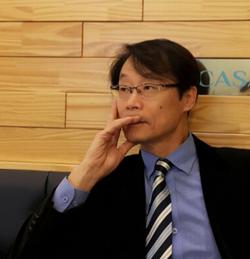
◆ Songsan
A poet and researcher of history and philosophy. Former director of the Rhee Syngman Institute. Currently serves as a research advisor for the Korean Modern and Contemporary History Research Association and as the representative of the philosophy forum Lyceum. He has published four poetry collections, co-translated 'Heroes of Hooko Island,' and published 'Chosun Became Myth' and 'Humanities on the Tatami.' He is currently actively engaged in research and practice for the liberal cultural movement. Songsan is a pen name.

 [Statement by the Seo-beo-kka Korea Military Academy Save-the-Nation Comrades Association] ㉛ Recount the Votes Publicly, as the Previous Recount Concealed Election Fraud
Tongyeong Mayoral Election Recount [Photo=Yonhap News]South Korea's liberal democracy is dying. The National Election Commission (NEC) and the judiciary, which have plummeted into criminal syndicates
[Statement by the Seo-beo-kka Korea Military Academy Save-the-Nation Comrades Association] ㉛ Recount the Votes Publicly, as the Previous Recount Concealed Election Fraud
Tongyeong Mayoral Election Recount [Photo=Yonhap News]South Korea's liberal democracy is dying. The National Election Commission (NEC) and the judiciary, which have plummeted into criminal syndicates
 What is the significance of the "Trump 2028" red hats that keep making a comeback?
It is noteworthy that President Donald Trump is "intentionally" fueling controversy over whether he can actually run in the 2028 presidential election, even though it is "highly likely he is seriously
What is the significance of the "Trump 2028" red hats that keep making a comeback?
It is noteworthy that President Donald Trump is "intentionally" fueling controversy over whether he can actually run in the 2028 presidential election, even though it is "highly likely he is seriously
 Jin Cummings: “North Korea says it will increase the number of spies, so what is the government doing?”
U.S. political columnist Gene Cummings has publicly questioned the South Korean government, asking, "North Korea is declaring that it will increase its number of spies, so what is the South Kore
Jin Cummings: “North Korea says it will increase the number of spies, so what is the government doing?”
U.S. political columnist Gene Cummings has publicly questioned the South Korean government, asking, "North Korea is declaring that it will increase its number of spies, so what is the South Kore
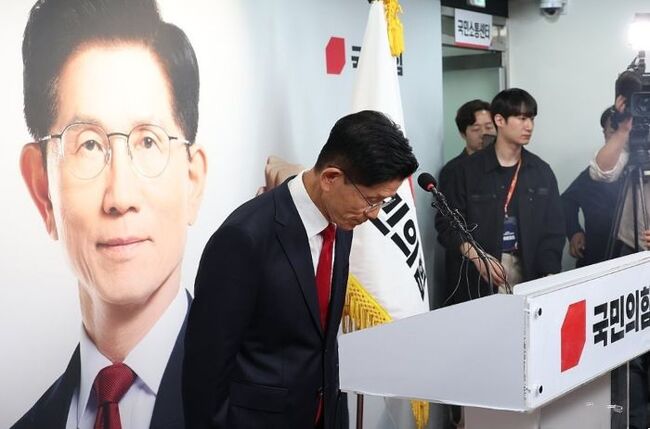 “Too little, too late?…” Kim Moon-soo, who previously conceded his presidential election defeat, now demands a special counsel investigation into ‘allegations of election fraud in the 2025 presidential election’
People Power Party presidential candidate Kim Moon-soo concedes defeat during a press conference at the party headquarters in Yeouido, Seoul, on June 4, 2025. [Joint Press Corps]As allegations emerge
“Too little, too late?…” Kim Moon-soo, who previously conceded his presidential election defeat, now demands a special counsel investigation into ‘allegations of election fraud in the 2025 presidential election’
People Power Party presidential candidate Kim Moon-soo concedes defeat during a press conference at the party headquarters in Yeouido, Seoul, on June 4, 2025. [Joint Press Corps]As allegations emerge
 Stock Market Crash 'Black Tuesday'… KOSPI down 10.8%, KOSDAQ down 7.7%
The KOSPI fell by more than 5% in early trading on the 28th, triggering a sell-side sidecar.On the 28th, the KOSPI plunged by more than 10%.Due to the sharp decline, a sell-side sidecar—a temporary
Stock Market Crash 'Black Tuesday'… KOSPI down 10.8%, KOSDAQ down 7.7%
The KOSPI fell by more than 5% in early trading on the 28th, triggering a sell-side sidecar.On the 28th, the KOSPI plunged by more than 10%.Due to the sharp decline, a sell-side sidecar—a temporary
 [World Heritage Committee] 25 New World Heritage Sites Inscribed in Busan… South Korea Successfully Expands 'Getbol' Listing
The Chairperson of the World Heritage Committee speaks at the plenary session of the 48th session of the World Heritage Committee, held at BEXCO in Busan on the 20th. [Photo: Yonhap News]A total of 25
[World Heritage Committee] 25 New World Heritage Sites Inscribed in Busan… South Korea Successfully Expands 'Getbol' Listing
The Chairperson of the World Heritage Committee speaks at the plenary session of the 48th session of the World Heritage Committee, held at BEXCO in Busan on the 20th. [Photo: Yonhap News]A total of 25
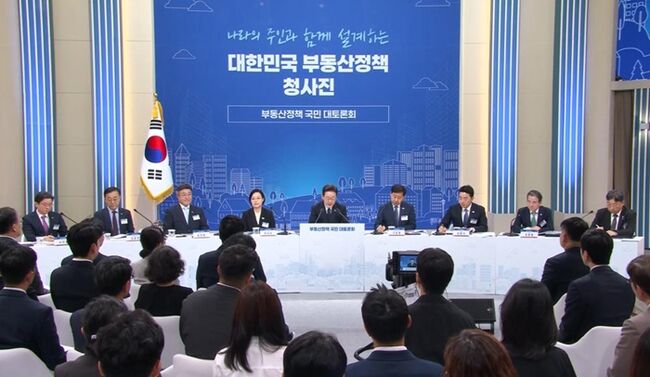 [Liberal Democratic Party Statement] Calling it a Grand Real Estate Debate… It Was Nothing More Than a Private Party Among Themselves
The 'National Grand Debate on Real Estate Policy' held on July 23rd and 27th. [Photo=Yonhap News]The 'National Grand Debate on Real Estate Policy,' hosted by the Lee Jae-myung administration under the
[Liberal Democratic Party Statement] Calling it a Grand Real Estate Debate… It Was Nothing More Than a Private Party Among Themselves
The 'National Grand Debate on Real Estate Policy' held on July 23rd and 27th. [Photo=Yonhap News]The 'National Grand Debate on Real Estate Policy,' hosted by the Lee Jae-myung administration under the
 [Photo] Evidence of Election Fraud Flooding U.S. Media… Trump Had 2.7 Million Votes Stolen
 [Video] U.S. Semiquincentennial Air Show... 'Art in the Sky' streaks across New York
 [Editorial Cartoon] A Draconian Law That Undermines Freedom of Expression

 List
List