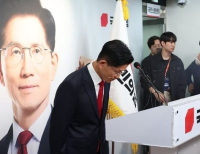
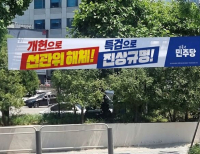
A composite image of President Lee Jae-myung delivering a policy speech at the National Assembly and a mock ballot paper to be used in the June 3 local elections.
President Lee Jae-myung, after approving a supplementary budget of 26.2 trillion won to overcome the Middle East war crisis on March 31, delivered a policy speech at the National Assembly on April 2.
He described the supplementary budget as a "breakwater to protect people's lives" and referred to the current situation as a "state of emergency for the people's livelihood and economy." He also emphasized that it was a "debt-free supplementary budget."
However, a supplementary budget is not a mechanism that is meant to be embellished with rhetoric. It is a fiscal action that should be explained through figures, priorities, targets, and scope. This supplementary budget was different from its inception. The language of crisis preceded the budget, and political rhetoric took precedence over policy.
The facts must be viewed coolly.
The current Middle East war began on February 28, and President Lee instructed a swift preparation of a supplementary budget on March 12. The issue is that, under the guise of responding to the post-war situation, the supplementary budget was designed not with precise measures to handle the war's impact, but with a broad inclusion of politically resonant projects.
The details of its preparation make this even clearer.
The government stated that the budget allocation was 10.1 trillion won for alleviating the burden of high oil prices, 2.8 trillion won for stabilizing people's livelihoods, 2.6 trillion won for minimizing industrial damage and stabilizing supply chains, 9.7 trillion won for reinforcing local finances, and 1 trillion won for national debt redemption. In addition, it included support payments of up to 600,000 won for 70% of households in the lower income brackets, consumption support in the form of local currency, and projects for youth entrepreneurship and employment.
Although it was named a supplementary budget for war response, its actual structure is different. It is closer to a political package that mixes responses to oil prices, consumption stimulus, youth policies, and tangible support.
The core is simple.
If it were truly a supplementary budget to respond to the shock of war, it should have first sharply targeted the industries and demographics directly hit by soaring international oil prices and supply chain instability. Alleviating the burden of logistics, raw material and import cost increases, and energy-dependent industries should have been prioritized.
However, Lee Jae-myung spoke of a "breakwater" and a "stepping stone for leap" in his policy speech, and the budget expanded its scope to match these words. The rhetoric of crisis preceded the response to the crisis, and political tangibility took precedence over fiscal precision.
This is the grammar of political finance, not emergency finance.
There are also clear points to consider legally.
Article 89, Paragraph 1, Item 2 of the National Finance Act stipulates that a supplementary budget can be prepared when there are significant changes in internal or external conditions such as economic recession, mass unemployment, changes in inter-Korean relations, or economic cooperation, or when such changes are anticipated. This current situation is strongly characterized by responding to the shocks in oil prices, exchange rates, and supply chains caused by the Middle East war.
In that case, the door opened by the system should, at best, be for responding to external shocks. However, local currency-based consumption support, youth projects, and various livelihood-related projects were all included at once. When a supplementary budget that should be an emergency exit becomes a convenient entrance for the administration, fiscal principles collapse.
This is why the memory of the Moon Jae-in administration overlaps.
The Moon Jae-in administration is recorded to have prepared a total of 10 supplementary budgets, amounting to 154.1 trillion won, through the COVID-19 pandemic. While the crisis was real, in the process, supplementary budgets became solidified as a constant tool of governance rather than an exceptional measure.
Once a path is forged, administrations resort to supplementary budgets whenever a crisis arises. The rigor of the original budget weakens, and fiscal management shifts from planning to reaction. National governance increasingly leans not towards "politicization of the budget," but towards "budgetization of politics."
The direction shown by the Yoon Suk-yeol administration was in the opposite direction. There has been only one supplementary budget. Regardless of its evaluation, at least the signal of managing the total expenditure increase within the framework of the original budget and establishing fiscal discipline was clear.
In contrast, the current Lee Jae-myung administration is reverting to a pattern of speaking of crises, escalating their severity, and layering extensive, tangible expenditures on top of that.
The phrase "debt-free supplementary budget" does not change the essence either. What matters is not the fact that new national bonds were not issued, but rather what and to what extent money is being spent. The existence of excess tax revenue does not justify politically excessive budgeting.
A supplementary budget is not an easy mechanism.
If a supplementary budget is presented shortly after the original budget is finalized, that in itself raises questions about budget forecasting ability and fiscal philosophy. Furthermore, if the practice of bundling external shocks with local currency, youth projects, and livelihood-related support becomes repetitive, the original budget degenerates into a preview rather than a plan.
If the state steps forward to speak of uncertainty, then speaks of a supplementary budget, and finally speaks of results, the supplementary budget is no longer an emergency measure. It becomes a technique for the administration to politically exploit crises, rather than a tool for managing them.
The state must be cool-headed in the face of crisis.
However, the Lee Jae-myung administration is leaning towards politically exploiting crises rather than managing them. While speaking of war impacts, it broadly includes local currency and tangible support, and in its policy speech, it amplified the political justification for the supplementary budget by fronting "breakwater" and "state of emergency."
If this is repeated, a supplementary budget will no longer be an extraordinary fiscal measure. It will become a political technique for the administration to explain crises, amplify uncertainty, disburse money, and manage approval ratings.
If Moon Jae-in opened that door with COVID-19, Lee Jae-myung is widening it further by using the Middle East war as a pretext. A country where finance is dragged by politics has no future.
What is needed now is not rhetoric about dispersing money, but fiscal principles that remain unshaken even in times of crisis.

 [Statement by the Seo-beo-kka Korea Military Academy Save-the-Nation Comrades Association] ㉛ Recount the Votes Publicly, as the Previous Recount Concealed Election Fraud
Tongyeong Mayoral Election Recount [Photo=Yonhap News]South Korea's liberal democracy is dying. The National Election Commission (NEC) and the judiciary, which have plummeted into criminal syndicates
[Statement by the Seo-beo-kka Korea Military Academy Save-the-Nation Comrades Association] ㉛ Recount the Votes Publicly, as the Previous Recount Concealed Election Fraud
Tongyeong Mayoral Election Recount [Photo=Yonhap News]South Korea's liberal democracy is dying. The National Election Commission (NEC) and the judiciary, which have plummeted into criminal syndicates
 What is the significance of the "Trump 2028" red hats that keep making a comeback?
It is noteworthy that President Donald Trump is "intentionally" fueling controversy over whether he can actually run in the 2028 presidential election, even though it is "highly likely he is seriously
What is the significance of the "Trump 2028" red hats that keep making a comeback?
It is noteworthy that President Donald Trump is "intentionally" fueling controversy over whether he can actually run in the 2028 presidential election, even though it is "highly likely he is seriously
 Jin Cummings: “North Korea says it will increase the number of spies, so what is the government doing?”
U.S. political columnist Gene Cummings has publicly questioned the South Korean government, asking, "North Korea is declaring that it will increase its number of spies, so what is the South Kore
Jin Cummings: “North Korea says it will increase the number of spies, so what is the government doing?”
U.S. political columnist Gene Cummings has publicly questioned the South Korean government, asking, "North Korea is declaring that it will increase its number of spies, so what is the South Kore
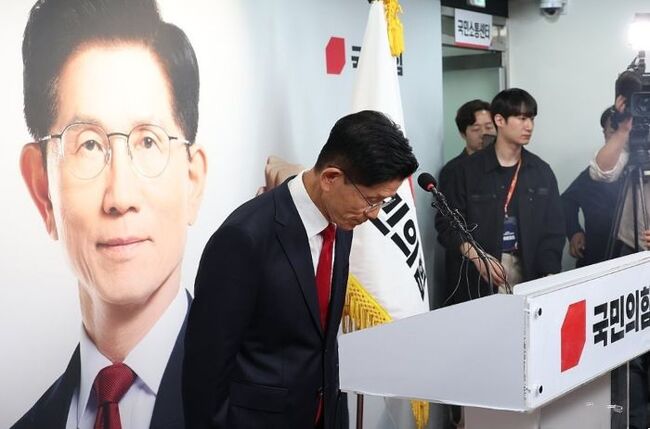 “Too little, too late?…” Kim Moon-soo, who previously conceded his presidential election defeat, now demands a special counsel investigation into ‘allegations of election fraud in the 2025 presidential election’
People Power Party presidential candidate Kim Moon-soo concedes defeat during a press conference at the party headquarters in Yeouido, Seoul, on June 4, 2025. [Joint Press Corps]As allegations emerge
“Too little, too late?…” Kim Moon-soo, who previously conceded his presidential election defeat, now demands a special counsel investigation into ‘allegations of election fraud in the 2025 presidential election’
People Power Party presidential candidate Kim Moon-soo concedes defeat during a press conference at the party headquarters in Yeouido, Seoul, on June 4, 2025. [Joint Press Corps]As allegations emerge
 Stock Market Crash 'Black Tuesday'… KOSPI down 10.8%, KOSDAQ down 7.7%
The KOSPI fell by more than 5% in early trading on the 28th, triggering a sell-side sidecar.On the 28th, the KOSPI plunged by more than 10%.Due to the sharp decline, a sell-side sidecar—a temporary
Stock Market Crash 'Black Tuesday'… KOSPI down 10.8%, KOSDAQ down 7.7%
The KOSPI fell by more than 5% in early trading on the 28th, triggering a sell-side sidecar.On the 28th, the KOSPI plunged by more than 10%.Due to the sharp decline, a sell-side sidecar—a temporary
 [World Heritage Committee] 25 New World Heritage Sites Inscribed in Busan… South Korea Successfully Expands 'Getbol' Listing
The Chairperson of the World Heritage Committee speaks at the plenary session of the 48th session of the World Heritage Committee, held at BEXCO in Busan on the 20th. [Photo: Yonhap News]A total of 25
[World Heritage Committee] 25 New World Heritage Sites Inscribed in Busan… South Korea Successfully Expands 'Getbol' Listing
The Chairperson of the World Heritage Committee speaks at the plenary session of the 48th session of the World Heritage Committee, held at BEXCO in Busan on the 20th. [Photo: Yonhap News]A total of 25
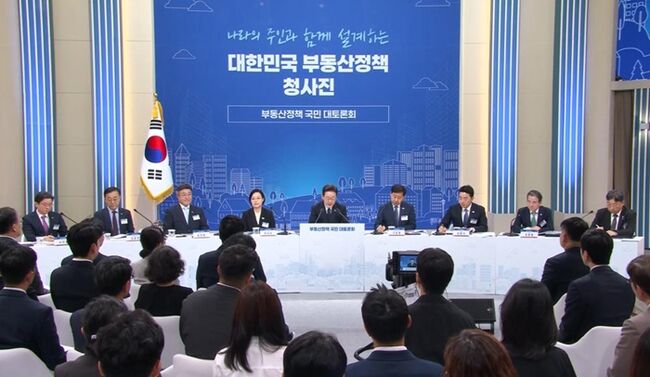 [Liberal Democratic Party Statement] Calling it a Grand Real Estate Debate… It Was Nothing More Than a Private Party Among Themselves
The 'National Grand Debate on Real Estate Policy' held on July 23rd and 27th. [Photo=Yonhap News]The 'National Grand Debate on Real Estate Policy,' hosted by the Lee Jae-myung administration under the
[Liberal Democratic Party Statement] Calling it a Grand Real Estate Debate… It Was Nothing More Than a Private Party Among Themselves
The 'National Grand Debate on Real Estate Policy' held on July 23rd and 27th. [Photo=Yonhap News]The 'National Grand Debate on Real Estate Policy,' hosted by the Lee Jae-myung administration under the
 [Photo] Evidence of Election Fraud Flooding U.S. Media… Trump Had 2.7 Million Votes Stolen
 [Video] U.S. Semiquincentennial Air Show... 'Art in the Sky' streaks across New York
 [Editorial Cartoon] A Draconian Law That Undermines Freedom of Expression

 List
List