Korea Exchange. [Photo = Yonhap News]
A Week Where Exchange Rates and Supply/Demand Priced in Before Strong Earnings
In the first week of April 2026, the Korean stock market did not falter due to weak fundamentals. In fact, real economic indicators were strong. Nevertheless, the market priced in exchange rates and foreign investor flows before earnings. The key this week was not the direction of the rise or fall, but what emerged as the priority variable for the Korean stock market.
On the surface, Middle East war news was the most prominent. However, what truly shook the Korean market was not the war itself, but the structure where the war stimulated oil prices and exchange rates, which in turn, affected foreign investor trading.
This week, the Korean stock market reacted more sensitively to the transmission channels of events than to the events themselves.
The weekly trend was clear.
On March 31st, the KOSPI closed sharply down 4.26% at 5052.46, and the Korean won weakened to 1530.1 against the dollar. Foreign net selling in March also reached a record high of 35.7 trillion won. What shook the market at the end of the month was not the fear itself, but the shock of simultaneous foreign outflows and a weak won.
However, the atmosphere changed dramatically on April 1st.
As expectations of an end to the conflict coincided with the March export figures release, the KOSPI surged 8.44% in a single day to 5478.70. While the sharp rebound in Samsung Electronics and SK Hynix pushed up the index, the market moved to recoup the worst prices rather than confidently betting on a trend reversal. The fact that institutional investors net bought over 4 trillion won, while foreigners and retail investors were net sellers, further illustrates the nature of this rebound.
That rebound also did not last long. As hawkish remarks related to the war resurfaced, the market quickly leaned towards caution.
This week, the Korean market did not experience a cross between optimism and pessimism, but rather a market where the direction of exchange rates and supply/demand had to be recalculated with every change in headlines. The issue was not the volume of news, but the speed at which that news translated into Korean asset prices.
The first variable that shook the stock market this week was the exchange rate.
Korea is a net oil importer with high dependence on the Middle East. Therefore, Middle East-related variables translate directly into Korea's energy prices and exchange rate burdens, bypassing U.S. news. Indeed, as the Middle East-induced shock grew, the government responded by preparing supplementary budget allocations. This week, the Korean market paid more sensitive attention to Seoul's exchange rates than to New York's optimism.
The second variable was foreign investor flows.
On April 3rd, foreign investors turned to net buying for the first time in 12 trading days, and the KOSPI also rebounded. Even with the same news, the market's interpretation differed entirely depending on whether foreign investors were selling or buying.
Ultimately, what changed the direction of the index this week was not the abundance or scarcity of positive news, but whether foreign capital would return. This week, foreign investor flows were synonymous with market sentiment, and market sentiment, in turn, translated into the index's rebound momentum.
The third variable was the nature of exports.
March exports increased by 48.3% year-on-year, marking the strongest growth rate since August 1988, with semiconductor exports surging by 151.4%. These figures indicated that the fundamental strength of Korean companies had not collapsed.
However, the market this week did not immediately link this performance to a trend reversal. Exports served as a buffer, but ultimately, the market's priorities lay with exchange rates and supply/demand.
Simply interpreting this week as a market driven solely by war news would be seeing only half the picture.
A more accurate interpretation is as follows:
The war stimulated oil prices and exchange rates, exchange rate volatility affected foreign investor flows, and foreign investor flows amplified the index's decline and rebound. On top of this, strong export performance acted as a buffer supporting the Korean stock market's floor.
Ultimately, this week's market reflected the channels through which U.S. news translated into Korean asset prices, rather than the U.S. news itself.
Next week's checkpoints are also clear.
First, whether the won/dollar exchange rate will become unstable again around the 1500 won level.
Second, whether foreign net buying will remain a temporary reversal or lead to renewed inflows centered on semiconductors.
Third, whether the strong March export performance can be linked to expectations of earnings that will underpin a stock market rebound.
If these three factors align in the same direction, the Korean stock market can move beyond a mere technical rebound and embark on restoring its weekly trend. Conversely, if the exchange rate becomes volatile again and foreign investor flows falter, this week's rebound is likely to be a relief rally only.
In summary, this week, exports were the buffer for the Korean stock market, the exchange rate was the warning sign, and foreign investor flows were the ultimate decision-maker for direction. The three variables that shook the market did not move independently.
This week's financial market was a process of re-inscribing that interconnected structure onto Korean asset prices.

 [Statement by the Seo-beo-kka Korea Military Academy Save-the-Nation Comrades Association] ㉛ Recount the Votes Publicly, as the Previous Recount Concealed Election Fraud
Tongyeong Mayoral Election Recount [Photo=Yonhap News]South Korea's liberal democracy is dying. The National Election Commission (NEC) and the judiciary, which have plummeted into criminal syndicates
[Statement by the Seo-beo-kka Korea Military Academy Save-the-Nation Comrades Association] ㉛ Recount the Votes Publicly, as the Previous Recount Concealed Election Fraud
Tongyeong Mayoral Election Recount [Photo=Yonhap News]South Korea's liberal democracy is dying. The National Election Commission (NEC) and the judiciary, which have plummeted into criminal syndicates
 What is the significance of the "Trump 2028" red hats that keep making a comeback?
It is noteworthy that President Donald Trump is "intentionally" fueling controversy over whether he can actually run in the 2028 presidential election, even though it is "highly likely he is seriously
What is the significance of the "Trump 2028" red hats that keep making a comeback?
It is noteworthy that President Donald Trump is "intentionally" fueling controversy over whether he can actually run in the 2028 presidential election, even though it is "highly likely he is seriously
 Jin Cummings: “North Korea says it will increase the number of spies, so what is the government doing?”
U.S. political columnist Gene Cummings has publicly questioned the South Korean government, asking, "North Korea is declaring that it will increase its number of spies, so what is the South Kore
Jin Cummings: “North Korea says it will increase the number of spies, so what is the government doing?”
U.S. political columnist Gene Cummings has publicly questioned the South Korean government, asking, "North Korea is declaring that it will increase its number of spies, so what is the South Kore
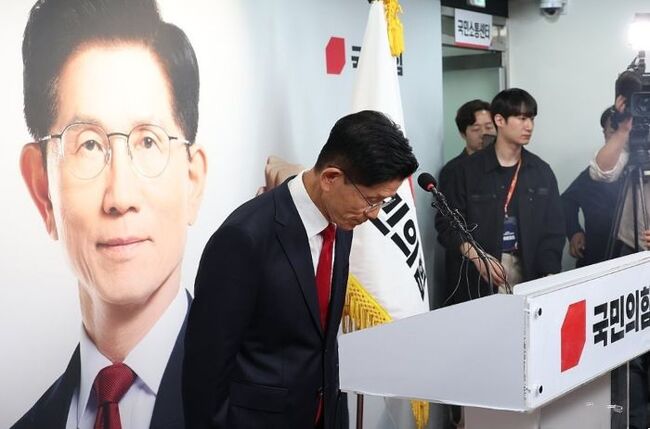 “Too little, too late?…” Kim Moon-soo, who previously conceded his presidential election defeat, now demands a special counsel investigation into ‘allegations of election fraud in the 2025 presidential election’
People Power Party presidential candidate Kim Moon-soo concedes defeat during a press conference at the party headquarters in Yeouido, Seoul, on June 4, 2025. [Joint Press Corps]As allegations emerge
“Too little, too late?…” Kim Moon-soo, who previously conceded his presidential election defeat, now demands a special counsel investigation into ‘allegations of election fraud in the 2025 presidential election’
People Power Party presidential candidate Kim Moon-soo concedes defeat during a press conference at the party headquarters in Yeouido, Seoul, on June 4, 2025. [Joint Press Corps]As allegations emerge
 Stock Market Crash 'Black Tuesday'… KOSPI down 10.8%, KOSDAQ down 7.7%
The KOSPI fell by more than 5% in early trading on the 28th, triggering a sell-side sidecar.On the 28th, the KOSPI plunged by more than 10%.Due to the sharp decline, a sell-side sidecar—a temporary
Stock Market Crash 'Black Tuesday'… KOSPI down 10.8%, KOSDAQ down 7.7%
The KOSPI fell by more than 5% in early trading on the 28th, triggering a sell-side sidecar.On the 28th, the KOSPI plunged by more than 10%.Due to the sharp decline, a sell-side sidecar—a temporary
 [World Heritage Committee] 25 New World Heritage Sites Inscribed in Busan… South Korea Successfully Expands 'Getbol' Listing
The Chairperson of the World Heritage Committee speaks at the plenary session of the 48th session of the World Heritage Committee, held at BEXCO in Busan on the 20th. [Photo: Yonhap News]A total of 25
[World Heritage Committee] 25 New World Heritage Sites Inscribed in Busan… South Korea Successfully Expands 'Getbol' Listing
The Chairperson of the World Heritage Committee speaks at the plenary session of the 48th session of the World Heritage Committee, held at BEXCO in Busan on the 20th. [Photo: Yonhap News]A total of 25
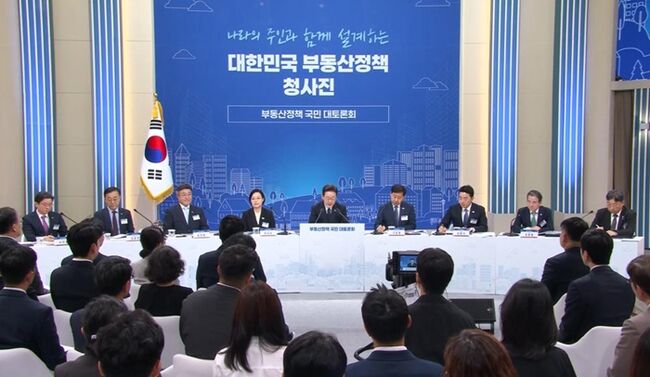 [Liberal Democratic Party Statement] Calling it a Grand Real Estate Debate… It Was Nothing More Than a Private Party Among Themselves
The 'National Grand Debate on Real Estate Policy' held on July 23rd and 27th. [Photo=Yonhap News]The 'National Grand Debate on Real Estate Policy,' hosted by the Lee Jae-myung administration under the
[Liberal Democratic Party Statement] Calling it a Grand Real Estate Debate… It Was Nothing More Than a Private Party Among Themselves
The 'National Grand Debate on Real Estate Policy' held on July 23rd and 27th. [Photo=Yonhap News]The 'National Grand Debate on Real Estate Policy,' hosted by the Lee Jae-myung administration under the
 [Photo] Evidence of Election Fraud Flooding U.S. Media… Trump Had 2.7 Million Votes Stolen
 [Video] U.S. Semiquincentennial Air Show... 'Art in the Sky' streaks across New York
 [Editorial Cartoon] A Draconian Law That Undermines Freedom of Expression

 List
List