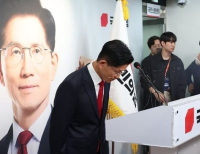
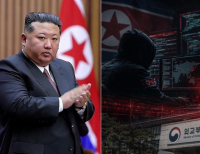
President Lee Jae-myung speaking at a cabinet meeting and emergency economic check-in at Cheong Wa Dae on April 6. [Photo=Yonhap News]
President Lee Jae-myung expressed regret to North Korea regarding the drone infiltration incident during a cabinet meeting on April 6.
Although he prefaced his remarks with "though it was not our government's intention," he simultaneously stated that "some irresponsible and reckless actions" had provoked military tension and instructed relevant ministries to implement immediate institutional improvements and actionable measures. This scene can be interpreted as the president, the highest authority, defining the nature of the incident and even setting the nation's stance.
The problem is that this is not the first time regret has been expressed to North Korea regarding drones.
Minister of Unification Jeong Dong-young had already expressed regret in February concerning drone infiltrations, and Kim Yo-jong evaluated it as "relatively common-sense behavior" while urging measures to prevent recurrence.
Then, on the night of the 6th, Kim Yo-jong stated that Lee Jae-myung's remarks were "very fortunate and a wise course of action for oneself." She revealed that Kim Jong-un had evaluated it as "the stance of an honest and bold person."
It appears the president has elevated an issue that had already been addressed at the ministerial level back to the highest level.
This leads to the question: Why the rush?
The justification of peace and tension reduction is something anyone can claim. However, a promise of prevention alone does not guarantee peace. Seoul expressing regret does not change Pyongyang's calculations, nor does it structurally ease tensions on the Korean Peninsula.
On the contrary, when the other party accepts such regret as a "wise course of action," while simultaneously mentioning the cessation of provocations, renunciation of contact, and consequences for recurrence, it is less about institutionalizing peace and more about adding grounds for pressure.
A more sensitive issue is the order of events.
The three civilians involved in this incident were indicted on charges of desertion and violation of aviation safety laws and were scheduled for their first trial on April 15. In other words, at the time of the president's remarks, the court had not yet begun substantive hearings, let alone determined the facts of the case.
The judgments of investigative agencies and courts are entirely different. Nevertheless, the president spoke about the incident as if it were an established fact and expressed national regret to North Korea for the outcome. As a president with a legal background, he should have been exceptionally cautious about this boundary.
It is precisely this haste that reminds many citizens of the West Sea official shooting incident.
This is not because the two incidents are the same. It is due to the impression that, in matters involving North Korea, the administration attempts to define the nation's stance before the facts are definitively established—an issue of order.
Regarding the West Sea official shooting incident, the Board of Audit and Inspection announced in 2023 that the government at the time had neglected the situation and concealed/distorted facts afterward. In contrast, in the first instance trial in December 2025, key figures in the Moon Jae-in administration's security line were acquitted, and in January 2026, the prosecution appealed only some charges against former National Security Advisor Seo Hoon and former Coast Guard Commissioner General Kim Hong-hee.
While legal evaluations are still partially contested, the political memory remains. For many citizens, that incident is imprinted as a memory of distrust, where political judgment preceded the protection of the people.
Another aspect seen in Lee Jae-myung's expression of regret is the "Moon Jae-in trauma."
The trauma mentioned here is not a psychological diagnosis. It is the memory of "Korea Passing," where Seoul's room to maneuver drastically shrinks the moment North Korea and the U.S. move independently. Reuters reported that after the collapse of the Hanoi summit in 2019, President Moon Jae-in lost significant room for maneuver.
The shadows of this can be seen in the recent movements of the Lee Jae-myung administration.
In January of this year, President Lee Jae-myung requested Xi Jinping to play a mediating role in North Korean issues. On April 6, the National Intelligence Service reported to the National Assembly that North Korea was distancing itself from Iran, leaving room for dialogue with the U.S. On the same day, the president expressed regret to the North.
Synthesizing this flow, it is difficult to rule out the possibility that this statement was not just directed at Pyongyang, but a signal that Seoul would not be excluded if North Korea-U.S. dialogue resumes—in other words, a message that "South Korea is not an obstacle to dialogue but a manageable partner."
However, when the haste to secure diplomatic leverage overrides national dignity and the rule of law, it becomes not a strategy but an anxious impatience.
The president brought up an issue that had already been addressed at the ministerial level. The nation expressed regret for an incident where a trial had not even begun. North Korea praised this but added further demands and stronger warnings.
It is difficult to describe this scene solely as language of peace.
Rather, it evokes suspicion that the government, overlapping the fears of being bypassed during the Moon Jae-in administration and the distrust left by the West Sea shooting incident, has once again lowered its stance too quickly in the face of the North Korean variable.
Peace does not come with haste. Moreover, peace that undermines national dignity and the order of judgment by oneself does not last long.

 [Statement by the Seo-beo-kka Korea Military Academy Save-the-Nation Comrades Association] ㉛ Recount the Votes Publicly, as the Previous Recount Concealed Election Fraud
Tongyeong Mayoral Election Recount [Photo=Yonhap News]South Korea's liberal democracy is dying. The National Election Commission (NEC) and the judiciary, which have plummeted into criminal syndicates
[Statement by the Seo-beo-kka Korea Military Academy Save-the-Nation Comrades Association] ㉛ Recount the Votes Publicly, as the Previous Recount Concealed Election Fraud
Tongyeong Mayoral Election Recount [Photo=Yonhap News]South Korea's liberal democracy is dying. The National Election Commission (NEC) and the judiciary, which have plummeted into criminal syndicates
 What is the significance of the "Trump 2028" red hats that keep making a comeback?
It is noteworthy that President Donald Trump is "intentionally" fueling controversy over whether he can actually run in the 2028 presidential election, even though it is "highly likely he is seriously
What is the significance of the "Trump 2028" red hats that keep making a comeback?
It is noteworthy that President Donald Trump is "intentionally" fueling controversy over whether he can actually run in the 2028 presidential election, even though it is "highly likely he is seriously
 Jin Cummings: “North Korea says it will increase the number of spies, so what is the government doing?”
U.S. political columnist Gene Cummings has publicly questioned the South Korean government, asking, "North Korea is declaring that it will increase its number of spies, so what is the South Kore
Jin Cummings: “North Korea says it will increase the number of spies, so what is the government doing?”
U.S. political columnist Gene Cummings has publicly questioned the South Korean government, asking, "North Korea is declaring that it will increase its number of spies, so what is the South Kore
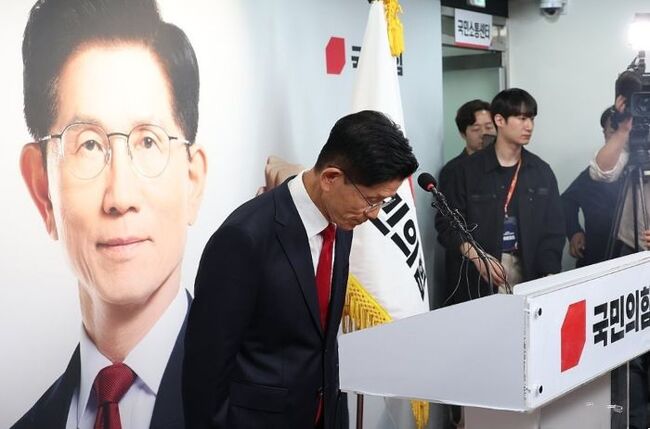 “Too little, too late?…” Kim Moon-soo, who previously conceded his presidential election defeat, now demands a special counsel investigation into ‘allegations of election fraud in the 2025 presidential election’
People Power Party presidential candidate Kim Moon-soo concedes defeat during a press conference at the party headquarters in Yeouido, Seoul, on June 4, 2025. [Joint Press Corps]As allegations emerge
“Too little, too late?…” Kim Moon-soo, who previously conceded his presidential election defeat, now demands a special counsel investigation into ‘allegations of election fraud in the 2025 presidential election’
People Power Party presidential candidate Kim Moon-soo concedes defeat during a press conference at the party headquarters in Yeouido, Seoul, on June 4, 2025. [Joint Press Corps]As allegations emerge
 Stock Market Crash 'Black Tuesday'… KOSPI down 10.8%, KOSDAQ down 7.7%
The KOSPI fell by more than 5% in early trading on the 28th, triggering a sell-side sidecar.On the 28th, the KOSPI plunged by more than 10%.Due to the sharp decline, a sell-side sidecar—a temporary
Stock Market Crash 'Black Tuesday'… KOSPI down 10.8%, KOSDAQ down 7.7%
The KOSPI fell by more than 5% in early trading on the 28th, triggering a sell-side sidecar.On the 28th, the KOSPI plunged by more than 10%.Due to the sharp decline, a sell-side sidecar—a temporary
 [World Heritage Committee] 25 New World Heritage Sites Inscribed in Busan… South Korea Successfully Expands 'Getbol' Listing
The Chairperson of the World Heritage Committee speaks at the plenary session of the 48th session of the World Heritage Committee, held at BEXCO in Busan on the 20th. [Photo: Yonhap News]A total of 25
[World Heritage Committee] 25 New World Heritage Sites Inscribed in Busan… South Korea Successfully Expands 'Getbol' Listing
The Chairperson of the World Heritage Committee speaks at the plenary session of the 48th session of the World Heritage Committee, held at BEXCO in Busan on the 20th. [Photo: Yonhap News]A total of 25
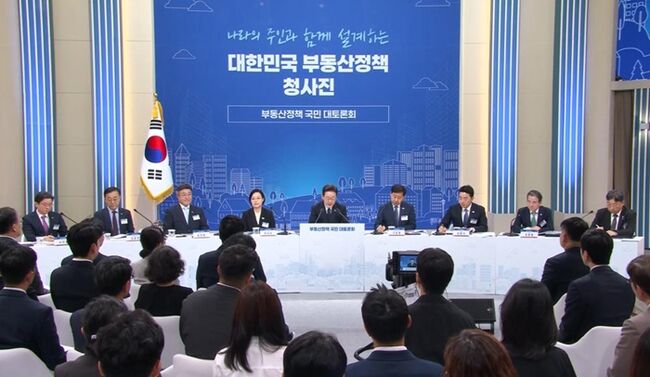 [Liberal Democratic Party Statement] Calling it a Grand Real Estate Debate… It Was Nothing More Than a Private Party Among Themselves
The 'National Grand Debate on Real Estate Policy' held on July 23rd and 27th. [Photo=Yonhap News]The 'National Grand Debate on Real Estate Policy,' hosted by the Lee Jae-myung administration under the
[Liberal Democratic Party Statement] Calling it a Grand Real Estate Debate… It Was Nothing More Than a Private Party Among Themselves
The 'National Grand Debate on Real Estate Policy' held on July 23rd and 27th. [Photo=Yonhap News]The 'National Grand Debate on Real Estate Policy,' hosted by the Lee Jae-myung administration under the
 [Photo] Evidence of Election Fraud Flooding U.S. Media… Trump Had 2.7 Million Votes Stolen
 [Video] U.S. Semiquincentennial Air Show... 'Art in the Sky' streaks across New York
 [Editorial Cartoon] A Draconian Law That Undermines Freedom of Expression

 List
List