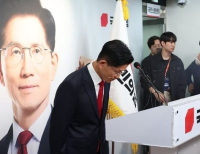
Scene from the ruling and opposition party consultation on the people's livelihood economy held at the Blue House on the 7th. [Photo = Yonhap News]
The core contentious issue at the meeting between President Lee Jae-myung and the leaders of the ruling and opposition parties held at the Blue House on the 7th was not the supplementary budget bill.
Although the meeting was held under the name of a 'Ruling and Opposition Party Consultation on the People's Livelihood Economy,' the main focus of political clashes was on constitutional amendment and a parliamentary inquiry into allegations of fabricated indictments.
In contrast, disagreements regarding the supplementary budget were resolved at the level of adjusting specific items, such as details of projects, execution methods, and whether to lower fuel taxes.
The Blue House characterized the meeting as an opportunity for bipartisan cooperation to respond to the economic crisis caused by the Middle East conflict and international geopolitical uncertainties.
Hong Ik-pyo, Senior Political Advisor, explained in a briefing on the 3rd that President Lee Jae-myung initiated the meeting with the understanding that national unity and bipartisan cooperation were necessary.
The meeting took place over lunch at the Blue House at 11:30 AM on the 7th and was attended by President Lee, Democratic Party Leader Jung Chung-rae and Floor Leader Han Byung-do, People Power Party Leader Jang Dong-hyuk and Floor Leader Song Eon-seok, Prime Minister Kim Min-seok, Presidential Chief of Staff Kang Hoon-sik, and Senior Political Advisor Hong Ik-pyo.
In his opening remarks at the meeting, President Lee requested cooperation in processing the supplementary budget bill to respond to the Middle East situation and in considering the constitutional amendment bill proposed in the National Assembly.
However, based on the briefings from each party after the meeting, constitutional amendment and the parliamentary inquiry emerged as much more direct points of contention than the supplementary budget.
While disagreements over the supplementary budget were limited to adjusting project items, methods, and priorities rather than outright opposition to its necessity, constitutional amendment and the parliamentary inquiry were confirmed as political issues on which the ruling and opposition parties were reluctant to compromise.
Regarding constitutional amendment, the People Power Party firmly drew a line.
According to Choi Bo-yoon, Spokesperson for the People Power Party, Leader Jang Dong-hyuk and Floor Leader Song Eon-seok clearly stated the party's stance against constitutional amendment being held concurrently with local elections. Leader Jang suggested to President Lee that he should first declare to the public that he would not seek a second term or re-election before discussing constitutional amendment.
President Lee reportedly avoided a direct answer to this suggestion. This was one of the moments of highest political tension throughout the entire meeting.
The issue of the parliamentary inquiry was even clearer.
The People Power Party strongly expressed its position at the meeting that the parliamentary inquiry into the alleged fabricated indictments should be postponed or suspended until the war ends.
Spokesperson Choi stated that Floor Leader Song Eon-seok pointed out the problems with this issue in the closed-door session and strongly argued that it should not be pursued until the end of the war.
In contrast, the Democratic Party maintained its position that the issue of fabricated indictments is state violence and a grave crime, and that a thorough investigation and measures to prevent recurrence are essential. This reconfirmed it as an issue with little room for compromise, leading to direct confrontation.
In contrast, the supplementary budget was an item for detailed adjustment rather than a full-scale conflict during the meeting.
Lee Jae-myung refuted the notion that the supplementary budget was "handing out cash" or populism, stating that if necessary, the National Assembly could add or adjust items during the deliberation and approval process.
The People Power Party also explained the necessity of its 'Seven Major Projects for National Survival' rather than outright rejecting the supplementary budget, and stated that they received a positive review from the Democratic Party.
Based on the explanations from both sides, it can be seen that although there were disagreements on the items and methods for the supplementary budget, it was not a point of contention that would determine the success or failure of the meeting, unlike constitutional amendment and the parliamentary inquiry.
In detail, further reduction of fuel taxes was a representative contentious issue.
Song Eon-seok argued that fuel tax reduction would be more directly beneficial to the public than cash support. However, according to the People Power Party's briefing, President Lee confirmed that there was a significant difference in perspective and a clear gap in positions on this matter.
This also illustrates that the essence of the supplementary budget was not outright rejection but policy disagreements surrounding the execution methods and constituent items.
Ultimately, despite the outward appearance of a 'People's Livelihood Economy Consultation,' the meeting revealed 'what is negotiable and what will ultimately lead to conflict.'
While the supplementary budget remained an area that could be adjusted during the National Assembly's budget review process, constitutional amendment led to debates over the power structure and the President's future, and the parliamentary inquiry devolved into disputes over judicial and political accountability, with neither the ruling nor opposition party willing to back down.
To summarize the outcome of the meeting in one sentence, the supplementary budget involved disagreements on items, while constitutional amendment and the parliamentary inquiry were the main issues.

 [Statement by the Seo-beo-kka Korea Military Academy Save-the-Nation Comrades Association] ㉛ Recount the Votes Publicly, as the Previous Recount Concealed Election Fraud
Tongyeong Mayoral Election Recount [Photo=Yonhap News]South Korea's liberal democracy is dying. The National Election Commission (NEC) and the judiciary, which have plummeted into criminal syndicates
[Statement by the Seo-beo-kka Korea Military Academy Save-the-Nation Comrades Association] ㉛ Recount the Votes Publicly, as the Previous Recount Concealed Election Fraud
Tongyeong Mayoral Election Recount [Photo=Yonhap News]South Korea's liberal democracy is dying. The National Election Commission (NEC) and the judiciary, which have plummeted into criminal syndicates
 What is the significance of the "Trump 2028" red hats that keep making a comeback?
It is noteworthy that President Donald Trump is "intentionally" fueling controversy over whether he can actually run in the 2028 presidential election, even though it is "highly likely he is seriously
What is the significance of the "Trump 2028" red hats that keep making a comeback?
It is noteworthy that President Donald Trump is "intentionally" fueling controversy over whether he can actually run in the 2028 presidential election, even though it is "highly likely he is seriously
 Jin Cummings: “North Korea says it will increase the number of spies, so what is the government doing?”
U.S. political columnist Gene Cummings has publicly questioned the South Korean government, asking, "North Korea is declaring that it will increase its number of spies, so what is the South Kore
Jin Cummings: “North Korea says it will increase the number of spies, so what is the government doing?”
U.S. political columnist Gene Cummings has publicly questioned the South Korean government, asking, "North Korea is declaring that it will increase its number of spies, so what is the South Kore
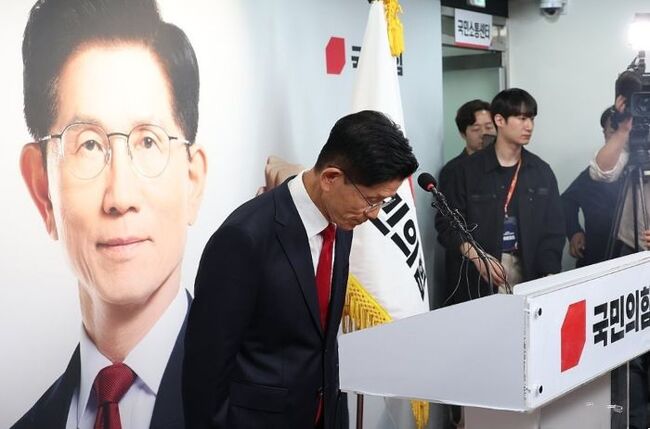 “Too little, too late?…” Kim Moon-soo, who previously conceded his presidential election defeat, now demands a special counsel investigation into ‘allegations of election fraud in the 2025 presidential election’
People Power Party presidential candidate Kim Moon-soo concedes defeat during a press conference at the party headquarters in Yeouido, Seoul, on June 4, 2025. [Joint Press Corps]As allegations emerge
“Too little, too late?…” Kim Moon-soo, who previously conceded his presidential election defeat, now demands a special counsel investigation into ‘allegations of election fraud in the 2025 presidential election’
People Power Party presidential candidate Kim Moon-soo concedes defeat during a press conference at the party headquarters in Yeouido, Seoul, on June 4, 2025. [Joint Press Corps]As allegations emerge
 Stock Market Crash 'Black Tuesday'… KOSPI down 10.8%, KOSDAQ down 7.7%
The KOSPI fell by more than 5% in early trading on the 28th, triggering a sell-side sidecar.On the 28th, the KOSPI plunged by more than 10%.Due to the sharp decline, a sell-side sidecar—a temporary
Stock Market Crash 'Black Tuesday'… KOSPI down 10.8%, KOSDAQ down 7.7%
The KOSPI fell by more than 5% in early trading on the 28th, triggering a sell-side sidecar.On the 28th, the KOSPI plunged by more than 10%.Due to the sharp decline, a sell-side sidecar—a temporary
 [World Heritage Committee] 25 New World Heritage Sites Inscribed in Busan… South Korea Successfully Expands 'Getbol' Listing
The Chairperson of the World Heritage Committee speaks at the plenary session of the 48th session of the World Heritage Committee, held at BEXCO in Busan on the 20th. [Photo: Yonhap News]A total of 25
[World Heritage Committee] 25 New World Heritage Sites Inscribed in Busan… South Korea Successfully Expands 'Getbol' Listing
The Chairperson of the World Heritage Committee speaks at the plenary session of the 48th session of the World Heritage Committee, held at BEXCO in Busan on the 20th. [Photo: Yonhap News]A total of 25
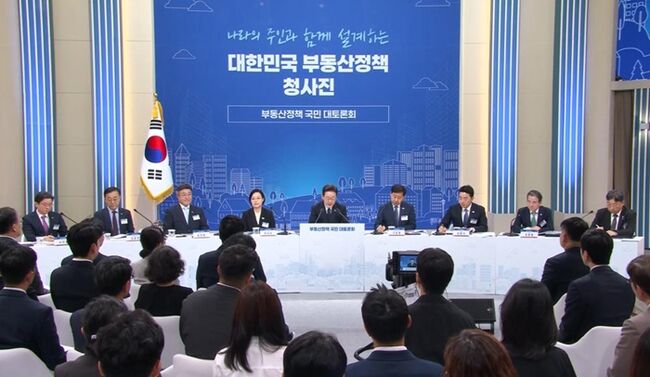 [Liberal Democratic Party Statement] Calling it a Grand Real Estate Debate… It Was Nothing More Than a Private Party Among Themselves
The 'National Grand Debate on Real Estate Policy' held on July 23rd and 27th. [Photo=Yonhap News]The 'National Grand Debate on Real Estate Policy,' hosted by the Lee Jae-myung administration under the
[Liberal Democratic Party Statement] Calling it a Grand Real Estate Debate… It Was Nothing More Than a Private Party Among Themselves
The 'National Grand Debate on Real Estate Policy' held on July 23rd and 27th. [Photo=Yonhap News]The 'National Grand Debate on Real Estate Policy,' hosted by the Lee Jae-myung administration under the
 [Photo] Evidence of Election Fraud Flooding U.S. Media… Trump Had 2.7 Million Votes Stolen
 [Video] U.S. Semiquincentennial Air Show... 'Art in the Sky' streaks across New York
 [Editorial Cartoon] A Draconian Law That Undermines Freedom of Expression

 List
List