The expectation of a ceasefire provided an opportunity for a rebound, but it was not a guarantee of a trend reversal.
The Seoul market prioritized oil prices, exchange rates, and foreign investor flows over the ceasefire news.
The essence of this week's rally was not optimism, but relief that the worst had been temporarily averted.
 The KOSPI and the Won/Dollar exchange rate are displayed on the current status board at the dealing room of Hana Bank's headquarters in Jung-gu, Seoul on the 11th. This week, the Korean stock market found an opportunity for a rebound due to hopes of a ceasefire in the Middle East, but the market ultimately paid more attention to the pace of recovery in oil prices, exchange rates, and foreign investor flows. [Photo=Yonhap News]
This week, the Korean stock market found relief but not reassurance.
While the easing of Middle East tensions provided an opportunity for a rebound, the Seoul market did not immediately declare a trend reversal based solely on this news.
What the Korean market focused on until the end was not the ceasefire itself, but the recovery pace of oil prices, the Won/Dollar exchange rate, and foreign investor flows. This is because even if war news improves, the discount rate on Korean assets will not easily decrease if defense costs remain the same.
Compared to last week, the market's central focus has clearly shifted.
If last week was about factoring in the exchange rate shock and foreign investor outflows to price in the reality that "even good fundamentals can be pushed aside by defense costs," this week revealed that "even with ceasefire hopes alive, a rebound will not easily become a trend unless oil prices and exchange rates support it."
If last week's warning sign was the exchange rate itself, this week's warning sign was the exchange rate, re-translated through oil prices, and investor flows.
This week's trend followed that structure.
Early in the week, expectations of a deadline extension and strong US employment data supported risk appetite. However, the market did not immediately rush into optimism.
As the negotiation deadline approached, anxiety increased again, and expectations of an extension at the end of the trading session eased tensions. Subsequently, news of a two-week ceasefire led to a sharp rebound in global stock markets and a significant drop in international oil prices.
However, the Korean market's interest went a step further. It sought to confirm, "Will oil prices fall further, will the exchange rate stabilize, and will foreign investors buy again?"
This point is crucial.
Korea is a major oil importer sensitive to Middle East variables, and oil price shocks directly translate into exchange rate fluctuations, inflation, corporate costs, and foreign investor flows.
Therefore, the Seoul market always asks one more question. This is why Seoul does not react with the same intensity as New York, even when New York rebounds.
This week, the Korean market prioritized calculating the path through which global news translates into Korean asset prices over the direction of global news itself.
Ultimately, the key takeaway from this week's Money Radar is clear.
The Korean stock market is not currently pricing in peace. It is a market that first looks at how much the costs of external shocks translating into Korean asset prices are reduced.
The essence of this week's rebound was closer to relief that the worst-case scenario had been temporarily postponed, rather than optimism itself.
Next Week's Checkpoints
First, whether international oil prices rebound sharply again. If oil prices surge again, the Korean market is likely to immediately price in defense costs once more.
Second, whether the Won/Dollar exchange rate stabilizes. If the exchange rate fluctuates, the strength of foreign investor return will inevitably weaken.
Third, whether foreign net buying continues, focusing on large-cap semiconductor stocks. If this trend continues, this rebound can be interpreted as a restoration of the trend, rather than just a relief-driven retracement.

 [Statement by the Seo-beo-kka Korea Military Academy Save-the-Nation Comrades Association] ㉛ Recount the Votes Publicly, as the Previous Recount Concealed Election Fraud
Tongyeong Mayoral Election Recount [Photo=Yonhap News]South Korea's liberal democracy is dying. The National Election Commission (NEC) and the judiciary, which have plummeted into criminal syndicates
[Statement by the Seo-beo-kka Korea Military Academy Save-the-Nation Comrades Association] ㉛ Recount the Votes Publicly, as the Previous Recount Concealed Election Fraud
Tongyeong Mayoral Election Recount [Photo=Yonhap News]South Korea's liberal democracy is dying. The National Election Commission (NEC) and the judiciary, which have plummeted into criminal syndicates
 What is the significance of the "Trump 2028" red hats that keep making a comeback?
It is noteworthy that President Donald Trump is "intentionally" fueling controversy over whether he can actually run in the 2028 presidential election, even though it is "highly likely he is seriously
What is the significance of the "Trump 2028" red hats that keep making a comeback?
It is noteworthy that President Donald Trump is "intentionally" fueling controversy over whether he can actually run in the 2028 presidential election, even though it is "highly likely he is seriously
 Jin Cummings: “North Korea says it will increase the number of spies, so what is the government doing?”
U.S. political columnist Gene Cummings has publicly questioned the South Korean government, asking, "North Korea is declaring that it will increase its number of spies, so what is the South Kore
Jin Cummings: “North Korea says it will increase the number of spies, so what is the government doing?”
U.S. political columnist Gene Cummings has publicly questioned the South Korean government, asking, "North Korea is declaring that it will increase its number of spies, so what is the South Kore
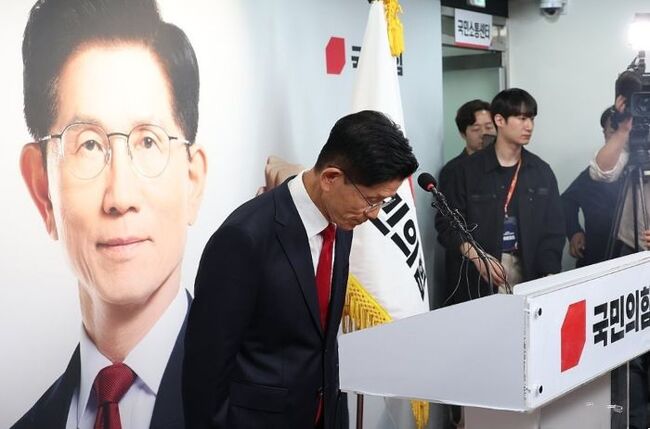 “Too little, too late?…” Kim Moon-soo, who previously conceded his presidential election defeat, now demands a special counsel investigation into ‘allegations of election fraud in the 2025 presidential election’
People Power Party presidential candidate Kim Moon-soo concedes defeat during a press conference at the party headquarters in Yeouido, Seoul, on June 4, 2025. [Joint Press Corps]As allegations emerge
“Too little, too late?…” Kim Moon-soo, who previously conceded his presidential election defeat, now demands a special counsel investigation into ‘allegations of election fraud in the 2025 presidential election’
People Power Party presidential candidate Kim Moon-soo concedes defeat during a press conference at the party headquarters in Yeouido, Seoul, on June 4, 2025. [Joint Press Corps]As allegations emerge
 Stock Market Crash 'Black Tuesday'… KOSPI down 10.8%, KOSDAQ down 7.7%
The KOSPI fell by more than 5% in early trading on the 28th, triggering a sell-side sidecar.On the 28th, the KOSPI plunged by more than 10%.Due to the sharp decline, a sell-side sidecar—a temporary
Stock Market Crash 'Black Tuesday'… KOSPI down 10.8%, KOSDAQ down 7.7%
The KOSPI fell by more than 5% in early trading on the 28th, triggering a sell-side sidecar.On the 28th, the KOSPI plunged by more than 10%.Due to the sharp decline, a sell-side sidecar—a temporary
 [World Heritage Committee] 25 New World Heritage Sites Inscribed in Busan… South Korea Successfully Expands 'Getbol' Listing
The Chairperson of the World Heritage Committee speaks at the plenary session of the 48th session of the World Heritage Committee, held at BEXCO in Busan on the 20th. [Photo: Yonhap News]A total of 25
[World Heritage Committee] 25 New World Heritage Sites Inscribed in Busan… South Korea Successfully Expands 'Getbol' Listing
The Chairperson of the World Heritage Committee speaks at the plenary session of the 48th session of the World Heritage Committee, held at BEXCO in Busan on the 20th. [Photo: Yonhap News]A total of 25
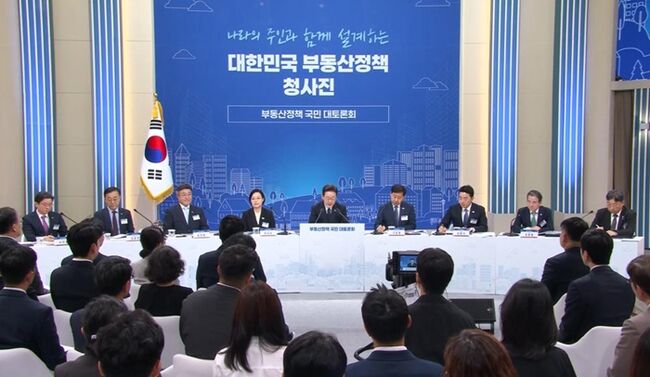 [Liberal Democratic Party Statement] Calling it a Grand Real Estate Debate… It Was Nothing More Than a Private Party Among Themselves
The 'National Grand Debate on Real Estate Policy' held on July 23rd and 27th. [Photo=Yonhap News]The 'National Grand Debate on Real Estate Policy,' hosted by the Lee Jae-myung administration under the
[Liberal Democratic Party Statement] Calling it a Grand Real Estate Debate… It Was Nothing More Than a Private Party Among Themselves
The 'National Grand Debate on Real Estate Policy' held on July 23rd and 27th. [Photo=Yonhap News]The 'National Grand Debate on Real Estate Policy,' hosted by the Lee Jae-myung administration under the
 [Photo] Evidence of Election Fraud Flooding U.S. Media… Trump Had 2.7 Million Votes Stolen
 [Video] U.S. Semiquincentennial Air Show... 'Art in the Sky' streaks across New York
 [Editorial Cartoon] A Draconian Law That Undermines Freedom of Expression

 List
List