Money has not left the market, but has simply chosen a new spot.
Semiconductors were the main event, while defense, shipbuilding, and nuclear power served as temporary refuges during a period of uncertainty.
The essence of this week's capital flow was not an escape, but a reallocation.
 A view of the Samsung Electronics Seocho building in Seocho-gu, Seoul, and the stock market in Yeouido, Seoul. This week, capital in the Korean market sought shelter in defense, shipbuilding, and nuclear power amid Middle Eastern variables, and then returned to semiconductors as hopes for a ceasefire revived. [Photo: Yonhap News]This week, money in the Korean market did not leave; it merely repositioned itself.
When fear escalated, investors sought refuge in less volatile areas, and as a sense of relief returned, capital flowed back to index-leading stocks.
The nature of this week's capital movements was a rearrangement, not an exodus.
Compared to the previous week, the dynamics of capital rotation have shifted.
While last week saw a pattern of foreign outflows, institutional price recovery, short-term refuge in defense and nuclear power, and belated foreign return, this week's trend showed a faster return to semiconductors as the primary focus.
If last week's capital was primarily seeking "where the damage is least," this week's capital began to more actively consider "where can become the market's center again."
This week's trend was relatively clear.
In phases where negotiation uncertainties lingered, sectors with defensive characteristics, such as energy and defense, held up relatively well. However, as hopes for a ceasefire grew, capital rapidly flowed back to heavily beaten technology and semiconductor stocks.
The strength of semiconductors in the U.S. market served as a crucial signal for the Korean market. Particularly, as expectations surrounding memory and AI infrastructure revived, Korean investors also began to view semiconductors as the central pillar once more.
This pattern is even more evident within the Korean market.
For the KOSPI to rebound strongly, Samsung Electronics and SK Hynix must lead the way. Conversely, when geopolitical tensions resurface, defense, shipbuilding, and nuclear power act as temporary havens.
Ultimately, capital did not contemplate leaving the market; instead, it moved within the Korean market, assessing which sectors were more strategic and which could recover more quickly.
If semiconductors were the main event, then defense, shipbuilding, and nuclear power were alternative refuges.
Looking deeper into this trend reveals it's more than just a simple recovery in risk appetite.
If war shakes not only energy facilities but also confidence in supply chains and the order of public goods, then the renewed focus on semiconductors, data centers, and power infrastructure takes on a different significance.
It's not just about increasing demand; it's about countries beginning to recognize an era where critical infrastructure cannot solely rely on the goodwill of others. In such times, capital moves based on the logic of strategic assets rather than growth stocks.
In summary, the key takeaway from this week's Capital Rotation Radar is as follows:
Money in the Korean market has not ended its period of fear, but is rather reassessing its position in the post-fear environment. Semiconductors have returned to center stage, and defense, shipbuilding, and nuclear power have continued to function as secondary refuges.
This week's capital movements were a repositioning, not an escape.
Next Week's Checkpoints
First, we need to see if foreign net buying continues in large-cap semiconductor stocks. If this trend persists, capital rotation can be interpreted as a return to index-leading stocks.
Second, observe whether the center of gravity for institutional buying remains in semiconductors or disperses again towards defense, shipbuilding, and nuclear power.
Third, track where capital seeks refuge when oil prices and exchange rates fluctuate again. These three factors, when considered together, will help gauge the sector rotation range and strength of the Korean market next week.

 [Statement by the Seo-beo-kka Korea Military Academy Save-the-Nation Comrades Association] ㉛ Recount the Votes Publicly, as the Previous Recount Concealed Election Fraud
Tongyeong Mayoral Election Recount [Photo=Yonhap News]South Korea's liberal democracy is dying. The National Election Commission (NEC) and the judiciary, which have plummeted into criminal syndicates
[Statement by the Seo-beo-kka Korea Military Academy Save-the-Nation Comrades Association] ㉛ Recount the Votes Publicly, as the Previous Recount Concealed Election Fraud
Tongyeong Mayoral Election Recount [Photo=Yonhap News]South Korea's liberal democracy is dying. The National Election Commission (NEC) and the judiciary, which have plummeted into criminal syndicates
 What is the significance of the "Trump 2028" red hats that keep making a comeback?
It is noteworthy that President Donald Trump is "intentionally" fueling controversy over whether he can actually run in the 2028 presidential election, even though it is "highly likely he is seriously
What is the significance of the "Trump 2028" red hats that keep making a comeback?
It is noteworthy that President Donald Trump is "intentionally" fueling controversy over whether he can actually run in the 2028 presidential election, even though it is "highly likely he is seriously
 Jin Cummings: “North Korea says it will increase the number of spies, so what is the government doing?”
U.S. political columnist Gene Cummings has publicly questioned the South Korean government, asking, "North Korea is declaring that it will increase its number of spies, so what is the South Kore
Jin Cummings: “North Korea says it will increase the number of spies, so what is the government doing?”
U.S. political columnist Gene Cummings has publicly questioned the South Korean government, asking, "North Korea is declaring that it will increase its number of spies, so what is the South Kore
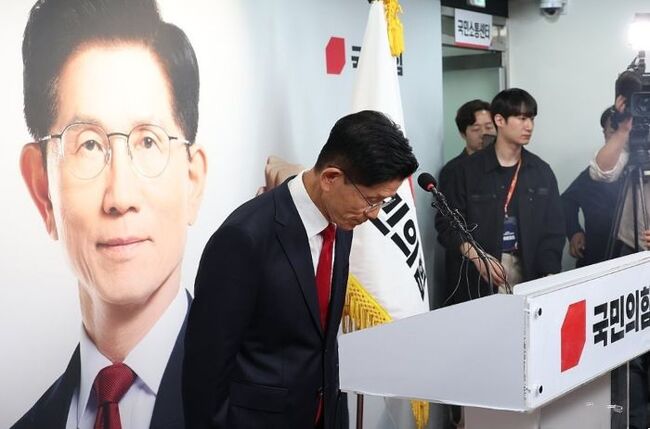 “Too little, too late?…” Kim Moon-soo, who previously conceded his presidential election defeat, now demands a special counsel investigation into ‘allegations of election fraud in the 2025 presidential election’
People Power Party presidential candidate Kim Moon-soo concedes defeat during a press conference at the party headquarters in Yeouido, Seoul, on June 4, 2025. [Joint Press Corps]As allegations emerge
“Too little, too late?…” Kim Moon-soo, who previously conceded his presidential election defeat, now demands a special counsel investigation into ‘allegations of election fraud in the 2025 presidential election’
People Power Party presidential candidate Kim Moon-soo concedes defeat during a press conference at the party headquarters in Yeouido, Seoul, on June 4, 2025. [Joint Press Corps]As allegations emerge
 Stock Market Crash 'Black Tuesday'… KOSPI down 10.8%, KOSDAQ down 7.7%
The KOSPI fell by more than 5% in early trading on the 28th, triggering a sell-side sidecar.On the 28th, the KOSPI plunged by more than 10%.Due to the sharp decline, a sell-side sidecar—a temporary
Stock Market Crash 'Black Tuesday'… KOSPI down 10.8%, KOSDAQ down 7.7%
The KOSPI fell by more than 5% in early trading on the 28th, triggering a sell-side sidecar.On the 28th, the KOSPI plunged by more than 10%.Due to the sharp decline, a sell-side sidecar—a temporary
 [World Heritage Committee] 25 New World Heritage Sites Inscribed in Busan… South Korea Successfully Expands 'Getbol' Listing
The Chairperson of the World Heritage Committee speaks at the plenary session of the 48th session of the World Heritage Committee, held at BEXCO in Busan on the 20th. [Photo: Yonhap News]A total of 25
[World Heritage Committee] 25 New World Heritage Sites Inscribed in Busan… South Korea Successfully Expands 'Getbol' Listing
The Chairperson of the World Heritage Committee speaks at the plenary session of the 48th session of the World Heritage Committee, held at BEXCO in Busan on the 20th. [Photo: Yonhap News]A total of 25
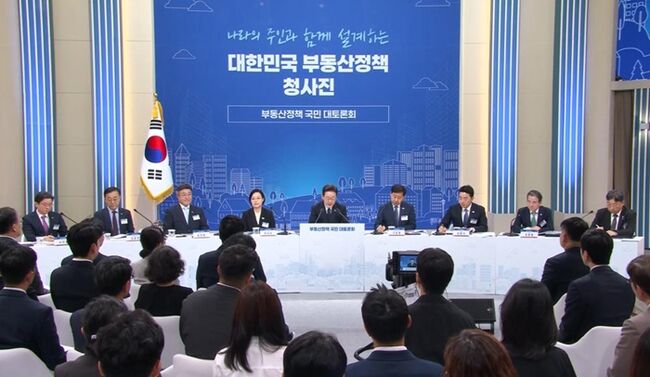 [Liberal Democratic Party Statement] Calling it a Grand Real Estate Debate… It Was Nothing More Than a Private Party Among Themselves
The 'National Grand Debate on Real Estate Policy' held on July 23rd and 27th. [Photo=Yonhap News]The 'National Grand Debate on Real Estate Policy,' hosted by the Lee Jae-myung administration under the
[Liberal Democratic Party Statement] Calling it a Grand Real Estate Debate… It Was Nothing More Than a Private Party Among Themselves
The 'National Grand Debate on Real Estate Policy' held on July 23rd and 27th. [Photo=Yonhap News]The 'National Grand Debate on Real Estate Policy,' hosted by the Lee Jae-myung administration under the
 [Photo] Evidence of Election Fraud Flooding U.S. Media… Trump Had 2.7 Million Votes Stolen
 [Video] U.S. Semiquincentennial Air Show... 'Art in the Sky' streaks across New York
 [Editorial Cartoon] A Draconian Law That Undermines Freedom of Expression

 List
List